FAI reveals how drone-racing tracks are engineered for speed and strategy
FAI's championship tracks turn drone racing into a geometry test, with 725 m in Namwon, about 650 m in Hangzhou, and simulator replicas that mirror race-day lines.
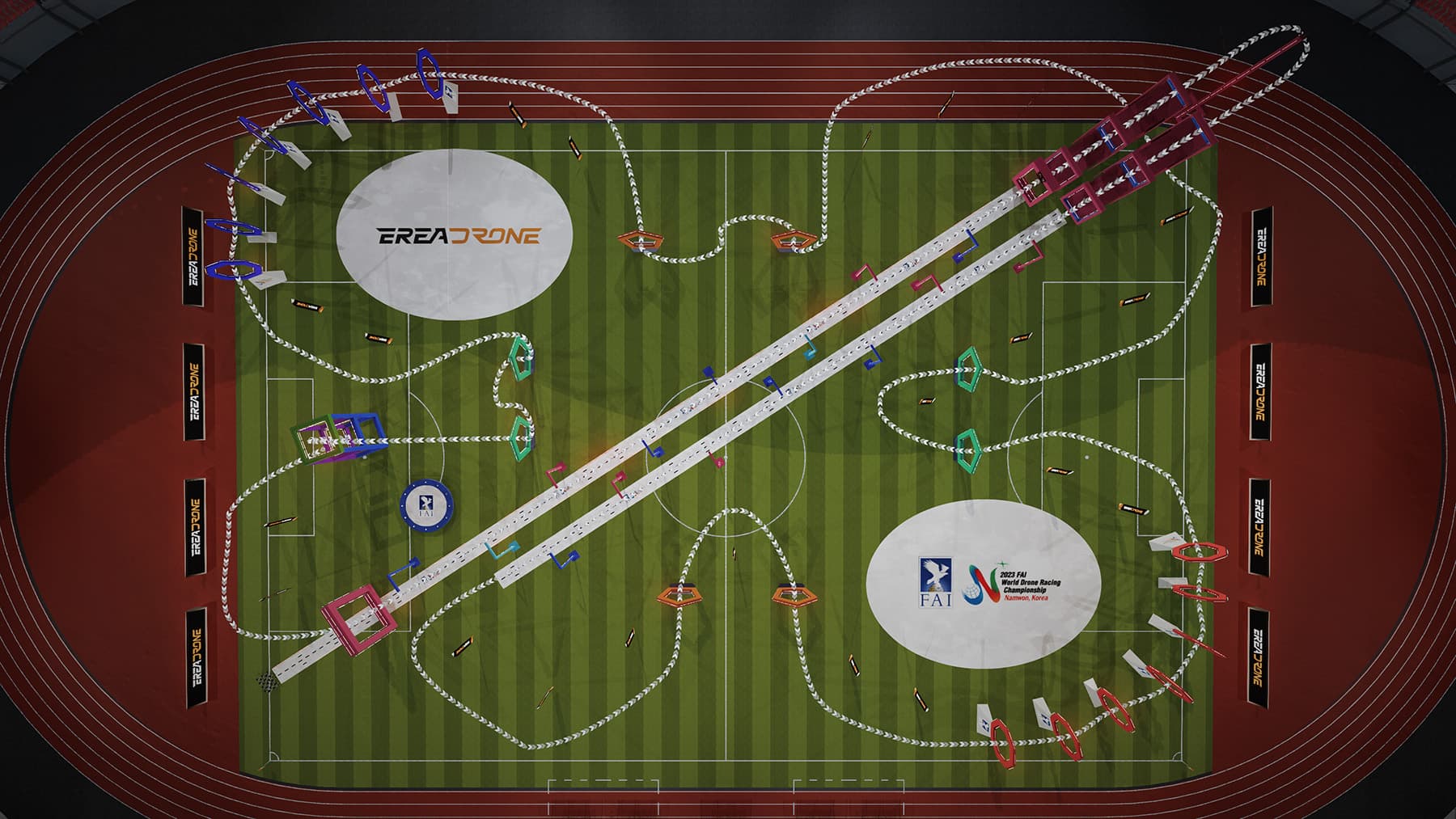
Elite drone racing is won in the line, not just the lap time. Fédération Aéronautique Internationale championship layouts in Namwon and Hangzhou show a sport where the track is engineered as a problem to solve, complete with 2D maps, dimension files, and simulator replicas that let pilots rehearse the exact geometry before the goggles go on.
The line is the race
FAI’s sporting language makes the key point plain: track length is measured along the optimum 3D flight path. That means the real competition is not the shortest distance between gates, but the fastest line through the full sequence of turns, climbs, and acceleration zones. A pilot who can stay low, clean, and efficient through the right parts of the course carries speed that a more cautious flyer gives away.
That design logic is why circuit construction matters so much. A long straight rewards clean acceleration and a low-drag approach, while a tight obstacle cluster punishes hesitation and forces memory, rhythm, and commitment in the goggles. FAI’s F9 Drone Sport technical meeting keeps racing circuit design and construction on the standing agenda, and the 2026 Sporting Code Volume F9 says an additional CIAM guide document exists specifically for track design and construction, with details, recommendations, and expectations for organizers.
Namwon set the template
The 2023 FAI World Drone Racing Championship in Namwon ran from 6 to 9 October 2023 at the Namwon Sports Town complex in Jeollabuk-do. FAI put 120 pilots from 30 countries in the stadium and listed Kim MinChan of Korea as the overall winner. On the race-track page, FAI gave the developed length as 725 m, measured along an optimised trajectory.
That 725 m figure is the important one for pilots because it tells them how much line management the course demands, not just how far the gates are spread on a map. When the measured path is longer than the headline layout, the course is effectively asking for more than raw throttle. It asks for a pilot to keep flow through the sequence, protect momentum, and avoid the tiny mistakes that force braking in a sport where braking is time lost.
Hangzhou turned the puzzle up another level
Hangzhou’s 2024 world championship ran from 31 October to 3 November 2024 at the Shangcheng District Sports Centre. FAI said 111 racers from 32 nations took part, and the championship page described the course as about 600 m long with 43 gates and 12 L-shaped obstacles. On the race-track page, the developed length was listed at about 650 m with an optimised trajectory, which underlines how FAI separates the nominal layout from the flown line.
The Hangzhou design went beyond simple geometry. FAI said it drew inspiration from the Qiantang River and the Bagua Tian site from the Song Dynasty, giving the course a cultural silhouette rather than a generic sports-grid feel. The track rose across three levels to a maximum height of 4 m, and thousands of LED lights lit the circuit for night flights, adding a visual layer that changes how pilots read depth, turn timing, and gate approach through the goggles.
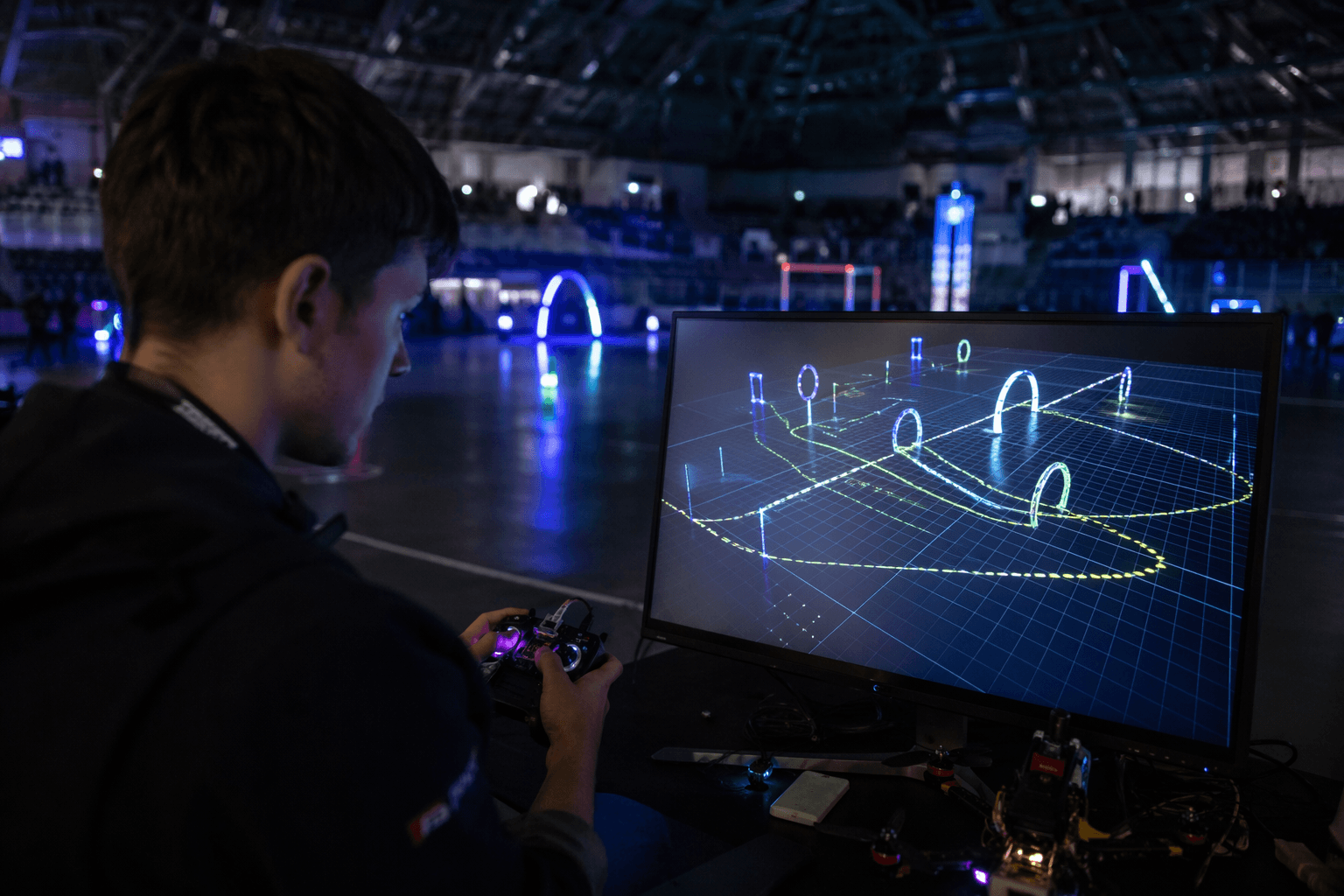
Those details matter because drone racing is not just about speed on a flat course. A three-level layout forces pilots to manage altitude changes while still preserving rhythm, and 12 L-shaped obstacles turn each section into a decision point rather than a straight sprint. Add LED lighting and night flying, and the course becomes a moving visual test as much as a motor-speed test.
Simulator prep is now part of the championship hardware
FAI does not just publish a map and leave pilots to guess. The championship pages for Namwon and Hangzhou include 2D layouts, overall views, and track-dimension files, which gives teams the raw geometry needed to study gate spacing, turn entry, and the places where speed can be carried or lost. For Hangzhou, FAI also pointed pilots to the EreaDrone simulator on Steam so they could load the same championship track before race day.
That is where the competitive edge lives. If a pilot can practice the exact gate order, the same vertical transitions, and the same obstacle spacing in a simulator, the first live lap becomes less about discovery and more about execution. In a sport decided by fractions of a second, the ability to rehearse the same geometry is not a novelty. It is preparation.
FAI’s broader push makes that even clearer. The first FAI E-Drone Racing World Cup series launched in 2024, extending the sport from physical circuits into online replicas and making course design more reusable across events. Once a track exists as a measured layout and a simulator file, it stops being a one-off showpiece and becomes a repeatable competitive asset.
A global sport with a standard rulebook
Hangzhou was not an isolated showcase. FAI said the 2024 world championship followed earlier FAI world championships in Shenzhen in 2018 and Ningbo in 2019, and the sport has since moved into The World Games in Chengdu from 13 to 16 August 2025. That kind of spread tells you drone racing is no longer testing whether it belongs on a global stage. It is already part of one.
The rulebook has kept pace. FAI’s 2026 Sporting Code Volume F9 places drone racing in the F9U class, and the Competition Rules, Drone Sports 2026 Edition took effect on 1 June 2026. That formal structure matters because it keeps course design, track construction, and pilot preparation tied to the same standards from one major event to the next.
The result is a sport where the spectacle on race day is only the visible layer. Underneath it is a carefully measured circuit, a simulator-ready replica, and a rules framework that treats track architecture as part of the competition itself. In drone racing, the fastest pilot is often the one who solves the track before everyone else does.
This article was produced by Prism’s automated news system from verified source data, official records, and press releases, then run through automated quality and moderation checks before publishing. The system is built and supervised by the people who set the standards it runs under. Read our full AI policy.
Did this article answer your question?


