Flywoo Firefly 20 Pro review spotlights tiny, fast FPV racer training quad
At 113 grams, the Firefly 20 Pro makes a bold promise: full-size DJI O4 Pro image quality in a two-inch trainer that could change how often racers fly.
Why 113 grams matters
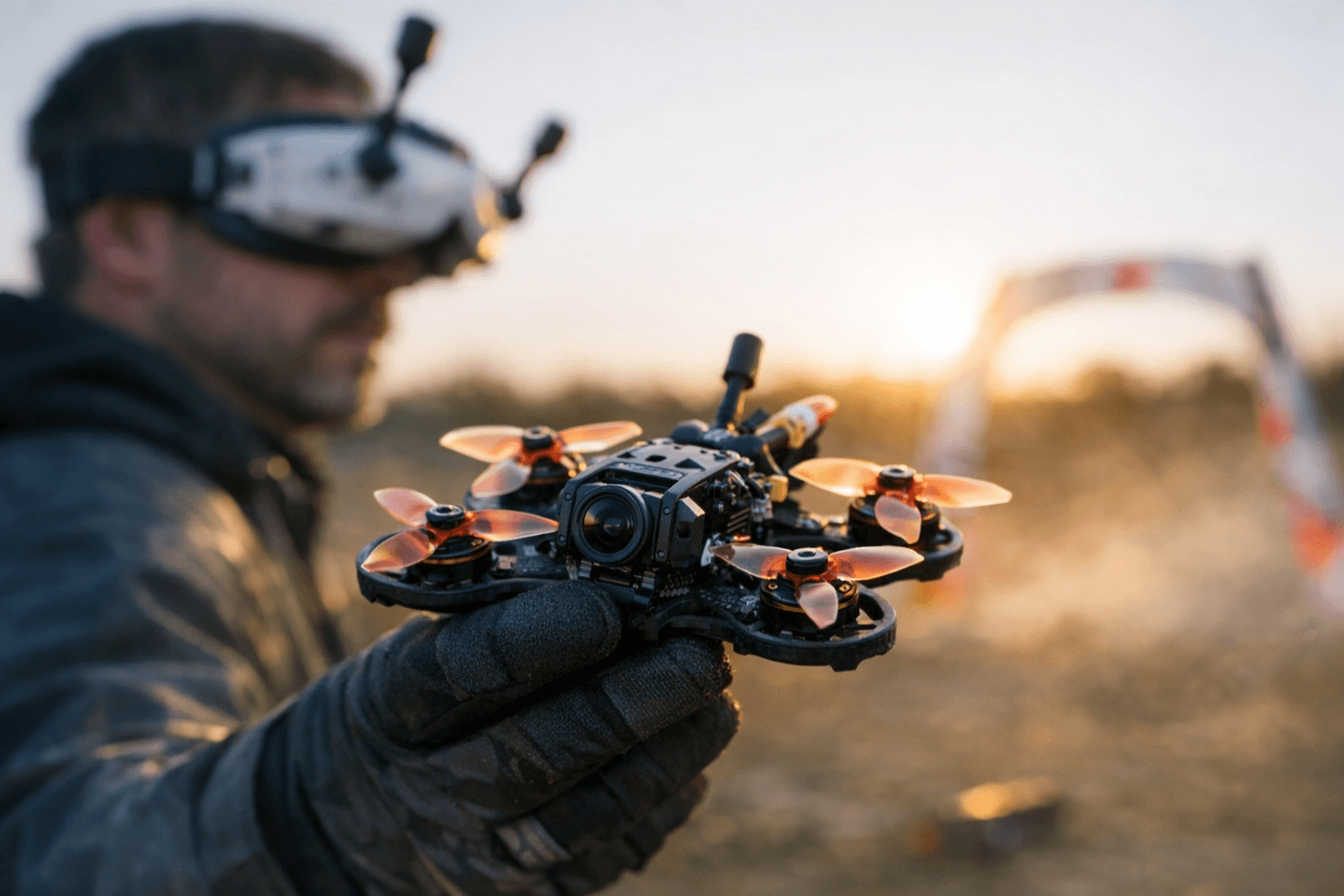
At 113 grams without a battery, the Flywoo Firefly 20 Pro is doing something most tiny FPV quads cannot: it is asking serious racers to treat a micro like a real training tool. The pitch is simple, but the implications are big. If a two-inch frame can carry DJI’s full-size O4 Pro system, hold up in crashes, and still feel sharp enough for fast lines, it may become the kind of quad you reach for far more often than a larger practice rig.
That is the real test here. Not whether it looks impressive on paper, but whether it gives enough speed, handling, and image quality to make tight-space practice worthwhile. Flywoo is selling the Firefly 20 Pro as a compact machine, but the question underneath the specs is broader: can a tiny, durable, digital micro lower the barrier to flying fast every day?
A race-minded build packed into a micro frame
The Firefly 20 Pro is built around a GOKU F405 SE 20A AIO flight controller, an ICM-42688-P gyro, 8MB of blackbox storage, and a Flywoo EL24E ExpressLRS 2.4 GHz receiver. Those are not cosmetic details. For pilots who care about repeatable laps, tune work, and recovery after a rough landing, they matter as much as the shell around them. The power system also backs up the intent, with ROBO 1303 6000KV motors, Gemfan 2023-3 tri-blade props, and an XT30 battery connector.
Flywoo’s own product pages frame the quad as a 2-inch micro drone with a rigid 2.5mm carbon bottom plate and a unibody front-arm structure. That combination points straight at the practical realities of FPV training: the frame needs to survive gate taps, turf strikes, and hard recoveries without turning into a weekend repair project. The camera tilt adjustment from 0° to 25° also shows the design is not just for hovering and cruising, it is set up for pitched-forward flying that matches aggressive racing lines.
DJI’s O4 Pro is the headline feature, and the weight challenge is the story
The part that makes the Firefly 20 Pro unusual is not just that it has digital video, but that it carries the full-size DJI O4 Air Unit Pro in a frame this small. DJI says the O4 Pro uses a 1/1.3-inch image sensor, records up to 4K/120fps, and supports 10-bit D-Log M. It also says the O4 Air Unit Pro is intended for frames 3 inches and above, which makes this 2-inch build stand out immediately.
That packaging challenge is no small thing. DJI says the O4 Air Unit Pro weighs about 15.6 grams for the air unit module without the camera module and about 32 grams with the camera module included. Squeezing that into a micro airframe helps explain why this build has drawn attention: it is trying to deliver premium video quality in a class of drone where every gram changes how the quad feels in a turn. For racers, that means a rare combination of compact size and serious imaging hardware, one that could make digital practice footage more useful for line analysis and setup tweaks.
What the Firefly 20 Pro feels like in practice
The review’s most useful point is not the spec sheet, but the behavior. Oscar Liang describes the Firefly 20 Pro as a quad that is easy to work on and beginner-friendly despite the performance on tap. That matters because a practice rig is only valuable if you are willing to fly it often, and fly it hard. A drone that is fussy to repair or intimidating to tune tends to sit on the bench, no matter how good its numbers look.
Flywoo recommends 4S 550mAh or 750mAh LiHV packs, with claimed flight times of about 5 to 6.5 minutes and a maximum speed listed at 120 km/h. That is enough speed to make the quad meaningful for aggressive line training, throttle control, and repeated small-space runs, while still keeping it in a size class that makes sense indoors or in a backyard. The camera is soft-mounted to reduce jello, the antennas are lightweight dipoles, and the frame can be opened with just four screws for access to the flight controller and O4 Pro internals. Those are the kinds of details that turn a spec-heavy micro into a tool instead of a toy.
For pilots building a real training setup, that balance is the point. A lighter quad like this usually means less intimidating damage, easier transport, and more chances to fly between bigger sessions. It will not replace a full-size rig for wide-open field sessions or raw prop authority, but it can absolutely become the craft you use to sharpen reflexes, practice camera angle discipline, and keep your digital system dialed in.
Where it fits in the market, and why that matters
Flywoo’s site lists the Firefly 20 Pro O4 Pro configuration as a new release, with pricing from $159.99 to $469.99 depending on configuration. That range puts the model in a wide lane, from entry-level access to a more complete premium setup. Third-party retailers such as GetFPV and Rotorama describe it as a pre-tuned, crash-resistant BNF-style quad that is ready to fly out of the box, which reinforces how Flywoo is trying to meet pilots where they already are: ready to race, but not always ready to build from scratch.
The shipping window also tells you where this product sits in the current cycle. Flywoo’s store shows estimated shipping between April 17 and April 20, 2026 for at least one listing, which means the Firefly 20 Pro is arriving right as pilots are looking for real-world handling answers, not launch-day hype. In a market where ultra-compact digital micros are becoming more important, the bigger story is not simply that Flywoo made a small drone. It is that DJI’s higher-end video platform is now being forced into smaller and smaller frames, and racers are the ones who stand to benefit first.
The verdict for racers and practice pilots
The Firefly 20 Pro does not look like a replacement for every larger practice rig, and it does not need to be. Its value is in frequency. A 113-gram quad with a rigid carbon structure, serviceable internals, ExpressLRS control, and O4 Pro video quality is the kind of machine that makes fast flying easier to repeat, especially in tight spaces where a bigger quad is simply too much.
That is the real shift here. The Firefly 20 Pro is part of a growing class of ultra-compact digital micros that blur freestyle, training, and backyard racing into one practical platform. If it flies as cleanly as the design suggests, it could become the compact quad that gets more pilots in the air more often, and that is how training setups change for real.
This article was produced by Prism’s automated news system from verified source data, official records, and press releases, then run through automated quality and moderation checks before publishing. The system is built and supervised by the people who set the standards it runs under. Read our full AI policy.
Did this article answer your question?