Jordan Temkin became drone racing’s first true professional star
Temkin didn’t just win early drone races. He turned a garage build and back-to-back DRL titles into the first real pro star power the sport could sell.
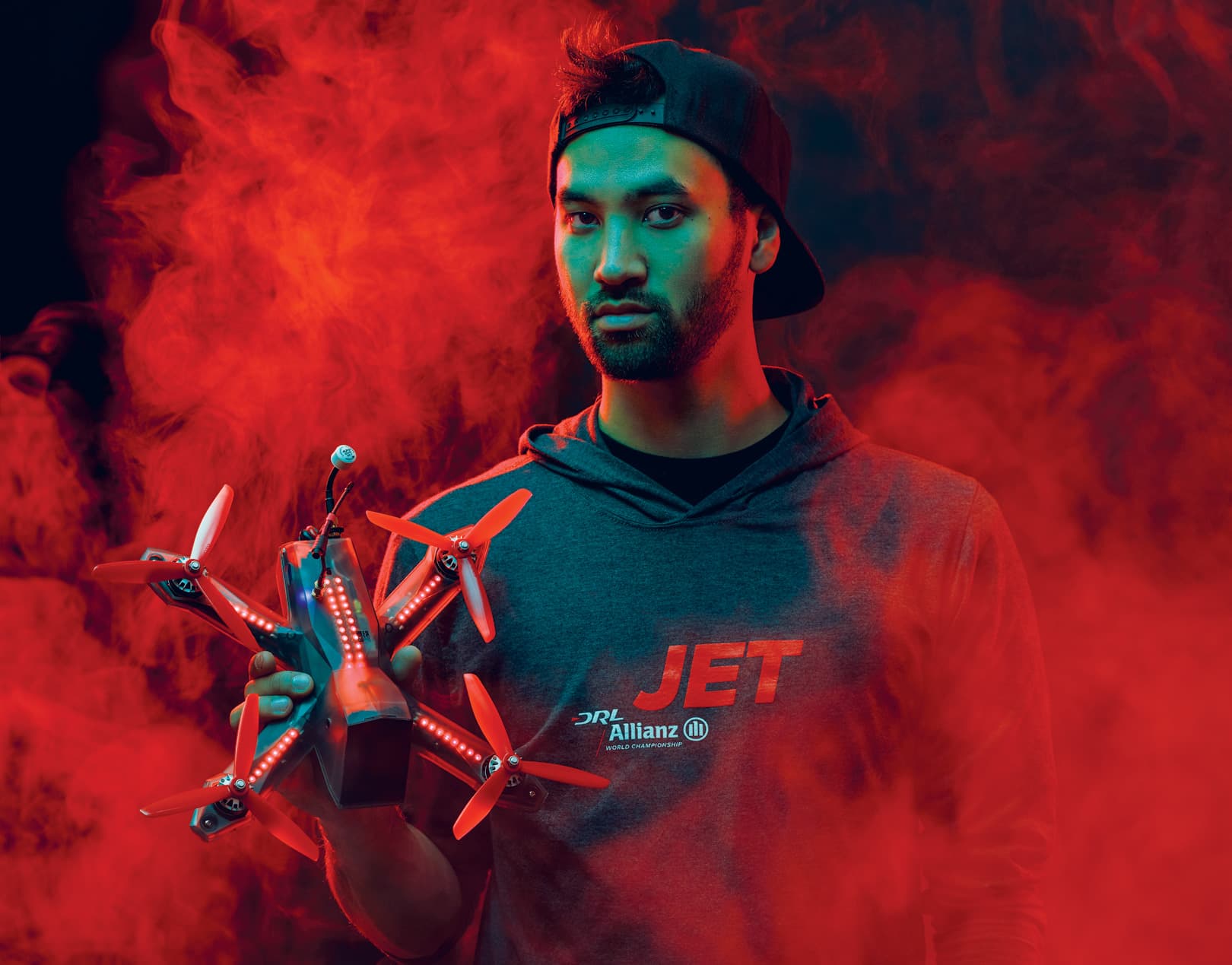
Jordan Temkin’s name stuck because he arrived before drone racing had a script. He built his first machine from inexpensive online parts and a 3D-printed frame, got it flying in September 2014, and then turned that make-it-yourself beginning into the sport’s first true professional arc. By the time he was winning titles, drone racing was no longer just a hobby with goggles. It was a circuit, a broadcast product, and a place where one pilot could become the face of the whole thing.
From tinkerer to racer
Temkin discovered drones in 2013, while the sport still lived mostly in garages, parking lots, and the odd makeshift course. He graduated from the University of Colorado Boulder in 2014, worked at a Boulder sandwich shop, and then made a small but telling move to Fort Collins, a place the university profile described as more drone-friendly. That detail matters because Temkin did not come out of a polished motorsports pipeline. He came out of the same maker culture that fed the early FPV scene, where pilots built, broke, tuned, and rebuilt their own gear until it finally held together in the air.
His first drone was not some high-end commercial setup. It was assembled from cheap parts and a 3D printer, which tells you almost everything about the era. The sport rewarded ingenuity as much as pure reflexes, and Temkin’s early choices showed a pilot who understood that every gram, every frame, and every fix could change a lap time. Before he was flying for titles, he was racing across the United States in events that sometimes drew as many as 150 competitors, a useful reminder that the early scene was crowded even if it was not yet mainstream.
The titles that gave the sport a face
The breakthrough came in 2016, when Temkin won the first ever Drone Racing World Championship and became the original Drone Racing League world champion after taking the inaugural season. He repeated as champion in 2017, and that back-to-back run is what turned him from a winner into a reference point. Plenty of pilots can win a single event in a new sport. Far fewer become the benchmark the sport uses to explain itself.
ESPN’s 2017 profile treated him as proof that drone racing could be a full-time job, not just an expensive weekend obsession. That framing is the key to understanding his place in the sport. Temkin was not only collecting trophies. He was helping prove that a pilot could build a career out of speed, precision, and enough consistency to stay relevant when the novelty wore off.
PBS later used him the same way, describing him as a two-time Drone Racing League champion while leaning on his perspective to explain the physics and mechanics of FPV racing. That is what made Temkin unusually valuable: he could win, but he could also translate the sport for people who had never worn goggles. He became both competitor and interpreter.
The league that turned racing into a product
The Drone Racing League was founded in January 2016 and launched with six key events that year, a sign that it wanted to behave like a real circuit from the start. DRL’s first full season aired on ESPN in the fall of 2016 as a 10-episode series, and the deal arrived after the league had already pulled in $12 million in investment. The sport was moving fast, but not randomly. It was building a media machine around the action.
The racing itself had the kind of numbers that made it easy to sell on TV. ESPN said DRL pilots flew quadcopters at speeds of up to 120 mph, which is the kind of figure that sounds exaggerated until you see the blur of a race line through a gate. The 2016 championship field was trimmed from more than 30 FPV pilots to 12 finalists, a useful measure of how selective the league was even when it was young. By 2017, the finale at Alexandra Palace in London featured eight top pilots in a round-robin format on a one-of-a-kind course that cut through the entire building on June 13, 2017.
Alexandra Palace billed that event as the UK’s first professional drone race. That mattered because it showed how quickly the sport was moving from underground spectacle to public-facing competition. Temkin was winning inside a structure that already looked bigger than the hobby scene that produced him.
Why Temkin became the prototype
Temkin was the right champion for the era because he arrived with the right mix of grit and readability. He had the homemade start, the self-built gear, the move to a more drone-friendly city, the road miles, the titles, and the kind of nickname, Jet, that made him sound like he belonged on a broadcast graphic. He also picked up the trappings that made the career feel real: cash prizes, free trips, a TV show on ESPN, and two racing contracts with DRL.
That package is what set him apart from a generic profile subject. He was not just an athlete with a backstory. He was the template for how drone racing could present a star. The sport was still young enough that one pilot could embody its entire pitch: technical, fast, slightly futuristic, and easy to package for television.
What today’s top pilots have to do differently
Temkin’s path worked because drone racing was still inventing its own mythology. A back-to-back champion could still define the sport, and a league with a handful of seasons could still make one pilot feel like a breakthrough brand. Today’s top pilots would have to do more to separate themselves in a scene that is deeper, more competitive, and harder to dominate for long.
They would still need speed, but speed alone is not enough. They would need repeatable results across bigger fields, sharper gear decisions, and a public identity that travels beyond one title run. They would have to treat the sport less like a breakout and more like a portfolio: race craft, media presence, and enough consistency to stay visible when other pilots can match the pace.
Temkin’s later shift into film and commercial drone work closes the loop on that evolution. He helped prove that FPV skill could translate beyond the race course, and that early stars in drone racing could become part of the wider drone economy. That is why his title run still matters. He was the first pilot to make professional drone racing look like a career, not a curiosity.
This article was produced by Prism’s automated news system from verified source data, official records, and press releases, then run through automated quality and moderation checks before publishing. The system is built and supervised by the people who set the standards it runs under. Read our full AI policy.
Did this article answer your question?