Military Investment and Autonomy Research Are Reshaping Competitive Drone Racing
Defense giants and AI researchers have turned competitive drone racing into a live proving ground for autonomous systems, with a $500K Anduril competition and the U.S. Army fielding its own FPV team reshaping who flies and why.
The first thing competitive drone racing pilots are noticing is not a new gate design or a faster quad — it's soldiers and software engineers showing up at the same start line. What was once a niche distinction between sport and defense has collapsed into a single, high-velocity overlap, and the structural consequences for pilots, leagues, manufacturers, and event rights holders are only beginning to land.
The Pentagon Comes to the Race Track
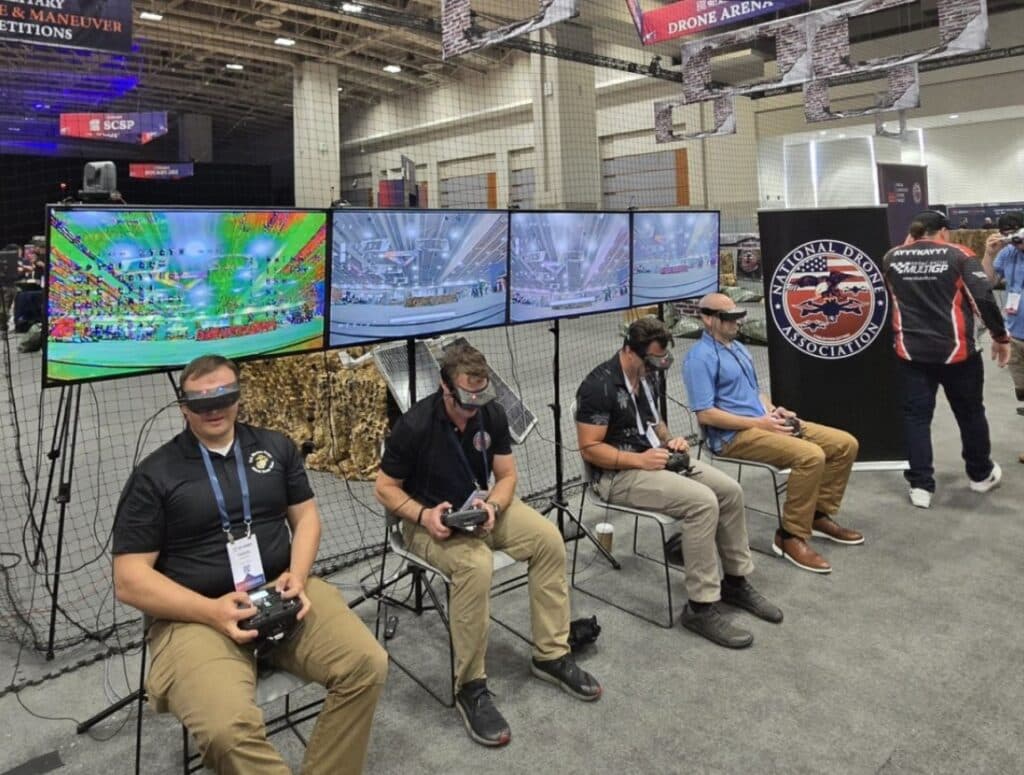
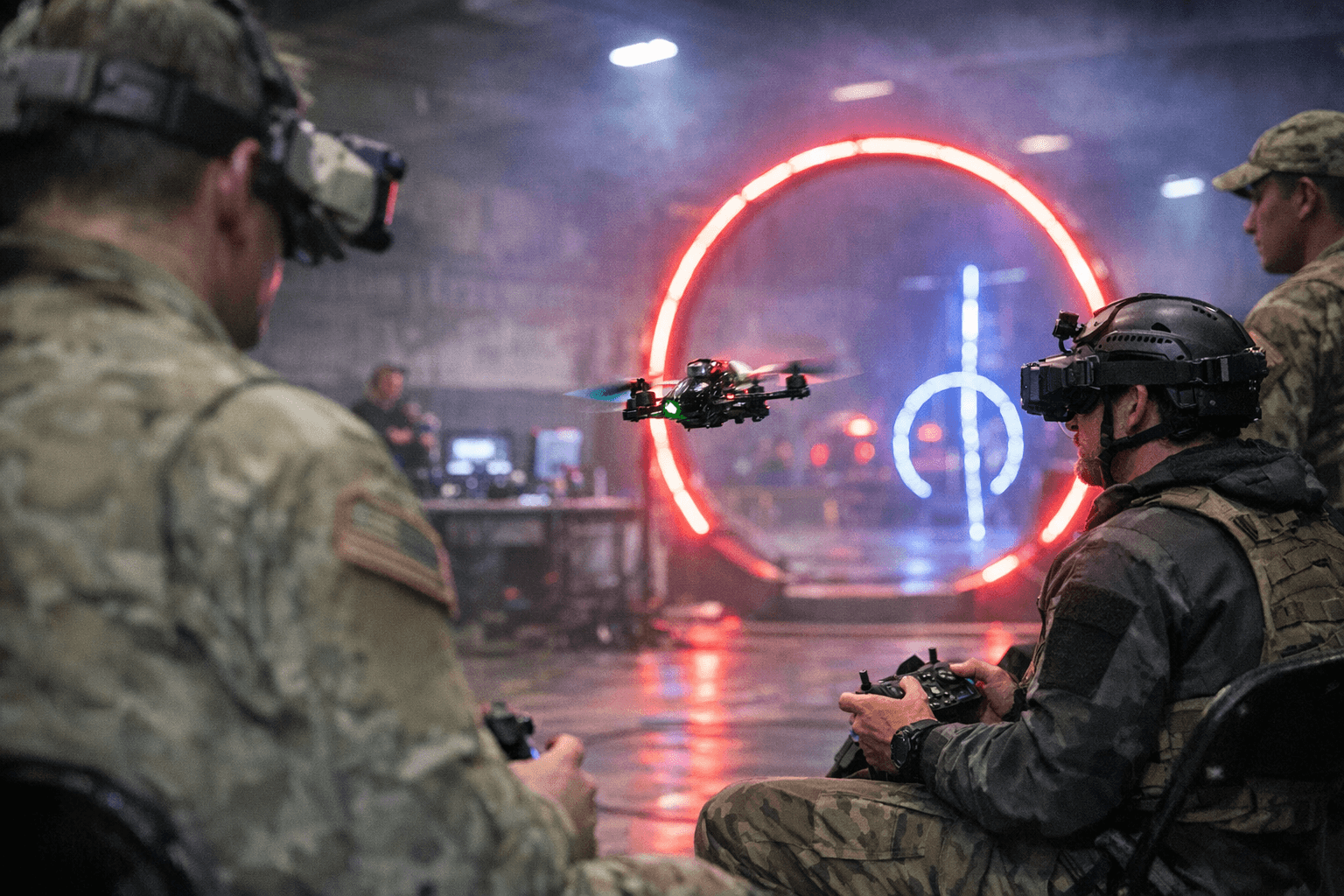
Secretary of War Pete Hegseth has announced an ambitious plan to outfit combat units with tens of thousands of unmanned systems in 2026 and hundreds of thousands more by 2027. That scale of deployment demands a massive pool of skilled operators, and the military is increasingly finding that competitive FPV racing is among the fastest ways to build one. The U.S. Army has assembled a competitive drone team based out of Fort Rucker, made up of soldiers and civilians from across the Army, with a mandate to bring visibility to the service, assist with recruiting, and provide tactical and developmental input.
The team was built to be deliberately diverse, drawing from infantry, aviation, military police, and cyber backgrounds, with some members having FPV experience and others coming from larger systems like the Shadow UAS. The intent is cross-pollination: the range of experience allows the team to learn from each other, and then in turn take that knowledge back to their units.
That feedback loop runs in both directions. Captain Nathan Rosenberger, an AI technician assigned to the Army's Artificial Intelligence Integration Center, has been candid that "the racing is not really tactically relevant," but adds, "to be good at racing, you need to be very accurate. That translates really well to being able to fly precisely when you need to." The Army's own "Best Drone Warfighter Competition" — held in February 2026 at Fort Hood — extended this logic further. The competition brought together top unmanned aircraft system operators from across the Army to test technical skill, tactical judgment, and combat integration under pressure, assessing readiness and validating the Army's ability to develop skilled, adaptable drone operators for global missions.
Anduril Rewrites the Competition Format
If the Army's presence on the race circuit represents a gradual institutional shift, Anduril's entry into the space is a deliberate detonation of the old model. The AI Grand Prix, founded by Anduril in partnership with the Drone Champions League, Neros Technologies, and JobsOhio, is a global autonomous drone racing competition challenging engineers to prove their autonomy software under real-world flight conditions.
The core premise: humans don't fly. Software does. Competitors will race fully autonomous drones built by Neros Technologies, with no human pilots and no hardware modifications allowed, ensuring the competitive edge is gained entirely by developing the best software. Anduril founder Palmer Luckey was blunt about why sponsoring a traditional race never made sense for a company built on autonomy. When the idea of sponsoring a standard drone racing tournament came up internally, Luckey told the team it "would be a really dumb thing for Anduril to sponsor," arguing instead that "we should really sponsor a race that's about how well programmers and engineers can make a drone fly itself."
Individuals or teams of up to eight will compete for a $500,000 prize pool and a job at Anduril. The competitive arc runs from virtual qualification rounds in the spring through an exclusive two-week, in-person training and qualification experience in September 2026 in Southern California, culminating in a final race in November at Anduril's new Arsenal-1 factory in Ohio. The inaugural U.S. competition signals Anduril's intent to expand the AI Grand Prix globally, with future seasons planned across Asia, the Middle East, and Europe.
AI Breaks the Human Barrier in Abu Dhabi
The Anduril format doesn't exist in isolation — it arrives as a cascade of research results has permanently altered the expected relationship between human pilots and autonomous systems. The autonomous system "Swift," which combines deep reinforcement learning in simulation with data collected in the physical world, competed against three human champions including the world champions of two international leagues and won several races against each while demonstrating the fastest recorded race time.
That result was sharpened further in April 2025 in Abu Dhabi, where one approach won the A2RL Grand Challenge and enabled an autonomous drone to win, for the first time, an independently organized human vs. AI drone racing competition — sequentially beating three human FPV world champions in a direct knockout tournament. That controller achieved a fastest completion time of 16.56 seconds, outperforming three world champion-level FPV pilots.
The Abu Dhabi Autonomous Racing League Drone Championship in January 2026 delivered another decisive test of autonomous and human performance, as Technology Innovation Institute's TII Racing set the fastest autonomous lap to win the AI Speed Challenge, while World FPV Champion Minchan Kim narrowly claimed victory in the Human vs AI finale. The margin of that human victory was a single race in a best-of-nine showdown — tied at four wins apiece before the final decider.
All drones in the A2RL competition competed fully autonomously using a single forward-facing monocular RGB camera and an inertial measurement unit — no LiDAR, no stereo vision, no GPS, and no external positioning systems were permitted, with the minimal sensor configuration mirroring the perception available to human pilots and ensuring that performance gains are driven by AI software, not sensor complexity.
The Investment Wave Reshaping the Hardware Ecosystem
These competition results are not happening in a vacuum. According to data from Drone Industry Insights, 77% of 2025's investment went to dual-use drone companies serving both civilian and military markets, with only 23% ($888 million) going to purely commercial applications. Hardware companies captured 77% of 2025 drone investment, up from 46% in 2023, reversing the software-first trend that dominated 2018 to 2022.
Investment in military use still means better technology on the commercial side, as defense applications fund technological development that will eventually benefit commercial applications such as smarter autonomous flight systems, detect-and-avoid capabilities, and long-endurance platforms. Early 2026 data accelerates that picture: in just the first two months of the year, approximately $1.7 billion was invested in the drone market.
For competitive racing leagues, this capital flow matters because it concentrates R&D in platforms that are directly relevant to race-grade hardware. Beyond competition, A2RL operates as a public science testbed, compressing years of autonomous systems research into days of visible, measurable performance, providing credible benchmarks that directly inform real-world applications.
What This Means for Pilots, Leagues, and the Sport's Identity
The convergence generates a genuine tension at the center of the sport. Human FPV racing built its audience on the extraordinary precision and instinct of elite pilots — operators who spend years mastering split-second reactions that AI is now beginning to replicate. Open research questions still include safely and effectively managing mixed human-robot multi-vehicle racing, reliable state estimation at extreme speeds, coordinating multiple autonomous racers, ensuring safety, and improving sim-to-real algorithm transfer. That list is also, effectively, a list of the most commercially and militarily valuable autonomy problems on the planet.
For established leagues like the Drone Champions League, the calculus has shifted from entertainment-only positioning toward operating as an infrastructure layer for autonomy development. DCL, the world's leading professional drone racing organization, has its AI vector module integrated into the Anduril competition platform — a structural arrangement that places one of sport racing's premier organizers directly inside a defense-funded autonomy pipeline.
The Army's presence in commercial events reinforces this from the other direction. Beyond the best uses for systems in competition, the Army is looking at how competition results might translate back to the service's expanding requirements for unmanned aerial systems — trying new things and taking a competition-fueled outsider's look, unconstrained by doctrine.
Racing is no longer just racing. Every gate cleared by an autonomous system is a data point. Every human pilot who edges out a machine is documenting the remaining gap between instinct and algorithm. The sport that was once the purest expression of human reflexes at speed has become the world's most public laboratory for the technology that will replace them.
Know something we missed? Have a correction or additional information?
Submit a Tip