MIT turns drone racing into autonomous UAV training program
MIT is turning drone racing into a lab for autonomous flight, where FPV culture meets AI and students race DJI Tello quads into the future.
MIT is turning drone racing into a lab for autonomous flight, and that is a bigger deal than a campus exercise sounds. The school’s Autonomous Air Vehicle Racing program treats the sport as both a competition and a research problem, which is exactly where drone racing is headed if you care about what comes next, not just who is fastest today.
From FPV adrenaline to autonomy R&D
The pitch is straightforward, but the implications are not: rapidly expanding UAV technology has opened up new applications, and MIT points to the popularity of FPV drone racing as one reason students show up in the first place. That matters because FPV is still the beating heart of drone racing culture, a sport built on reflexes, visual feel, and split-second line selection. MIT is not trying to kill that culture. It is trying to bottle its pressure and feed it to machines.
The other side of the program’s logic is just as important. MIT says companies like Amazon are interested in fully autonomous aerial delivery vehicles, which means this is not only about sport, but about building the talent and tooling that will shape real UAV systems. That is why drone racing works so well as a testbed: it compresses perception, planning, control, and hardware tradeoffs into one brutally honest format.
How the program is built
The Autonomous Air Vehicle Racing course sits inside the broader MIT Beaver Works Summer Institute, a rigorous, project-based STEM program for high school students entering their senior year. BWSI started in 2016 with a single course and 46 students. MIT says student enthusiasm helped it grow to 14 courses and year-round offerings, which tells you the demand is not fading. It is compounding.
The structure is two-part. First comes an online prerequisite course open to interested students, though applicants must be nominated and approved before registration. Then a selected group moves on to a four-week summer program. MIT Lincoln Laboratory also frames the online courses as useful for teachers and for students working through Python, machine learning, and autonomous systems, which gives the program a reach far beyond one summer camp style experience.
The 2026 Autonomous Air Vehicle Racing online course is explicitly presented as prerequisite material to be completed before arriving on campus for the summer program. That sequencing matters. MIT is not just teaching racing. It is building a pipeline.
What students actually build
The hardware choice is telling. The course uses the DJI Tello, a commercial quadrotor platform, paired with open-source libraries and custom algorithms. That combination strips away the noise and puts the focus where MIT wants it: on autonomy. Students are not just flying a drone around cones. They are building the logic that lets a quadrotor read a course, decide what comes next, and move with control.
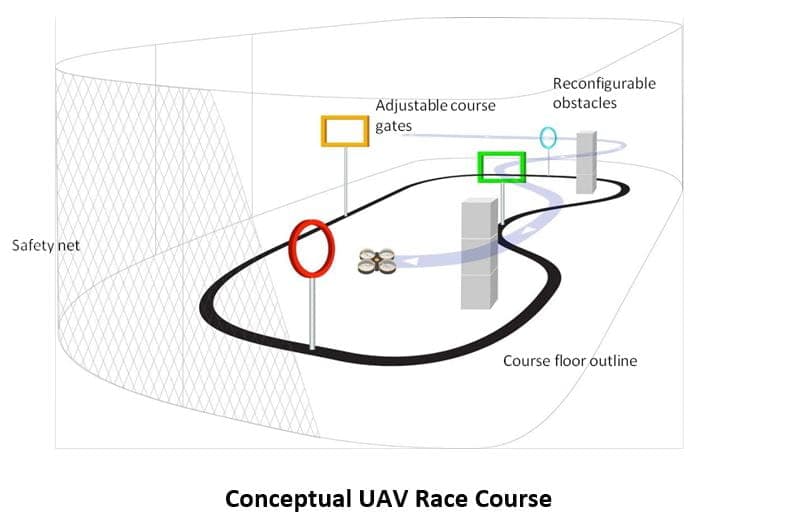
MIT says the students work in teams, and the experience ends in a competition where the course projects and lectures are put to use on racing challenges. The program is built around the idea of making a quadrotor autonomously navigate a racecourse designed for the summer program, which is the key detail here. The racecourse is not a gimmick. It is the proving ground.
The 2024 syllabus breaks that work into four clear phases: quadrotor basics, computer vision, planning and control, and challenge week. That sequence is exactly what makes the program more than a toy. It forces students to understand the machine from the ground up, then connect the math to the hardware and finally to race-day execution.
MIT’s course overview says the goal is to teach the theory, software, hardware, and practical skills needed to design and fly an autonomous UAV through a structured indoor obstacle course. That is a robotics curriculum disguised as a racing program, and it is a smart disguise.
Why the final race matters
The public-facing part of the program is not an afterthought. MIT livestreamed the Autonomous Drone Racing finals in both 2024 and 2025, which tells you the school sees this as a showcase, not just a classroom deliverable. That public window matters because drone racing has always thrived on spectacle. The best ideas in the sport tend to survive when they can be seen.
There is also a bigger competitive context. Drone racing is already an international sport, with televised events and prize money that can reach $100,000 for the winning pilot. In that world, a course like this is not an academic side street. It is a feeder system for the next generation of talent, whether that talent ends up in a cockpit, in a lab, or in a control stack.
Research backs up the logic. A 2021 study found that professional FPV drone racers consistently outperformed beginners in lap times, velocity, and racing line efficiency. That is the part people sometimes miss when they talk about racing as pure reflex. The top pilots are not just faster thumbs. They are better decision-makers. They see lines earlier, waste less motion, and carry speed with cleaner geometry.
What autonomy changes for the sport
Autonomous drone racing has already moved beyond theory. Competitions have been organized at IROS and NeurIPS, and the AlphaPilot challenge pushed the space even further. Nature published a 2023 paper on champion-level drone racing using deep reinforcement learning, which is a pretty strong sign that the algorithmic side is no longer a curiosity.
That is where MIT’s approach becomes genuinely important. If racing is also an R&D lab, then the sport’s future may not look like a simple human-versus-machine split. It may look like new race formats, hybrid pilot roles, and drones designed from the start to be tuned for both human and autonomous performance. Some racers will still be pure pilots. Others will become systems engineers in racing gear, building the stack that decides how fast the drone can think.
The contrarian read is this: autonomy is not coming for drone racing to replace its culture. It is coming because the sport is already one of the best ways to measure what a flying machine can actually do under pressure. MIT understands that better than most. By treating racing as training for autonomous UAVs, it is not just teaching students how to fly. It is helping define what racing itself will become.
This article was produced by Prism’s automated news system from verified source data, official records, and press releases, then run through automated quality and moderation checks before publishing. The system is built and supervised by the people who set the standards it runs under. Read our full AI policy.
Know something we missed? Have a correction or additional information?
Submit a Tip