Top FPV Goggles for 2026: Latency, Image Quality, and Racer Picks
HDZero's 3ms glass-to-glass latency and DJI's 15ms Race Mode are reshaping what competitive FPV pilots demand from their goggles in 2026.
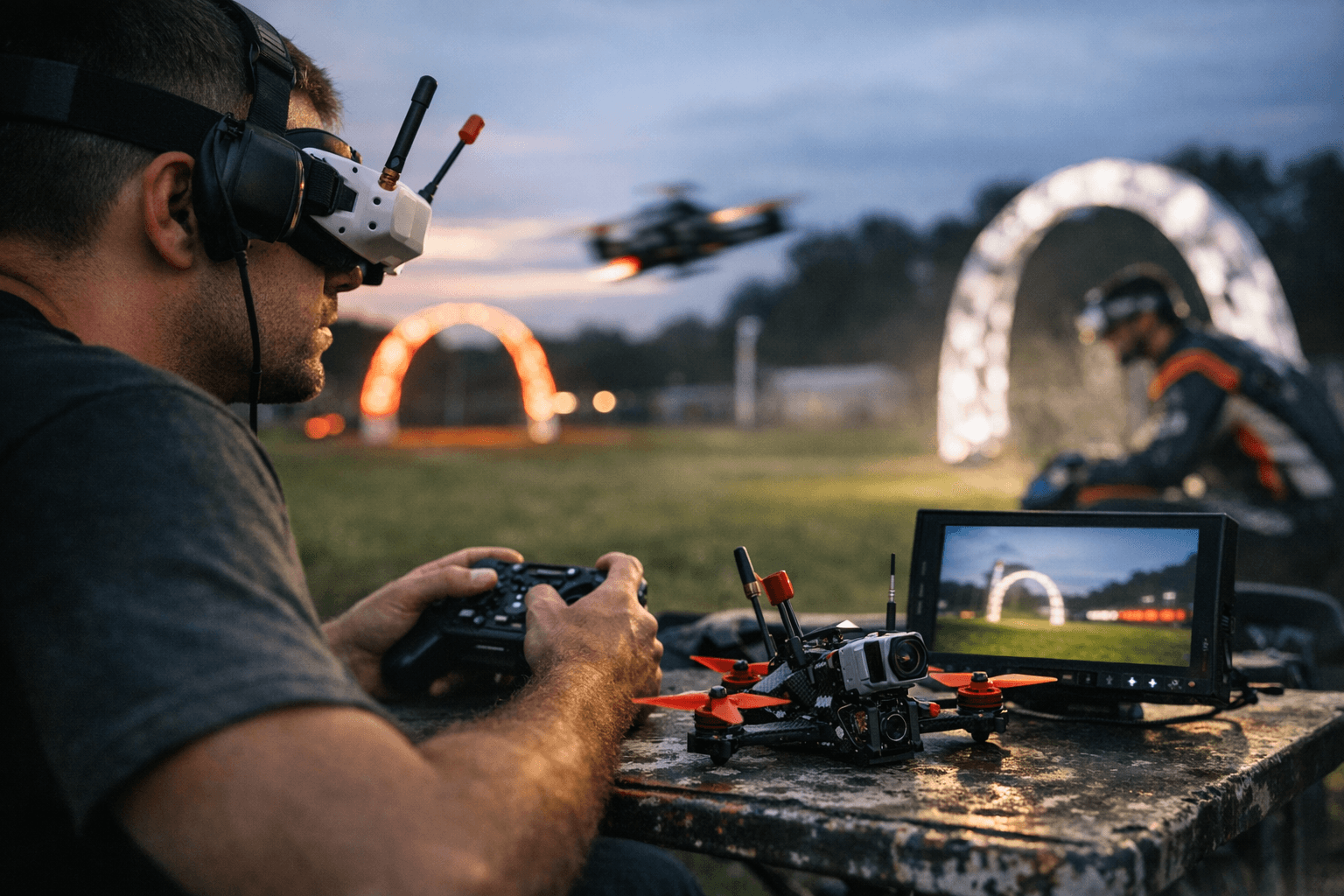
Choosing FPV goggles is not a peripheral decision. It directly shapes lap consistency, reaction time, fatigue across heats, and a pilot's ability to dissect DVR footage after the race. The wrong choice doesn't just cost money; it costs positions on the course.
The 2026 goggle landscape has consolidated around a few core systems: analog, DJI's digital ecosystem anchored by the O4 Pro Air Unit, HDZero, and Walksnail. Each involves a genuine technical philosophy, not just a price tier. Understanding what separates them requires looking past spec sheets and into what actually changes when a pilot drops into a gate at full throttle.
The Analog Baseline: Still Alive, Still Relevant
Analog is the oldest and cheapest path into FPV racing, and it earns its place in the conversation on merit, not nostalgia. Analog systems offer under 2ms display latency at the goggle, making them extremely responsive by any measure. The tradeoff is image fidelity: analog video is softer, less detailed, and prone to static or breakup as signal weakens. DVR recordings from analog goggles are functional but low-resolution, suitable for reviewing flight lines rather than producing social media content.
The cost advantage is real. Analog setups remain the most affordable entry point across the entire FPV spectrum, and they run on a one-way broadcast architecture that imposes no interference penalty on nearby pilots. Experienced pilots flying analog for price reasons are common, and for tight-budget builders who intend to upgrade later, analog is a legitimate starting point. As Oscarliang puts it: "Analog is ideal for racing and freestyle performance, not for cinematic image quality."
HDZero: The Fixed-Latency Case for Racing
The FPV community sometimes jokingly refers to HDZero as "Analog Plus," and that framing is genuinely useful. As Oscarliang describes it, "HDZero behaves very much like analog, but with improved image quality, even ever so slightly better latency." What makes it serious for competition isn't the nickname, it's the physics.
By integrating the entire goggle display pipeline with HDZero's fixed-latency video transmission, the HDZero Goggle 2 achieves 3ms glass-to-glass sub-frame latency with no jitter or dropped frames. That number resolves an apparent contradiction that has circulated in earlier reviews: HDZero's "advertised latency around 60ms" figure referenced by Oscarliang refers to an older characterization, while the current Goggle 2 hardware spec confirms sub-3ms display latency. A published latency comparison places HDZero 90 at 3.9ms end-to-end and 15ms at the system level, versus DJI O4 Pro Race Mode at 18ms and 27ms respectively.
The structural advantage isn't just the raw number. "Unlike DJI and Walksnail, whose latency can vary depending on signal strength, HDZero maintains consistent latency throughout the flight. This predictability allows pilots to time maneuvers more precisely, which is critical in competitive racing." That consistency matters across an entire race event, not just in one clean run. HDZero's latency is fixed, not variable, which appeals to racers who prize consistent timing over image-recovery tricks that add jitter.
The HDZero Goggle 2 builds on the original with a sharper dust-resistant optic module, built-in analog receiver, integrated WiFi for wireless mirroring, and a protective hard case, while keeping the ultra-low latency, open-source flexibility, and all-in-one digital plus analog support. The goggle runs an open-source Linux OS, giving pilots full control over channel scanning, source switching between HDZero digital and built-in analog, and image settings. The DVR supports recording on all inputs, including HDMI. For pilots who want to review gate entries from multiple angles or share footage wirelessly, the built-in 2.4GHz Wi-Fi allows streaming the FPV feed live to smartphones or tablets with a straightforward setup.
The Goggle 2 features 1080p 90Hz adaptive refresh rate OLED micro-displays and supports multiple resolutions for different flying types: 1080p/30, 720p/60, 540p/90, and 540p/60. The goggles hold the latency crown in digital FPV and offer comprehensive DVR functionality catering to racers, freestylers, and whoop pilots alike.
DJI: The Image Quality Standard
Where HDZero wins on latency consistency, DJI wins on visual fidelity and signal penetration. Oscarliang's assessment is direct: "DJI is, without doubt, the best in its class when it comes to image quality and signal penetration." The latest DJI O4 Pro Air Unit "delivers stunning visuals that genuinely feel like flying through a GoPro," and that comparison isn't marketing language; the O4 Air Unit Pro supports 4K recording at up to 120fps and offers D-Log M, ideal for color grading in post editing.
The mechanism behind DJI's image quality involves a design tradeoff with direct latency implications. "DJI uses a two-way data transmission system where lost or corrupted packets are retransmitted to preserve image quality. This greatly improves link robustness, penetration, and resistance to interference, but it results in slightly higher latency, especially when signal strength is weak."
The DJI O4 Air Unit Series features a Racing Mode with 15ms low latency, measured using DJI Goggles 3 in Racing Mode. Race Mode is only available with Goggles 3 and N3 and is not supported on Goggles 2 or Integra. Pilots running Goggles 2 with the O4 Pro can still expect latency under 30ms with 1080p/100fps video quality. For context, Oscarliang notes: "we are talking about only 30ms (or 15ms in Race Mode) of latency, unless you race on a professional level, it's not an issue at all for most people."
The O4 Pro streams 1080p video at 60Mbps to the DJI Goggles N3 and Goggles 3, and 1080p at 50Mbps to Goggles 2 and Integra. DJI's Racing Mode supports up to eight aircraft racing simultaneously. That multi-pilot capacity is a practical detail that matters on race day when frequency coordination becomes a live issue.
Walksnail: Where It Fits
Walksnail competes in the digital mid-tier alongside HDZero, though with an important behavioral distinction. Both Walksnail and DJI exhibit variable latency that responds to signal conditions, unlike HDZero's fixed output. No manufacturer-stated latency figures for Walksnail's current lineup were verifiable in independent testing at press time, making a direct numeric comparison with HDZero's 3ms display figure premature. Pilots evaluating Walksnail should request current measured specs rather than relying on advertised claims alone.
DVR and Post-Race Analysis
For pilots who treat DVR footage as a training tool, system choice has downstream consequences. Analog DVR is functional but limited in resolution; it works for reviewing race lines but cannot produce content worth sharing. Digital systems change that calculus significantly. "Digital systems also produce much better DVR footage directly from the goggles. Even without an external camera, the onboard digital feed can look surprisingly good for social media use."
The HDZero Goggle 2's built-in DVR records 1080p/60fps H.265 video to microSD, with local recordings retaining original quality without compression artifacts. DJI's Goggles 3 paired with the O4 Pro Air Unit produce comparable quality in the live feed and allow color grading options through D-Log M that neither HDZero nor analog can match.
Racing Hardware Context: What the Goggles Are Flying With
The goggle decision doesn't exist in isolation. Racing builds use high KV motors that spin at higher RPM and deliver explosive throttle response. Flight tuning on racing drones is aggressive: "The drone reacts instantly to stick inputs, making it ideal for tight race gates and rapid direction changes." Camera systems on racing drones are "usually smaller and optimized for low latency rather than high resolution. The goal is real-time clarity, not cinematic image quality."
That hardware context reinforces why latency and latency consistency carry such weight in goggle selection. A 10ms difference in what a pilot perceives versus what the drone is actually doing compounds over the course of a race heat. The choice between DJI's image supremacy and HDZero's fixed-latency predictability is not a casual preference; it maps to what a pilot needs from their equipment at the gate.
Buying Checklist: Three Things to Confirm First
Before committing to any goggle system, confirm three things: the transmission type, the exact system compatibility, and supported frequency bands. Getting this wrong can mean a drone and goggles that simply will not connect. That compatibility check is not a formality. DJI's Race Mode, for example, is available only on DJI Goggles 3 and N3, not on Goggles 2 and Integra, due to hardware limitations. Pilots who buy Goggles 2 expecting Race Mode performance won't find it.
The RTF (Ready-to-Fly) versus build decision is equally consequential: it "depends on your experience level, technical confidence, and how much time you want to invest before your first flight." There is no universal right answer, but knowing your system before ordering eliminates the most common and most expensive compatibility mistakes.
On cost: camera and VTX combinations run from US$99 to US$229, while FPV goggles range from US$229 to US$500 depending on the system. Digital builds sit at the higher end of both ranges; analog setups can be assembled for less. The real cost isn't just the purchase price, though. It's the hours spent diagnosing an incompatible component that should have been verified before checkout.
The 2026 goggle decision ultimately comes down to what race day looks like for you. If fixed latency and a fully open-source platform define your priorities, HDZero's Goggle 2 sets the current standard. If image quality, signal penetration, and a polished ecosystem matter more than absolute latency consistency, DJI's O4 Pro with Goggles 3 is the harder system to argue against.
This article was produced by Prism’s automated news system from verified source data, official records, and press releases, then run through automated quality and moderation checks before publishing. The system is built and supervised by the people who set the standards it runs under. Read our full AI policy.
Did this article answer your question?