Brungard Returns, but Youngstown State Faces Key Receiver, Corner Battles
Beau Brungard won the 2025 Walter Payton Award with 3,230 passing yards and 1,378 rushing yards, but YSU must replace 1,658 combined receiving yards before it can seriously chase an MVFC title.
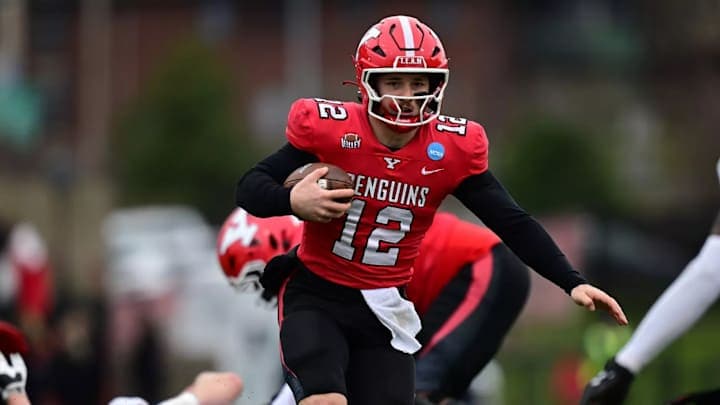
The question hanging over Youngstown State's entire 2026 spring camp isn't whether Beau Brungard can play at an elite level. He settled that last fall, winning the Walter Payton Award after completing 68.7 percent of his passes for 3,230 yards and 26 touchdowns, while adding 1,378 rushing yards and 24 more scores on the ground. The Walter Camp Foundation named him the FCS Player of the Year. He became the first Penguin quarterback ever named to the Stats Perform All-America first team. The real question is whether the program can rebuild enough around him to convert that individual brilliance into a deep MVFC run before his window closes.
That framing matters because the answer depends almost entirely on two position groups that enter spring camp with enormous uncertainty: the wide receiver room and the cornerback unit. Both lost significant personnel. Both need spring practice to produce a clear answer. The Penguins went 8-5 in 2025 and fell in a gut-punch 43-42 first-round playoff loss to Yale, a game they led 35-7 at halftime. Getting back to the postseason, and further, means not leaving either group unsettled into August.
The Receiver Room: 1,658 Yards to Replace
Max Tomczak and Ky "Flash" Wilson were the pillars of Youngstown State's passing game last season. Tomczak finished with 70 receptions for 1,021 yards and eight touchdowns. Wilson added 57 catches for 637 yards and four scores, while also returning 32 kicks for 842 yards. Together they accounted for the majority of Brungard's most trusted throws. Both are gone.
The internal options, returning wideouts Fresh Walters and RK Dandridge, give the Penguins a foundation, but the coaching staff has clearly prioritized transfer additions to accelerate the rebuild. Lynn Wyche-El, a first-team All-GLIAC performer who spent four seasons at Grand Valley State, represents the highest-profile addition. Lorenzo Jenkins arrives from Bethune-Cookman after posting more than 400 receiving yards in 2025. Connor Smith brings rare size at 6'4" after transferring from Assumption. The wildcard is Bryan Hunt, an All-G-MAC selection from Findlay in 2024 who missed the entire 2025 season with a season-ending injury and could emerge as a disruptive deep threat if he returns to that form.
Indicator One: Route-Tree Trust
The first thing to watch in spring is not who catches the most passes in a scrimmage, it's which receivers Brungard trusts across the full route tree. A quarterback of Brungard's caliber quickly self-sorts his target list: he'll throw rhythm routes to some players and hold deeper concepts for others. Which receiver earns the intermediate crossing routes and option routes against zone coverage will signal who becomes the true WR1 before fall.
The win-path scenario this unlocks is direct. North Dakota State, Southern Illinois, and Illinois State all run zone-heavy coverage schemes that force quarterbacks to manipulate the second level. If Brungard identifies one reliable intermediate receiver in spring, the Penguins enter MVFC play with an answer to the most common coverage they'll see. Without that receiver, opponents will continue daring YSU to beat them through the air while committing extra run defenders to limit Brungard's legs.
Indicator Two: Explosive-Play Rate
Wilson's departure strips the offense of its most natural source of big plays. He wasn't just a possession receiver; he turned short passes into long gains and returned kicks at a level few FCS programs can match. Replacing that explosiveness is a structural challenge, not just a personnel one.
Bryan Hunt, if healthy, is the most intriguing candidate to restore that dimension. His All-G-MAC recognition in 2024 came on the back of consistent big-play production, and a full season of recovery time makes his return worth monitoring closely. Wyche-El's four seasons of GLIAC experience also suggest a player who understands how to create separation at the catch point, not just run clean routes. Spring will reveal whether either player can threaten defensive backs over the top.
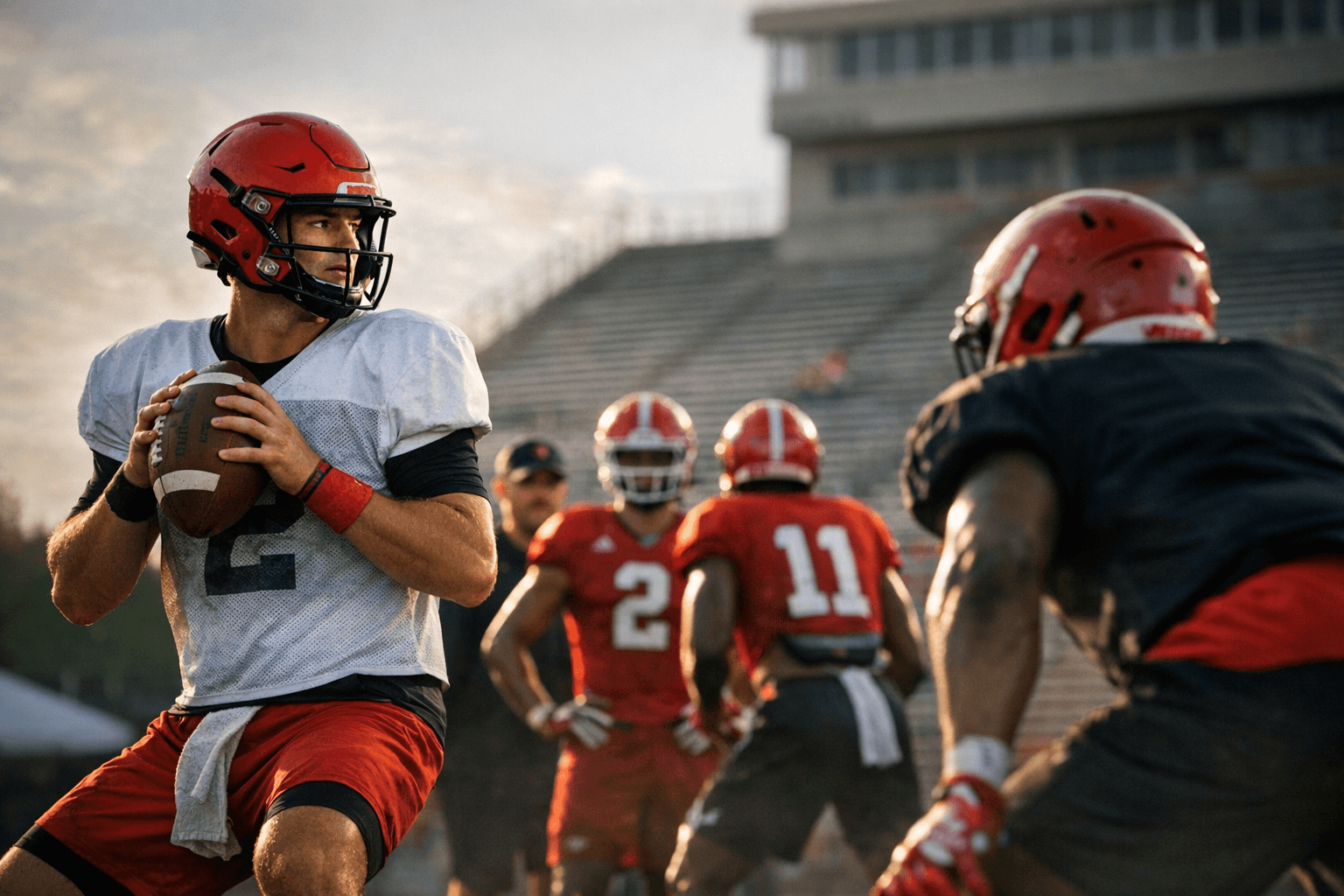
The 2026 win-path attached to this indicator runs through the playoff bracket. Youngstown State's first-round exit last November illustrated what happens when a defense can stop the run and sit on short throws: the offense stalls at critical moments. A genuine explosive-play threat at receiver changes the calculus for defensive coordinators, keeps safeties from cheating downhill, and extends Brungard's rushing lanes in the process.
Indicator Three: Third-Down Conversion Chemistry
Brungard's 68.7 percent completion rate suggests a quarterback who processes quickly and delivers accurately under pressure. But third-down conversion rate is about something more specific: do the receiver and the quarterback read the situation identically? Route adjustments against different coverages, subtle stem variations, and late-developing breaks all require reps together to synchronize.
This is where the competition among Jenkins, Walters, Dandridge, and Smith becomes most meaningful. The receiver who shows the ability to win third-and-medium against press coverage in spring practice is the one Brungard will default to when the offense needs a first down in November. Historically, FCS programs that identify a reliable third-down chain-mover in spring outperform projections in close conference games, exactly the kind of one-score MVFC games where Youngstown State's season will be decided.
The Cornerback Question
While the offensive conversation dominates, the defensive backfield carries equal weight in any honest assessment. Four cornerbacks from last season's roster have departed, leaving a unit that must be rebuilt almost from scratch at a critical position.
Dev Holman, a two-time All-PFL selection transferring from Butler, enters as the most credentialed candidate and the likely frontrunner for one starting spot. Darvens Tunis, a Shippensburg transfer who made nine starts as a redshirt freshman, provides competitive depth with meaningful experience. The coaching staff's willingness to run aggressive pressure packages in the fall will depend heavily on whether those two, and whoever emerges alongside them, can hold coverage without help in single-high looks.
What Spring Resolves
Youngstown State isn't a rebuild project. Brungard's presence alone makes the Penguins a legitimate MVFC contender on paper, a conclusion the Walter Payton Award committee already validated. But contention on paper and contention in November are separated by exactly the kind of positional battles that spring camp is designed to settle. The receiver competition will tell scouts and opposing coordinators whether Brungard has a true alpha target in 2026. The cornerback competition will tell the coaching staff whether the defense can be trusted to win games independently. Both answers need to be yes for Youngstown State to advance past the first round of the FCS playoffs for the first time since 2023.
This article was produced by Prism’s automated news system from verified source data, official records, and press releases, then run through automated quality and moderation checks before publishing. The system is built and supervised by the people who set the standards it runs under. Read our full AI policy.
Did this article answer your question?