FCS Playoff Committee, Army-Navy Executive Order Headline Offseason Podcast
The FCS Oversight Committee just voted to formally reward all-D1 schedules in at-large selection, and Trump's Army-Navy executive order may force the FCS quarterfinals and Celebration Bowl to shift dates.
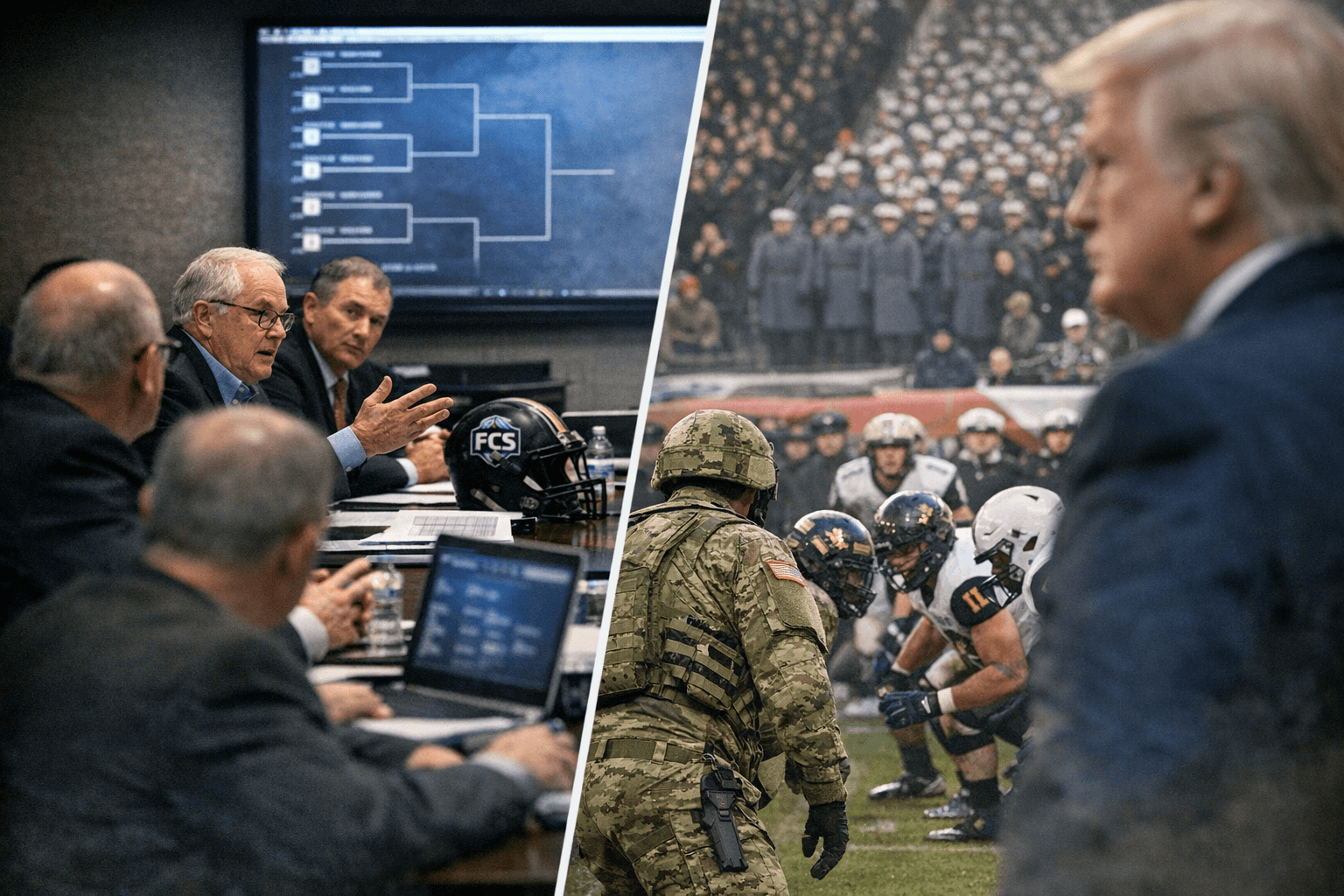
The FCS Oversight Committee quietly rewired how playoff resumes get evaluated this offseason, and a presidential executive order signed at the White House is now rippling across the college football calendar in ways that could directly hit FCS quarterfinals and the Celebration Bowl. HERO Sports Senior FCS Analyst Sam Herder breaks it all down in a 36-minute solo episode of FCS Football Talk, released March 24, covering five distinct policy developments that will shape the 2026 season and beyond.
Playoff Committee Formally Rewards All-D1 Schedules
The most consequential news for FCS programs comes straight from the FCS Oversight Committee. The FCSOC voted to amend the recommended policy language to allow the FCS Championship Committee to give more consideration to teams that have played all Division I opponents and/or a greater number of Division I opponents. Specifically, it approved the following language: "The committee will give more consideration to teams that have played all Division I opponents and/or a greater number of Division I games."
This is a formalization of what the committee had previously implied but never codified so directly. Each playoff committee member can weigh things differently when it comes to selection criteria, ranging from overall record, D1 wins, ranked wins, strength of schedule, eye test, insight from other committee members, or utilizing the FCS media and coaches polls. The new language removes ambiguity: teams that schedule non-D1 opponents are now explicitly at a disadvantage in the at-large race.
The practical stakes are real. Non-D1 wins still count on a playoff resume, but scheduling non-D1 opponents can potentially hurt a team because it's one less opportunity at a D1 win. Programs sitting on the bubble in November will feel this most acutely — a single FCS win over a Division II or NAIA opponent could cost a team a higher seed or an at-large bid altogether.
The Championship Game Date Could Move
The second major development Herder covers involves the FCS title game calendar. The FCS championship game is currently scheduled for Monday, January 4. With the NFL regular season ending January 10, the NCAA is looking into potentially moving the FCS title game to January 11; the FCSOC approved a Legislative Relief Waiver to permit the final date for postseason competition to occur on the second Monday of January in 2027 (January 11, 2027).
This is not a done deal. A legislative relief waiver provides appropriate notice in the championship planning process, and the committee's proposal to modify the final date for postseason competition in FCS will be considered during the June 2026 legislative process. For at least 2026 and 2027, the title game will be played at FirstBank Stadium in Nashville, Tennessee, home of the Vanderbilt Commodores, due to renovations beginning at Toyota Stadium following the 2025 title game. If the date moves to January 11, Nashville will host a championship under a shifted calendar for the first time.
Trump's Executive Order and the FCS Scheduling Collision
The most politically charged topic in the episode is the executive order that President Donald Trump signed at the White House. Trump signed the "Preserving America's Game" executive order, vowing to protect the Army-Navy game's time slot from College Football Playoff expansion. The order states that the recent and potentially ongoing expansion of the College Football Playoffs and other postseason college football games threatens to encroach upon the second Saturday in December, a date traditionally reserved exclusively for "America's Game."
The language of the order is sweeping. The executive order states that "no college football game, specifically college football's CFP or other postseason games, be broadcast in a manner that directly conflicts with the Army-Navy Game." To support the initiative, the executive order instructs the Federal Communications Commission and the United States Department of Commerce to work alongside the NCAA, College Football Playoff officials, and television networks to avoid overlapping game times.
For the FCS, the collision point is December. The Army-Navy game is scheduled for December 12, 2026, at MetLife Stadium in East Rutherford, New Jersey, and the game remains in its usual slot on the second Saturday of December. That same window has historically housed the FCS quarterfinals and the Celebration Bowl. As of the 2025 season, two FCS conferences usually do not participate in the FCS tournament — the Mid-Eastern Athletic Conference and Southwestern Athletic Conference — and since 2015, their champions play each other in the Celebration Bowl, the only active bowl game featuring FCS teams.
The Celebration Bowl conflict is especially pointed. With most college football broadcasts running three to four hours, the Celebration Bowl was still live when Army-Navy began, placing HBCU football's premier postseason event directly inside the same four-hour mid-December window now being discussed as "exclusive." If exclusivity becomes the prevailing language around December scheduling, then future calendar reshuffling becomes a question of priorities; history suggests that when space tightens, HBCU football is more often asked to move than to be defended.
The order itself may face legal headwinds. President Trump hopes to block TV competition for the Army-Navy game, but the law might disagree. The president acknowledged that the administration "will probably get sued at some point," an apparent reference to First Amendment concerns raised over government mandates for specific programming.
Changes to the Targeting Rule
Herder also addresses changes to the targeting rule, one of the most debated calls in college football at every level. While the specific rule text is still being finalized through the legislative calendar, this discussion is particularly relevant in the FCS, where targeting enforcement has carried significant game-management implications. Any shift in how officials call, review, or penalize targeting will affect game flow and player safety protocols across the 24-team playoff field.
A New Subdivision at the Top of Division I?
Perhaps the most structurally significant topic on the episode is the possibility of a new subdivision forming at the top of Division I. This conversation has been building for years as the gap between resource-rich Power Four programs and the rest of FBS has widened dramatically. A formal new tier above FBS would have cascading implications for FCS: it could redefine what "Division I" means for at-large selection purposes, reshape the competitive landscape for FCS programs that schedule FBS opponents as resume-builders, and potentially alter the long-term viability of FBS-to-FCS scheduling partnerships that FCS programs depend on for revenue.
The Show and the Prior Episode
The March 24 episode runs 35 minutes and 54 seconds, with Herder going solo through the news-bits segment. It is one of two recent installments of FCS Football Talk, presented by HERO Sports and BetMGM. The previous episode, released March 18, ran 53 minutes and 11 seconds and featured KC Smurthwaite, a HERO Sports writer and college athletics consultant. That conversation covered future outlooks for conferences including the UAC and Summit League, future realignment dominoes, the college football landscape, and private equity in the FCS playoffs — a separate but interconnected thread of offseason uncertainty.
The show's format shifts with the season. During the regular season, FCS Football Central Senior Editor Zach McKinnell joins Herder as co-host; in the offseason, Herder brings in guests from across the FCS for deeper conversations. The podcast is available on Apple Podcasts, Spotify, iHeart, and Spreaker, where full transcripts are available for both recent episodes.
The June 2026 legislative calendar is where most of these conversations converge — the championship date proposal, the at-large criteria language, and the targeting rule changes all run through that process. Between now and then, how aggressively the executive order gets enforced and whether legal challenges materialize will determine just how much the December calendar gets remapped.
This article was produced by Prism’s automated news system from verified source data, official records, and press releases, then run through automated quality and moderation checks before publishing. The system is built and supervised by the people who set the standards it runs under. Read our full AI policy.
Did this article answer your question?