How FCS football was created by a split in Division I
FCS was not a branding tweak. It was the NCAA’s answer to college football’s awkward middle class, and the playoff-first model still defines the subdivision.

FCS football exists because college football had a structural problem it could not solve with one national setup. The NCAA built a three-division system in 1973 to align like-minded campuses around fairness, competition and opportunity, then split Division I for football in 1978 because the sport needed two different paths, not one oversized category.
Why Division I split in the first place
The point of the split was practical. NCAA membership language describes Division I-A as the principal football schools and Division I-AA as the rest of the football-playing schools, which tells you the divide was about institutional profile as much as on-field results. Some schools were built to chase major bowls and national visibility; others needed a championship structure that fit their scale, budget and football footprint.
That is the real origin story of what is now called the Football Championship Subdivision. The subdivision was not invented to give smaller schools a softer label. It was created to solve the problem of how to organize Division I football when schools were competing at different levels of resources and ambition.
The championship that gave the subdivision its identity
At the 72nd NCAA Convention in January 1978 in Atlanta, Georgia, the membership voted to establish the Division I-AA Football Championship and a statistics program for the division. That vote matters because it made the postseason the center of the subdivision from day one. The new group was not built around bowls or committee invitations. It was built around a bracket.
The first championship was a four-team, single-elimination tournament in Wichita Falls, Texas. Florida A&M beat Massachusetts 35-28 in the inaugural title game, and ABC televised it. That detail says more than a trophy ever could. From the start, Division I-AA was sold as real championship football, with a direct path to a title and enough national exposure to put the game on television.
Why the bracket mattered so much
A four-team field might sound modest now, but it established the subdivision’s core argument: if you want to crown a champion on the field, you can do it in college football without relying on bowls. That was the philosophical break from the top tier of the sport, and it still shapes how fans read the FCS today.
The campus-based format also gave the subdivision a different feel. Instead of sending teams into a bowl ecosystem where postseason access depends on arrangements outside the field, the NCAA gave Division I-AA an elimination tournament that could grow on its own terms. That model became the FCS calling card long before the subdivision got its current name.
How the playoff grew into a full national path
The field expanded to eight teams in 1981, then to 12 in 1982. That 12-team format was not just a bigger bracket on paper. Eight teams played first-round games at campus sites, while the top four seeded teams received byes, which meant the NCAA was already balancing access, seeding and home-site value in the early 1980s.
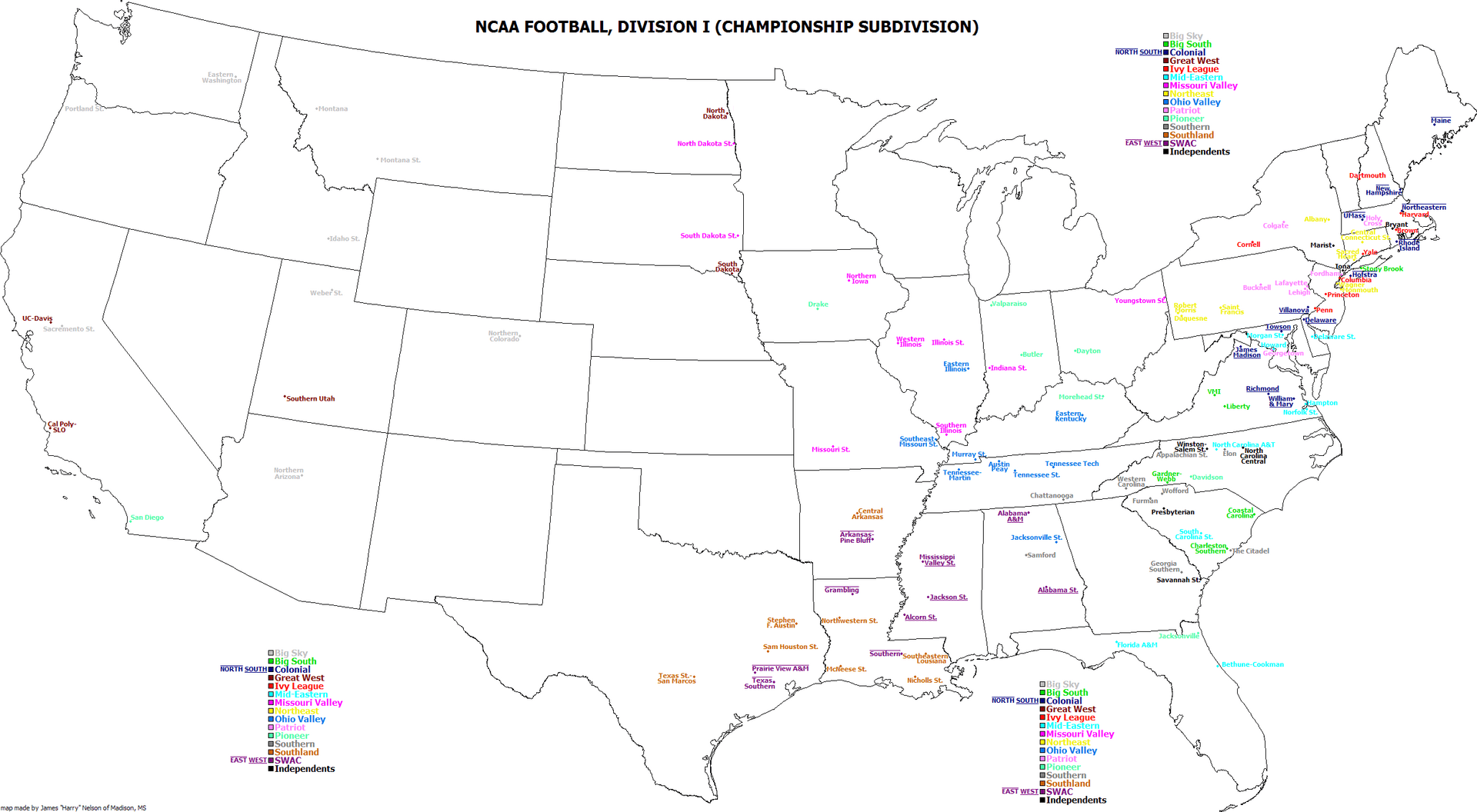
The championship expanded again to 16 teams in 1986, with each team playing a first-round game. That growth is the clearest sign that the subdivision’s logic worked. The NCAA did not have to force the playoff model into football. It kept widening because programs and fans accepted that a national title could be earned through a bracket, one campus site at a time.
What FCS means compared with FBS
The modern split is still easy to understand if you compare the postseason paths. The NCAA says 128 FCS members conduct their postseason within an NCAA bracketed tournament. By contrast, 134 FBS programs play in bowl games and are eligible for the national championship through the College Football Playoff.
That difference is the whole identity of the subdivision in one sentence. FCS is the place where the postseason is still a tournament, which means the path to a title is more direct and more open. It also helps explain why the subdivision remains attractive to schools that are not built to live in the bowl economy. The playoff is not a side feature in FCS. It is the product.
Why the name change mattered
Division I-A and Division I-AA were renamed the Football Bowl Subdivision and Football Championship Subdivision in the 2006-07 period. The rename did not create a new level of football. It clarified what each side of the split was for.
The old labels described where schools sat in the hierarchy. The new labels describe how they finish. FBS points to the bowl structure that has long defined the top of the sport, while FCS tells you the title comes through a championship bracket. That is a cleaner, more honest way to explain the divide to anyone trying to understand college football’s structure.
Why this history still explains the present
The original logic behind the split still shapes the questions people ask about FCS football today. Playoff access works differently here because the subdivision was built around a national tournament, not around a bowl system with a handful of major invitations. Resource gaps matter here because the whole structure was designed to acknowledge that Division I schools were not all operating on the same football model.
That is why FCS identity has stayed so durable. The subdivision was created to make college football more workable for schools with different institutional profiles, then given a championship structure that fit that mission. The result is a level of the sport where the bracket still matters most, and where the path to legitimacy has always run through the postseason, not around it.
FCS football is still living inside the solution the NCAA designed in 1978. The names have changed, the field has grown, and the stakes have gotten bigger, but the defining idea has not moved: this is the subdivision where the title is won on the field, through a playoff built for schools that needed their own way in.
This article was produced by Prism’s automated news system from verified source data, official records, and press releases, then run through automated quality and moderation checks before publishing. The system is built and supervised by the people who set the standards it runs under. Read our full AI policy.
Did this article answer your question?