Iowa’s FCS transfers making immediate impact in spring practice
Iowa's spring is already validating a familiar roster bet: FCS transfers are bringing real reps, real production, and almost no guesswork.
Iowa’s FCS pipeline is paying off fast
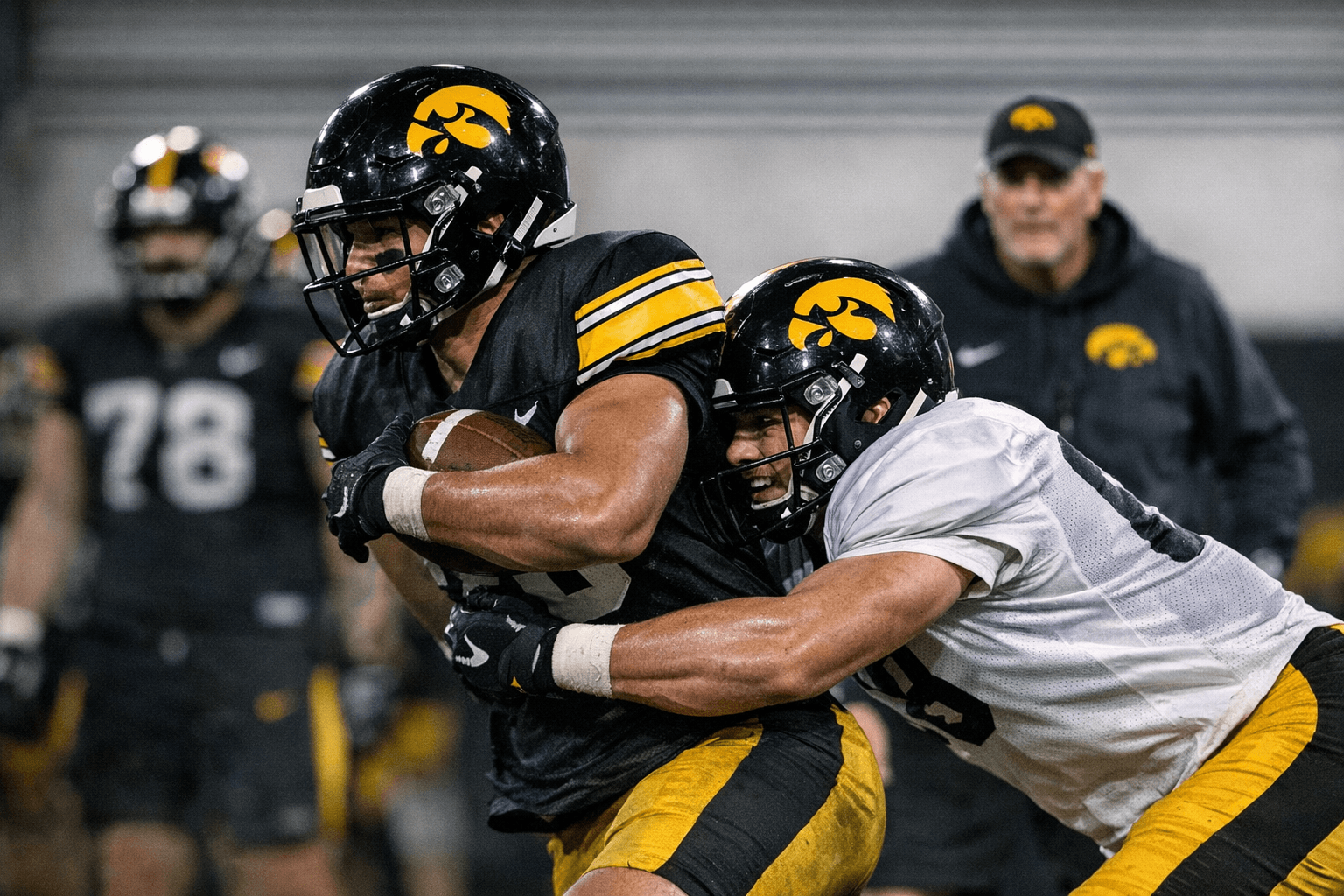
Iowa did not spend the offseason chasing splashy portal headlines. It built around players who had already produced in real games, and spring practice is showing why that matters. The Hawkeyes added 16 transfers to the 2026 roster, opened spring ball on March 25, and entered camp with 102 players while needing to replace 27 seniors from a 9-4 team that finished sixth in the Big Ten and beat Vanderbilt in the ReliaQuest Bowl.
That is the broader story here. Iowa’s FCS additions are not long-shot developmental bets. They fit the program’s long-standing preference for mature players who already know how to handle contact, pressure, and weekly game plans. In a portal era full of upside speculation, Iowa is betting on something simpler and often smarter: proven college football.
Why the FCS has become a target
The Hawkeyes have always valued fit over noise under Kirk Ferentz, and the transfer market has only sharpened that instinct. FCS players often arrive with a profile that Power programs can trust immediately: they have played enough snaps to show who they are, they have usually been older and more physically developed, and their production comes against live competition, not summer hype.
That lowers the projection risk. A receiver who has already won contested catches, a defensive tackle who has logged dozens of starts, or a running back who has carried an offense through a full season can be slotted into a role much faster than a player whose résumé is mostly traits. Iowa’s spring is a case study in how that market works when a program needs dependable help right away.
Tony Diaz is already looking like a day-one piece
The clearest example is Tony Diaz from UTRGV. Iowa’s roster lists him with 2,216 receiving yards, 95 catches, and 29 touchdowns for his career, along with 15 tackles, two interceptions, two forced fumbles, two fumble recoveries, one defensive touchdown, and one punt return. That is a college résumé with two-way value and real production baked in.
More importantly, Diaz is already showing it in spring work. Local coverage on April 9 and 10 reported that he was making a strong impression in practice and hauled in a touchdown catch during a media-viewing session. He has also taken first-team reps, and the takeaway is obvious: Iowa did not add him to wait around. It brought him in because his skill set can help now, even with a modest frame.
Diaz matters because he gives Iowa something the offense has not always had in abundance, a receiver who can win a competitive throw and survive the weekly physical grind. That is exactly the kind of lower-risk, higher-certainty add that makes FCS players attractive to a power-conference staff.
Evan James adds the speed element Iowa has needed
If Diaz is the possession and toughness piece, Evan James from Furman is the vertical release valve. He is described as a former FCS freshman All-American, and that matters because it signals more than raw speed. It says he has already translated tools into production against college competition.
Iowa’s official roster lists James among the 2026-27 transfers, though his bio page was not yet fully populated in the available materials. Even so, the fit is easy to see. Iowa has often been forced to manufacture explosive plays instead of leaning on them, and James gives the Hawkeyes a chance to stretch the field in a way that changes how defenses line up.
The best FCS transfers often solve one problem cleanly. James looks like that kind of solve. He does not need to become a new player in Iowa City. He just needs to bring his speed into a system that can actually use it.
Brice Stevenson brings a veteran interior presence
The defensive front is getting the same kind of help. Brice Stevenson from Holy Cross is taking first-team reps and is expected to help against the run after arriving with 32 games and 26 starts of experience. That is the exact profile Iowa likes up front: experienced, sturdy, and ready for the weekly trench work that defines Big Ten football.
Iowa’s roster also notes a family line that reinforces the football pedigree. Stevenson’s father, Robert Stevenson, played at Florida State, where he was a team captain, All-American, and All-ACC honoree. That does not make Brice Stevenson productive by itself, but it does underline the kind of maturity and background Iowa tends to value when it needs a lineman who can step in without a long adjustment period.
For a defense built on controlling the line, a player with that kind of start total is not a luxury. He is a stabilizer.
L.J. Phillips Jr. may be the biggest swing of all
The name with the most obvious ceiling is South Dakota running back L.J. Phillips Jr., listed by Iowa as Lendon Phillips, Jr., a 5-foot-9, 225-pound junior from Wichita, Kansas. He rushed for 1,921 yards and 19 touchdowns last season, then earned first-team All-America honors from Walter Camp, AFCA, and Sports Illustrated, along with second-team recognition from the Associated Press and Phil Steele.
That is not speculative talent. That is a back who already dominated at his level. Iowa views him as a major part of its 2026 backfield rotation, and that makes perfect sense given the school’s identity. The Hawkeyes have long relied on running backs who can handle volume, absorb contact, and keep the offense on schedule. Phillips has already shown he can do all three.
His addition also says something larger about the FCS-to-FBS pipeline. When a player arrives with that much production and that many honors, the question is not whether he can play college football. The question is how quickly a bigger program can scale his impact.
The defensive depth pieces matter too
Not every transfer has to become a headline to matter. Kahmari Brown from Elon is a rotational pass-rush piece, which gives Iowa another body who can help the edge rotation stay fresh. Anthony Hawkins from Villanova is a battle-tested defensive back competing for snaps, and Iowa’s roster confirms him as a Hawkeye transfer even though his detailed bio was not visible in the available materials. Emmanuel Olagbaju from North Dakota adds needed size to the defensive front, which is exactly the kind of practical addition that keeps a spring depth chart honest.
These are the kinds of players that make the whole portal strategy work. Iowa is not just trying to hit one home run. It is stacking useful pieces across the roster so the spring becomes a competition for roles, not a scramble to find bodies.
What Iowa’s spring is really telling us
The Hawkeyes’ spring has played out under extra scrutiny, too. On April 14, the NCAA announced infractions tied to impermissible contact in the transfer portal, a reminder that roster building has become its own high-stakes frontier. Iowa also plans an open spring practice at Kinnick Stadium on April 25, which should offer another public look at how these newcomers are settling in.
But the bigger lesson has already surfaced. Iowa is proving that the FCS can function as a ready-made talent market for Power programs that know what they need. Diaz, James, Stevenson, Phillips, Brown, Hawkins, and Olagbaju each arrive with a different skill set, but the shared trait is the one that matters most: they have already done it in college football.
That is why the Hawkeyes look so purposeful this spring. They are not waiting on projection. They are leaning into production, and that is often how a roster gets better fastest.
This article was produced by Prism’s automated news system from verified source data, official records, and press releases, then run through automated quality and moderation checks before publishing. The system is built and supervised by the people who set the standards it runs under. Read our full AI policy.
Did this article answer your question?