Missouri Valley tops 2026 FCS conference power rankings
The Missouri Valley still leads, but the Big Sky and UAC are close enough to keep the 2026 FCS title race crowded at the top.
The spring map of FCS football starts with playoff math: the NCAA bracket is still 24 teams, with 10 automatic qualifiers and 14 at-large bids, so the leagues that can stack multiple playoff threats matter most. That is why the Missouri Valley, Big Sky, and United Athletic Conference sit on one tier, while realignment is reshaping the rest of the board around them.
1. Missouri Valley Football Conference

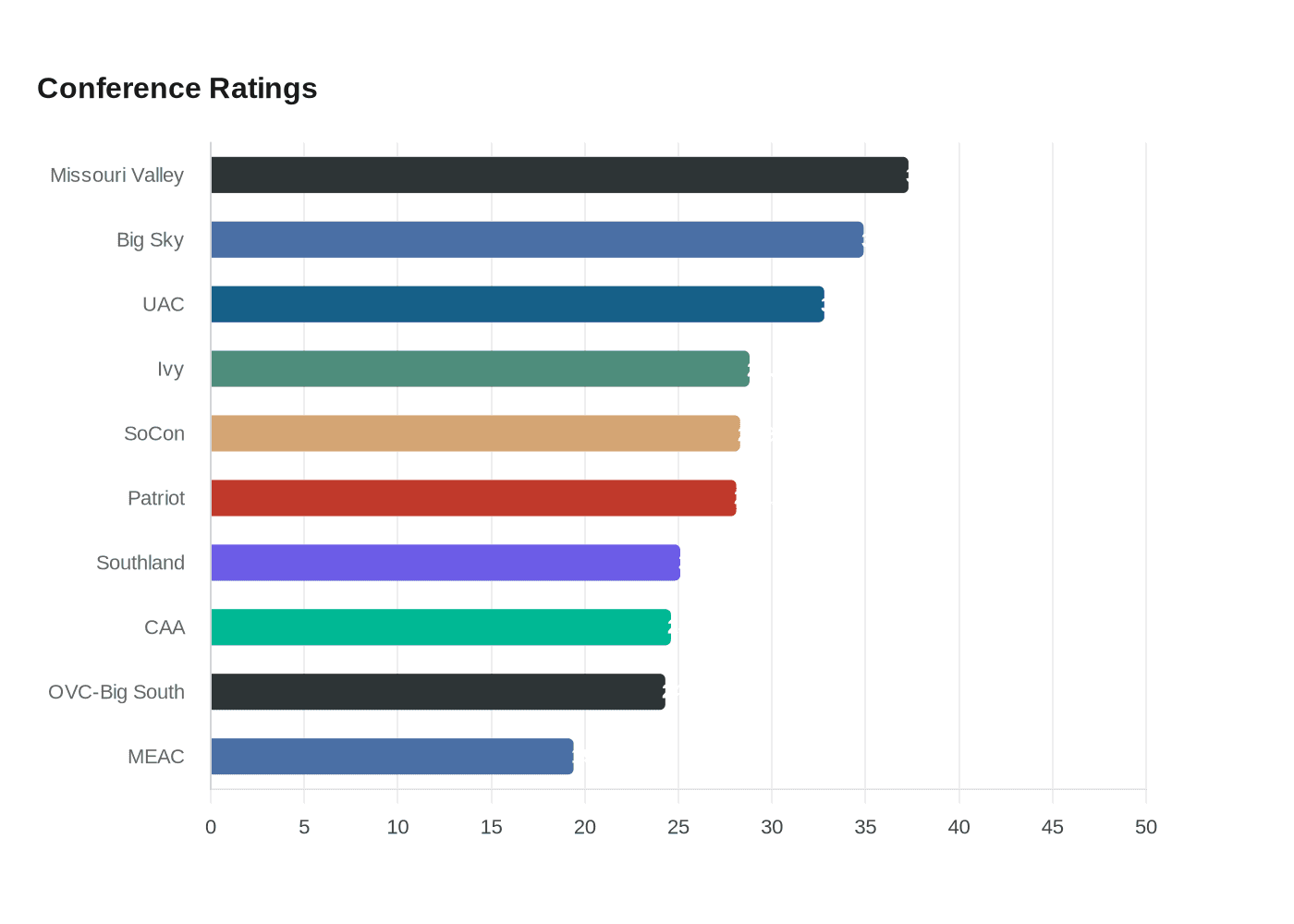
The MVFC stays on top at 37.3 because it still looks like the deepest weekly grind in the subdivision, not just a league with one flagship program. Six of its nine remaining teams grade as legitimate top-20 FCS programs, Illinois State just played for the national title, and the conference has now reached 15 straight FCS Championship Games.
2. Big Sky Conference
The Big Sky is right on the Missouri Valley's heels at 34.9, and Montana State's 35-34 overtime win over Illinois State in the championship game is the kind of proof that keeps the West in the national title conversation. Justin Lamson earned Most Outstanding Player honors in that game, Brent Vigen's Bobcats ended a 41-year title drought, and the league's 11-full-member footprint only makes its depth harder to ignore.
3. United Athletic Conference
At 32.8, the UAC remains firmly in the elite tier even after realignment moved Southern Utah and Utah Tech out of the league. That number matters because it says the conference still has enough top-end and week-to-week resistance to challenge for multiple playoff bids instead of leaning on one lone contender.
4. Ivy League
The Ivy League's 28.8 rating makes it the ranking's biggest conversation starter, because fourth place is both a compliment and a challenge to the league's postseason ceiling. Yale's road win at Youngstown State and its competitive showing against Montana State gave the Ivy real credibility, but the lack of a deep playoff run still leaves the conference with something to prove.
5. Southern Conference
The SoCon checks in at 28.3, and Tennessee Tech's arrival on July 1, 2026 gives the league another program looking to raise its ceiling fast. Tennessee Tech described the move as a way to accelerate its road to future athletic success, and the expansion to 11 teams adds another layer to a conference that already survives on tough Saturdays and narrow margins.
6. Patriot League
The Patriot League is almost level with the SoCon at 28.1, but its real story is the arrival of Villanova and William & Mary, which pushes the league to 10 football members for the first time. Jennifer Heppel called Villanova's addition a "significant and exciting moment," and that kind of upgrade changes how the league's automatic-bid race will feel from September through November.
7. Southland Conference
The Southland sits at 25.1, which keeps it in the middle of a tight pack where every nonconference swing game matters. In a 24-team playoff format with only 14 at-large spots, a league in this range can still influence the bracket, but it needs a cleaner résumé than the top three conferences.
8. Coastal Athletic Association
The CAA lands at 24.6, and the number reflects how much value it lost when Villanova and William & Mary headed to the Patriot League. That is the balance-of-power shift inside the subdivision: a once-broad league is being trimmed while other conferences are adding proof points and playoff pressure.
9. Ohio Valley Conference-Big South
At 24.3, the OVC-Big South is close enough to the Southland and CAA to keep the lower middle of FCS football crowded. The gap between these leagues is tiny enough that a few results in September can determine whether a conference feels like a one-bid path or a real at-large threat.
10. Mid-Eastern Athletic Conference
The MEAC's 19.4 rating puts it well below the scholarship-heavy leagues above it, but that does not erase the conference's place in the sport's cultural center. The number shows how far the playoff-resumé race still leans toward depth, while the MEAC's value comes from visibility, tradition, and the weekly stage it gives HBCU football.
11. Southwestern Athletic Conference
The SWAC is at 16.5, and that gap from the MEAC tells you the lower tier of the rankings is less about headlines than about structural strength. Even so, the league remains a major part of FCS football's social footprint, where game-day atmosphere and rivalries still carry national weight even when the power score stays modest.
12. Northeast Conference
The NEC's 16.2 rating barely trails the SWAC, underscoring how compressed the bottom of the scholarship FCS world can be. It also shows why the NEC's path is different from the power conferences: every title push has to be built with precision, because there is almost no margin to recover from a bad October.
13. Pioneer Football League
The Pioneer Football League occupies the 13th slot as the FCS's only non-scholarship conference, which makes it a structural outlier more than a simple last-place entry. That separation is exactly why the ranking is useful: it shows not just who is strongest, but which leagues are built to survive the playoff grind and which live in a different competitive economy altogether.
This article was produced by Prism’s automated news system from verified source data, official records, and press releases, then run through automated quality and moderation checks before publishing. The system is built and supervised by the people who set the standards it runs under. Read our full AI policy.
Know something we missed? Have a correction or additional information?
Submit a Tip