MVFC stays atop FCS conference rankings amid major realignment shakeup
The MVFC still has the deepest résumé in FCS football, but realignment is tightening the chase behind it. With bids and seeding on the line, the Big Sky, UAC and CAA are fighting to reshape the 2026 power map.

The MVFC still owns the standard
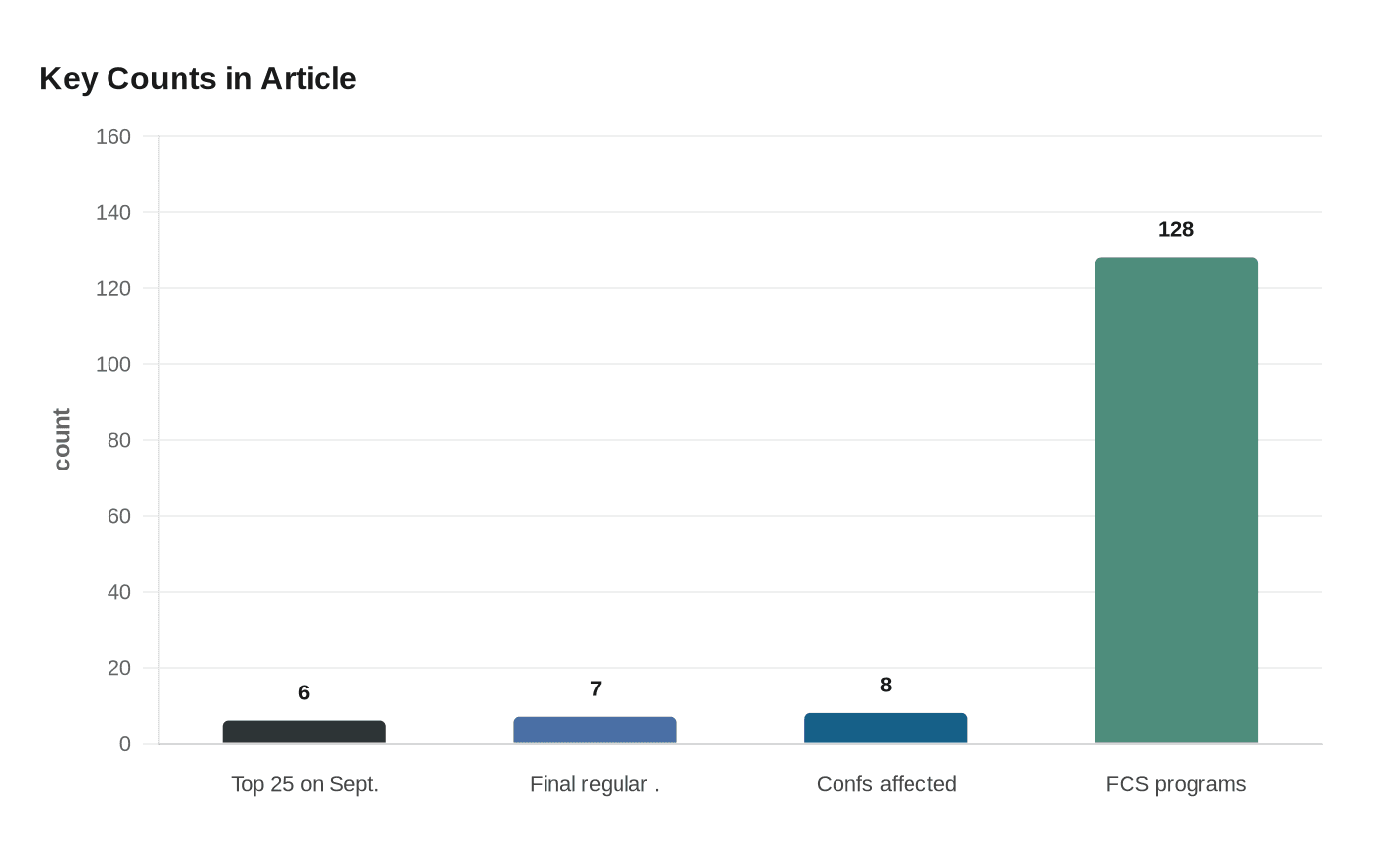
Zach McKinnell’s latest conference power conversation lands on a familiar answer, even as the ground under FCS football keeps shifting. The Missouri Valley Football Conference remains the benchmark because its depth still separates it from everyone else: six MVFC teams were in the Stats Perform Top 25 on Sept. 1, 2025, and seven finished in the final regular-season poll, more than any other league.

That kind of weekly density matters more than branding. In a 24-team playoff bracket, where 11 teams get automatic bids and 13 more enter as at-large selections, a conference’s value is measured by how many teams can survive the season with a résumé strong enough to get a bid, a seed, or both. The MVFC has been the league that can absorb a loss on Saturday and still look like a national title threat on Sunday.
McKinnell’s read, discussed on The Bluebloods podcast with Timothy Rosario of FCS Football Central, makes the same case through a 2026 lens: the MVFC is still No. 1, but the gap behind it is no longer static. The rest of the subdivision has spent the spring reshuffling, and that kind of movement usually shows up in November when the committee starts sorting out who gets in and who gets left in the at-large scramble.
Realignment is changing the shape of the race
The biggest reason the ranking conversation feels different this year is that the map itself is changing. The NCAA said on April 3, 2026 that eight of the 13 FCS conferences are affected by realignment, and the subdivision will have 128 programs. That is not a cosmetic tweak. It means the path to playoff access, seeding and national perception is being redrawn while teams are still building rosters for the next season.
The most consequential exits and arrivals hit the conferences McKinnell is weighing against the MVFC. North Dakota State is leaving the Missouri Valley for the Mountain West in 2026, a move that changes the league’s most recognizable brand and its weekly ceiling. Sacramento State is joining the Mid-American Conference as a football-only member starting in 2026, another signal that football power is increasingly leaking into broader FBS realignment lanes.
At the same time, the Big Sky is adding Southern Utah and Utah Tech beginning July 1, 2026, giving the league 11 full members, according to Southern Utah. Those additions matter because the Big Sky has been the MVFC’s most credible national challenger for years, and the conference itself has not been shy about its ambitions. In announcing the additions, it called itself “the nation’s preeminent FCS conference.”
That is not just a slogan. It is a statement of intent in a race where every extra ranked team can swing the seeding conversation and where one more quality win can be the difference between hosting in December and traveling on the road.
Why the Big Sky, UAC and CAA are closing the perception gap
McKinnell’s ranking debate centers on the leagues behind the MVFC because they are the ones most likely to affect the playoff bracket in 2026. The Big Sky remains the primary challenger. The United Athletic Conference is part of the top-tier conversation. And the Coastal Athletic Association is entering a different kind of test, one shaped as much by perception as by results.
The Big Sky’s case is straightforward: it keeps adding breadth and ambition at the same time. Southern Utah and Utah Tech strengthen the footprint and the depth of the league, and that depth is what postseason committees respond to when they compare conference résumés. A league that can field 11 full members and still project itself as elite can make a strong argument that its middle tier is becoming more dangerous, not less.
The UAC is harder to pin down, but that is part of why it belongs in the conversation. In a year where realignment has scattered the league structure, the most dangerous conferences are the ones that can turn uncertainty into opportunity. If the UAC keeps stacking credible weekly matchups, it can keep forcing its way into the same national conversation as the Big Sky, even if the MVFC still sits at the top.
The CAA, meanwhile, is navigating a different challenge. Its perception is shifting as it absorbs the loss of multiple football powers, and that kind of change does not happen overnight. In FCS, reputation can lag behind reality for a season or two, but playoff committees and poll voters eventually notice when a league loses too many anchor programs. The CAA’s next test is not just whether it can replace those names, but whether it can preserve the week-to-week quality that makes its best teams look battle-tested in December.
The Patriot League move matters for more than geography
The Villanova and William & Mary decisions to join the Patriot League as football associate members beginning in 2026 show how quickly the conference hierarchy can be altered by one or two moves. The Patriot League said Villanova becomes its 10th football member, and league leaders framed the addition as a major boost. Villanova also pointed to the league’s geographic footprint as a strong fit, which is exactly the kind of practical argument that matters when programs look for stability in a volatile realignment cycle.
This is where the bracket math starts to intersect with real life. A move that helps the Patriot League on paper can also make the CAA’s path steeper, because losing proven programs changes how opponents view the league’s depth and how the committee treats its middle of the pack. In FCS, conference strength is not an abstract debate. It decides who can afford one bad loss, who can still secure an at-large bid, and who has enough reputation left to survive a crowded seed discussion.
What to watch when the 2026 season starts
McKinnell’s ranking is really a guide to where the 2026 power line sits. The MVFC still owns it because its résumé is built on numbers no one else has matched recently. The Big Sky is the clearest challenger because it is expanding in ways that support both depth and identity. The UAC is forcing its way into the upper tier, while the CAA has to prove that perception can survive loss of personnel.
The practical stakes are immediate. In a 24-team playoff, the right conference label can be worth a seed, a home game or a safer at-large path. The wrong label can mean a road trip in December and a much shorter national-title runway. That is why this debate matters now, before a single 2026 snap is played: the conference hierarchy is not just about bragging rights anymore, it is the architecture of the FCS playoff race.
This article was produced by Prism’s automated news system from verified source data, official records, and press releases, then run through automated quality and moderation checks before publishing. The system is built and supervised by the people who set the standards it runs under. Read our full AI policy.
Did this article answer your question?