Opta spotlights FCS programs sustaining streaks amid portal chaos
Opta’s FCS lens shows how rare real program stability has become, with North Dakota State’s dynasty still the standard as portal churn reshapes the rest of the subdivision.
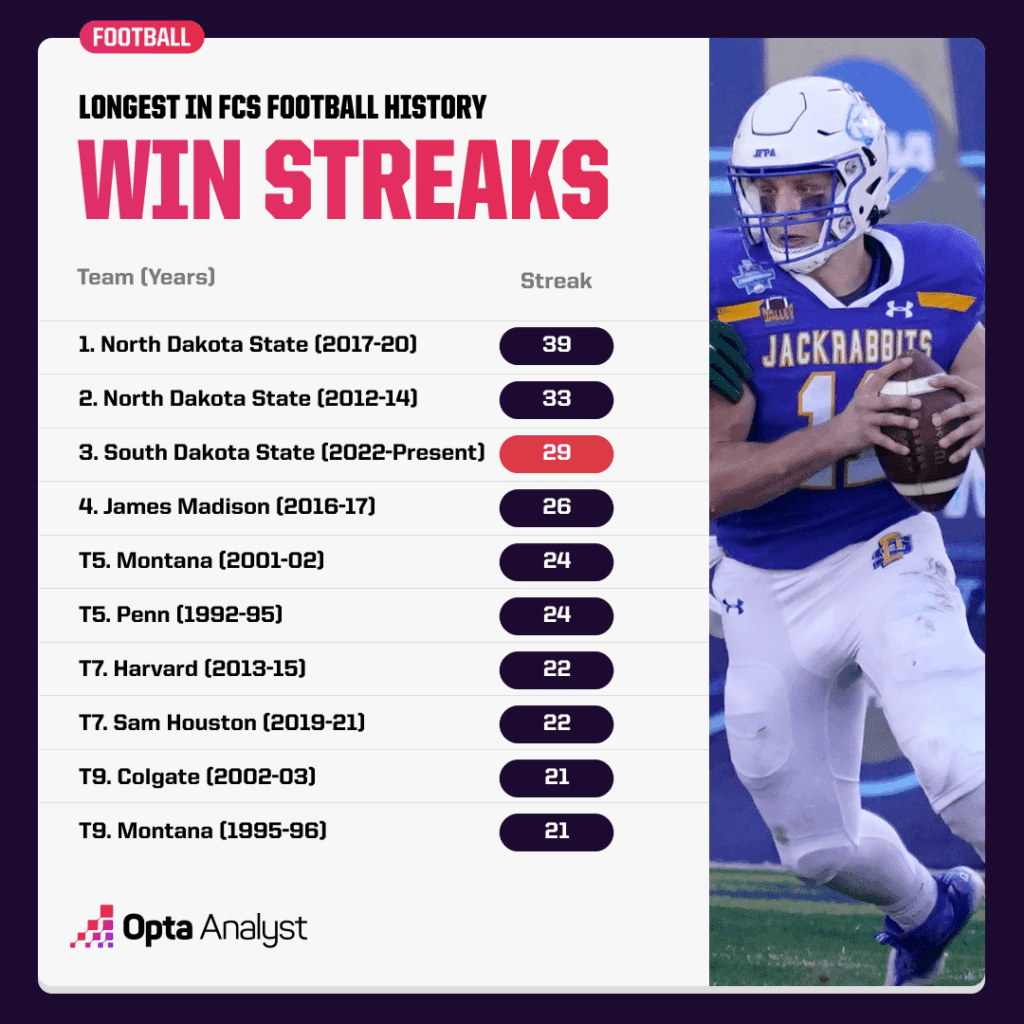
FCS streaks have become a stress test for survival
The most revealing thing about FCS football right now is not just who is winning, but who is still winning after the portal, realignment, and roster churn have done their best to tear continuity apart. Opta’s spotlight on streaks lands in a subdivision where stability is no longer the default, and that makes every long run matter more than a one-off playoff push.
Stats Perform has built its FCS platform around that reality. Its coverage includes the FCS Top 25, weekly player awards, and the annual Stats Perform FCS Awards Banquet, a package designed to keep the subdivision visible in a crowded college sports landscape. The company says its FCS initiatives, helped by the FedEx Ground partnership, generated more than 18 million media impressions during the 2023/24 season, a sign that the sport’s hidden strength is still finding an audience.
Why streaks matter more now than they used to
The FCS has always been defined by a handful of power programs, but the modern version of the subdivision is far more fragile. Transfer-portal movement can strip away a core in one offseason, and conference realignment can alter a team’s path before the season even begins. That is why streaks, especially consecutive winning seasons and championship runs, have become a cleaner measure of whether a program has actually solved volatility.
NCAA history pages and recent FCS coverage both frame streaks as central to the subdivision’s story. The official record book is the archive that preserves those runs, and it also underlines how difficult they are to sustain. In a sport where roster continuity can vanish quickly, a long streak usually means the staff has survived departures, recruited to a system, and kept the standard intact long after a breakthrough season should have faded.
North Dakota State remains the gold standard
No program illustrates that better than North Dakota State. The NCAA says the Bison own an FCS-record nine national championships, the clearest marker of a program that has repeatedly outlasted the chaos around it. Their five-title streak from 2011 through 2015 remains the most famous stretch in subdivision history, and the NCAA says they became the first school ever to win five consecutive NCAA Division I titles.
That run was never just about trophies. It was about continuity at a level that most FCS programs cannot afford to take for granted, from the quarterback room to the lines of scrimmage to the staff structure that keeps systems from collapsing when stars move on. In the modern portal era, North Dakota State’s standard feels even more valuable because it shows what happens when a program’s identity is strong enough to survive both success and turnover.
The Bison also sit at the center of the next phase of the FCS conversation for another reason: the NCAA says North Dakota State will depart the subdivision after its final season in 2025. That makes the program’s place in the streak discussion even more dramatic, because the benchmark will soon leave the league it helped define. The record will remain, but the comparison set changes with it.
The new FCS challenge is not just winning, but keeping the same team together
Recent NCAA and Opta storytelling around FCS football has repeatedly returned to the same theme: top programs are now being judged by how much of their core they can keep. NCAA.com has highlighted why top FCS stars returned to their schools rather than enter the transfer portal, and it has also devoted coverage to conference realignment, a reminder that the instability is not theoretical. It is shaping who returns, who leaves, and who gets a fair shot at building a streak.
That is where the subdivision’s best programs separate themselves. South Dakota State, Montana, James Madison, and Jacksonville State all sit in the broader conversation because each has helped define a different era of FCS credibility, whether through championships, playoff relevance, or the ability to keep winning while the landscape shifts around them. The common thread is not perfection. It is durability.
Frisco, Texas remains the sport’s showcase stage, and Fargo, North Dakota still carries the weight of the dynasty standard. Nashville, Tennessee is part of the broader celebration ecosystem through the awards platform that keeps FCS stars in view. Those places matter because streaks do not live only in standings. They live in the infrastructure that keeps programs visible long enough for their runs to mean something.
What streaks really say about a program
- recruit for fit instead of quick fixes
- develop depth so one portal exit does not break the roster
- keep staff turnover from changing the team’s identity
- survive realignment without losing competitive edge
A long streak in FCS football is less a neat statistic than a referendum on modern program design. The teams that sustain success usually do a few things well:
That is why streaks are such a useful filter. They reveal which programs can absorb the shocks that now define college football and still show up in November with a chance to matter. In the FCS, where media attention has historically been inconsistent, that kind of consistency also helps tell the sport’s story to a larger audience.
The streak that looks most exposed entering 2026
The most vulnerable run entering 2026 is the one tied to North Dakota State’s place in the subdivision itself. The Bison’s dominance still sets the standard, but with the NCAA confirming their exit after 2025, the dynasty will no longer be measured inside the same FCS frame. That does not erase what the program built. It simply means the next chapter of streak-chasing will be written without the subdivision’s most imposing benchmark on the board.
That shift is exactly why Opta’s focus on streaks resonates. In an era defined by portal chaos, the rare FCS program that can keep winning is not just collecting victories. It is proving that structure, development, and identity still matter more than turbulence. The list of schools capable of doing that has never been long, and by 2026 it may be the clearest sign of who truly solved the volatility problem.
This article was produced by Prism’s automated news system from verified source data, official records, and press releases, then run through automated quality and moderation checks before publishing. The system is built and supervised by the people who set the standards it runs under. Read our full AI policy.
Did this article answer your question?