South Dakota State’s rushing offense raises concern entering 2026 run
South Dakota State still has title talent, but its 2025 rushing dip is the one flaw that could decide whether the Jackrabbits reach Nashville or stop short.
Why the rushing game is the playoff lever
South Dakota State still belongs in the championship conversation, but the margin between a semifinal run and a title push may come down to one thing: whether the Jackrabbits get their rushing offense back to its standard. In a program built on line play, efficiency, and physical control, 3.76 yards per carry in 2025 stood out as more than a bad number. It was the kind of crack that elite postseason defenses can widen into a season-ending problem.
That is why the rushing attack is the right place to start the conversation about the 2026 run. South Dakota State does not need a total rebuild. It needs the part of its identity that usually travels in November and December to become reliable again.
What the 2025 numbers actually say
The full picture is more troubling than one weak per-carry average. In Missouri Valley Football Conference play, South Dakota State finished dead last with 1,206 rushing yards on 334 carries, a 3.6-yard average that ranked behind the rest of the league and put the Jackrabbits in the same conversation as the season’s most inefficient ground games. The official team stats showed 154.9 rushing yards per game and 376.4 total yards per game, while the MVFC chart listed SDSU at 355.3 yards of total offense per game, eighth in the league.
That matters because the gap is not just between South Dakota State and its own usual level. North Dakota State led the MVFC at 5.1 yards per carry, a reminder of what championship-caliber rushing efficiency looks like in the same league. When one of the conference’s signature powers is down near 3.6 and another is above 5.0, the difference is not cosmetic. It is structural.
The broader FCS context makes the warning louder. South Dakota State’s 3.76 yards per carry was its worst rushing average since 2015, and most seasons since then have been above 5.0. The Jackrabbits were also grouped with South Carolina State, Lamar, Western Carolina, and Dayton/New Hampshire in the bottom five among winning teams in yards per carry, with three of those programs reaching the playoffs. That is the point: this was not a one-off issue for a rebuilding team. It was a contender-level outlier.
Where the offense lost its edge
South Dakota State’s rushing problem was not a complete absence of talent. It was a drop in week-to-week efficiency, and that distinction matters. The Jackrabbits still showed they could run the ball in bursts, but they were too inconsistent to impose the game they usually want. Too many drives likely became dependent on passing answers instead of being built through the ground game.
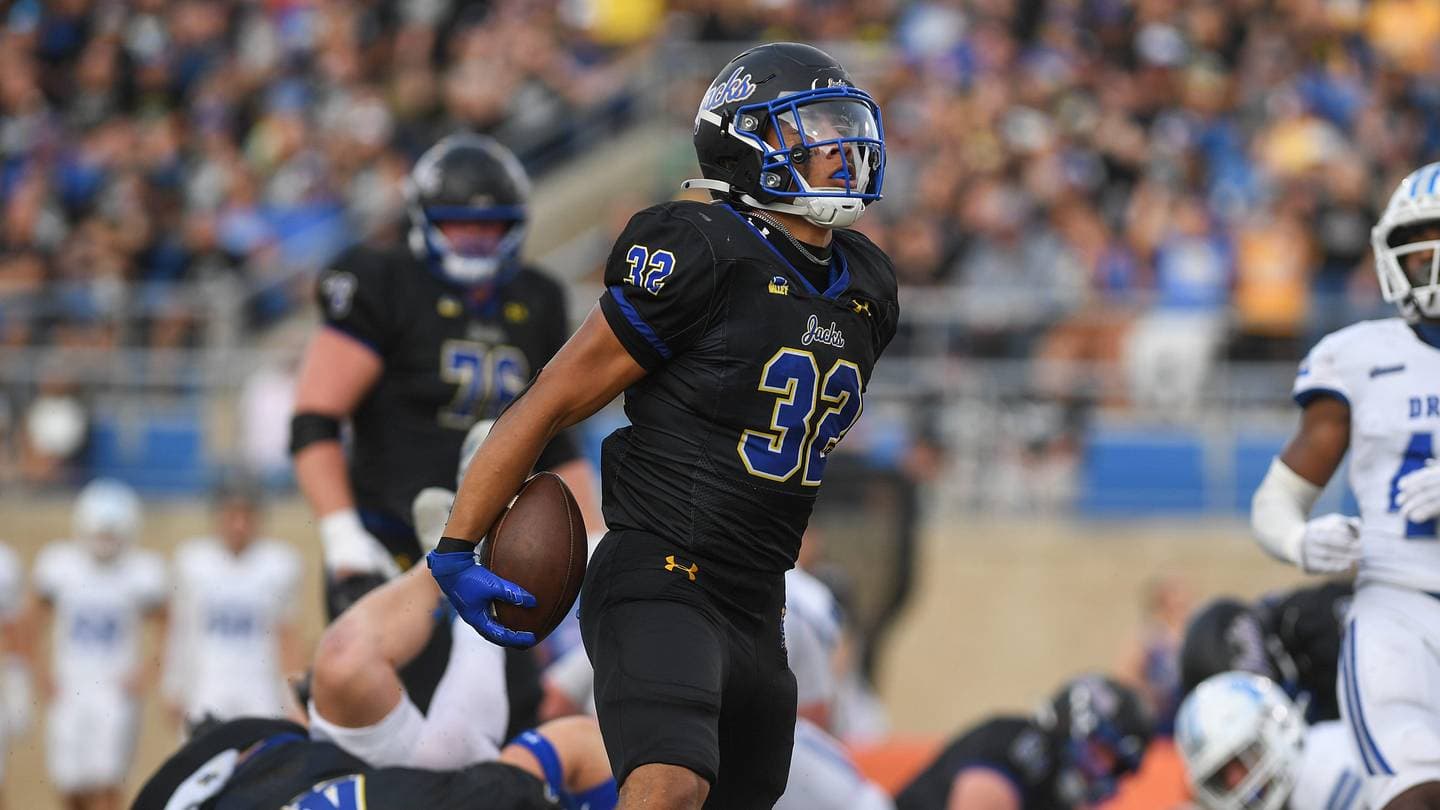
The clearest example came in Julius Loughridge’s debut against Sacramento State on Aug. 30, 2025. He rushed for 159 yards on 22 carries, and the Jackrabbits piled up 240 rushing yards in a 20-3 win. That was the version of South Dakota State that can control tempo, compress possessions, and make a strong defense defend every inch. But it was not the weekly baseline.
Loughridge finished the regular season with 916 rushing yards on 196 carries and six touchdowns, averaging 4.7 yards per carry. That is a solid season by almost any standard, especially for a first-year Jackrabbit. It also tells the story of the offense’s ceiling and its inconsistency at the same time. A back who can produce like that gives South Dakota State a real answer. The issue is whether the offensive structure can turn one effective runner into a stable, efficient unit.
What has to change in 2026
The fixes do not require South Dakota State to reinvent itself. They require cleaner execution and a sharper run-game structure. The most important adjustment is getting the offense back to winning first down more consistently, so the Jackrabbits are not living in second-and-long and third-and-medium situations against the best defenses in the bracket.
That starts with the front. If the line can generate better displacement, the offense can stop asking backs to create every yard after contact. It also means the staff has to use the depth chart in a way that keeps the run game fresh and varied, rather than letting the offense become predictable when one back is carrying the load. The 2026 roster includes James Basinger and Brenden Begeman at running back, and the mid-year addition of 17 transfers shows the staff is not treating this as a finished product.
Loughridge remains the centerpiece of the discussion because his profile shows why the ground game can still be a strength. Before transferring from Fordham University, he totaled 3,005 career rushing yards and 26 rushing touchdowns. He arrived with a proven resume and immediately flashed against Sacramento State. The question is not whether he can run. It is whether the system around him can restore the efficient, downhill rhythm that usually defines South Dakota State.
Why it changes the postseason ceiling
This is where the championship angle becomes real. South Dakota State finished 9-5 in 2025 and still made its 14th consecutive FCS playoff appearance, which tells you the floor remains high. But the ceiling in a title chase is different. Once the bracket tightens, the offense has to win on schedule against defenses that are prepared for every tendency. If the run game is only average, those games become harder to control.
A stronger rushing attack changes the entire playoff profile. It shortens drives, reduces pressure on the quarterback, and forces opponents to defend the full playbook. It also helps protect a first-year coaching transition. Dan Jackson, hired as the 22nd head coach in school history on Dec. 31, 2024, spent his first season watching what works and what breaks under postseason stress. Now he gets an offseason to define the identity more clearly.
For a team that still has championship talent, the goal is not just to be good enough to reach the bracket. It is to arrive with a run game that can hold up against elite fronts in December. If South Dakota State gets back closer to its usual standard on the ground, the path to Nashville looks more realistic. If it does not, the Jackrabbits may still win plenty of games, but they will have made the road to a title far steeper than it needs to be.
Know something we missed? Have a correction or additional information?
Submit a Tip