Fliteboard buyer guide weighs size, battery range, and safety for riders
The smartest Fliteboard buy starts with rider size, use case, and battery range. Get those wrong and you pay for it in stability, runtime, and safety.

Buy for the rider, not the logo
REAL Watersports’ new Fliteboard guide makes the right call from the first line of the decision tree: start with body size, intended use, and battery range, then choose the board. That matters because eFoils punish impulse buys. A board that looks sleek on a screen can become a bad fit the moment a bigger rider steps on it, a family tries to share it, or a long session runs out of battery before the fun starts.
Matt Nuzzo’s approach is refreshingly blunt for a premium buy. Fliteboard is not treated like a generic toy with a motor bolted on. It is treated like a system where construction quality, service support, and safety are part of the price you are actually paying. That framing is the whole story here: if you buy wrong, you do not just lose comfort, you can lose confidence, runtime, and money.
Start with size, because stability is the first test
The guide’s clearest message is that bigger riders usually need bigger boards. That is not a marketing slogan, it is physics and balance. Chasing the smallest possible platform may look cool, but the smaller the board, the less forgiving the sweet spot becomes, and learning gets harder fast.
That is why the comparison guide matters. REAL Watersports places the AIR at 80L and calls it the beginner inflatable board. The PRO comes in at 110L and is described as the balanced intermediate and advanced option. The ULTRA L3 sits at 67L and is aimed at advanced wave riding, while the RACE family is longer and narrower for speed and flat-water racing. The ICON is listed at 49L, which shows just how compact some of the premium options get.
If you are buying for a first timer, the AIR is the most straightforward entry point in the lineup because volume and stability are doing some of the work for you. If you are buying one board that several people will touch, the PRO makes more sense because it is the middle ground, not the knife-edge choice. If you are already past the learning curve and want a more specific riding feel, the ULTRA L3 and RACE split the market into clearly different lanes.
The right board depends on what kind of day you want to have
This is where the guide stops feeling like product copy and starts feeling like a real buying tool. The rider who wants a forgiving first setup needs something very different from the rider chasing faster sessions or more technical wave work. The family shared setup also plays by a different rulebook, because the board has to work for more than one body, not just one ambition.
A first-time buyer usually wants stability, forgiveness, and less drama. That points toward the AIR or, for a more versatile setup, the PRO. A progression-focused rider who already knows they will want more performance should look harder at the PRO, ULTRA L3, or even the narrower RACE family if speed is the goal. The key is not choosing the most aggressive shape because it sounds advanced. It is matching the board to the way you actually ride.
Battery choice is really a range-and-budget decision
Fliteboard’s battery families make the tradeoff obvious. The official U.S. store lists the Flitecell Nano at $2,310, the Flitecell Sport at $2,860, and the Flitecell Explore at $3,960. That spread tells you this is not just a performance choice. It is also a decision about how much you are willing to pay for runtime and how portable you want the setup to be.
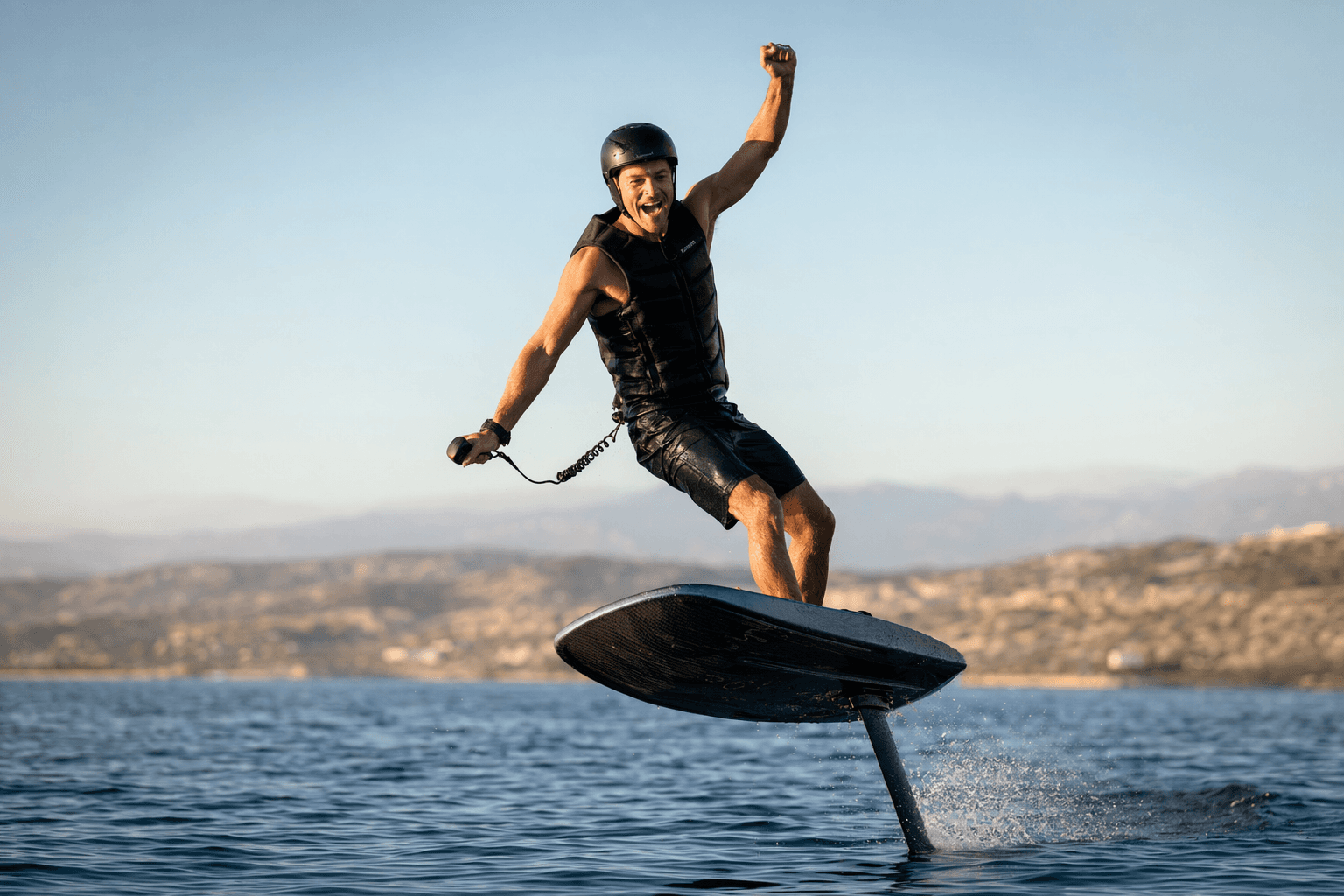
For riders who care about portability and quick handling, the smaller battery is the easy attraction. For riders who care more about longer sessions and fewer dockside calculations, the larger battery starts to justify its price. The guide’s point is that you should not buy battery by instinct. You buy it based on how long you want to stay out, how often you expect to travel with the gear, and how much extra weight or cost you are willing to absorb.
That is exactly why the battery question belongs near the top of the buying process, not the bottom. Too many premium buyers get dazzled by top speed and forget that runtime changes the whole experience. A short session that ends early because the battery is undersized is not a bargain.
Why Fliteboard sells itself as a premium system
Fliteboard leans hard into the idea that reliability is part of the value. The brand traces its origin to a 2016 idea from founder David Trewern, with the first public ride filmed in September 2017 and the website launched a month later. Since then, the company says it has grown to more than 330 Flite Dealers and Fliteschools worldwide, with head offices in Australia, the Netherlands, and the United States.
That network matters because premium boards are only premium if you can actually support them. Fliteboard says it offers a two-year warranty, and that local service layer is a big reason the guide pushes buyers away from bargain hunting. Cheaper boards can come with ugly surprises, including battery fires, construction failures, and other hazards that turn a lower sticker price into a much more expensive mistake.
The company also says it has more than 50 patents, and its safety package is extensive: an enclosed propulsion system, arming procedure, automatic tilt detection, a virtual leash, wireless safety key, and haptic alerts. Those are not minor details. They are the difference between a product that simply moves and one that tries to manage risk at the rider level.
The outside validation is not subtle
Fliteboard’s premium claim is backed by more than its own marketing. The Red Dot Design Award recognized the board as Best of the Best in 2020, and Red Dot’s listing highlights a patented unibody hull and a Flite Controller with GPS and Bluetooth. That combination of design and engineering is a strong signal that the brand is aiming beyond pure novelty.
Then there is the kind of stat that travels fast because it sounds impossible until you check it. Rob Wylie completed a 40 km Maldives channel crossing in 2022 on a single battery charge. That does not mean every rider needs record-level range, but it does show what the platform can do when battery, board, and rider are matched properly.
The bottom line
If you want the simplest decision tree, it looks like this: choose the board for your body size, then match it to the way you ride, then pay for the battery that fits your range. The AIR serves the beginner lane, the PRO is the versatile middle, the ULTRA L3 pushes toward advanced wave riding, and the RACE is built for speed and flat-water racing. Buy with that order in mind, and the premium price starts to make sense. Buy backward, and the board will remind you every time you step on it.
This article was produced by Prism’s automated news system from verified source data, official records, and press releases, then run through automated quality and moderation checks before publishing. The system is built and supervised by the people who set the standards it runs under. Read our full AI policy.
Did this article answer your question?