GONG showcases modern wing foiling style on long right-hand surf session
GONG's long right-hander shows wing foiling edging closer to surfing, with compact boards, a stiff mast and a maneuverable foil making committed turns look natural.

The run from Benjamin and Malo on a long right-hander does more than string together good-looking clips. It shows modern wing foiling at the point where equipment, line choice, and wave reading start to look genuinely surf-like, with freefly carves, bottom turns, off-the-lip hits, and down-the-line airs all flowing together in one session.
What makes it stand out is not just the action, but the system behind it. GONG is using the session to show how its current wave-oriented setup behaves in real surf, and the message is clear: this is a performance package built for riders who want more than straight-line cruising.
Why this session looks like surfing
The key ingredient is the long right-hand wave itself. A clean right-hander gives the riders room to link sections, set up deeper bottom turns, and carry speed down the line without constantly resetting their position. That matters because wing foiling starts to feel like true surfing when the rider can choose a line across the face instead of merely chasing lift.
Benjamin and Malo use that space well. The session mixes freefly carves with airs and top-to-bottom turns, which creates the same rhythm you expect in surfboard riding: accelerate, compress, redirect, release. When the foil is trimmed correctly and the rider keeps speed through the section, the wing disappears from being the whole story and becomes part of the turn rather than the point of it.
That is the difference intermediate riders can copy first. Before trying to make every move bigger, the real breakthrough is learning to hold a clean line on the face, stay balanced through the turn, and let the wave carry the run instead of forcing every maneuver.
The setup behind the style
GONG’s board and foil choices tell you exactly what kind of riding it wants to promote. The Mint FSP Pro is described by GONG as a performance shape made accessible for freeride, freefly, and wave riding. The Lemon FSP Pro is the compact, high-performance easy surfer that still likes freeride. Together, those boards point to a hybrid approach: enough stability to connect sections, but compact enough to encourage sharper turns and less drag.
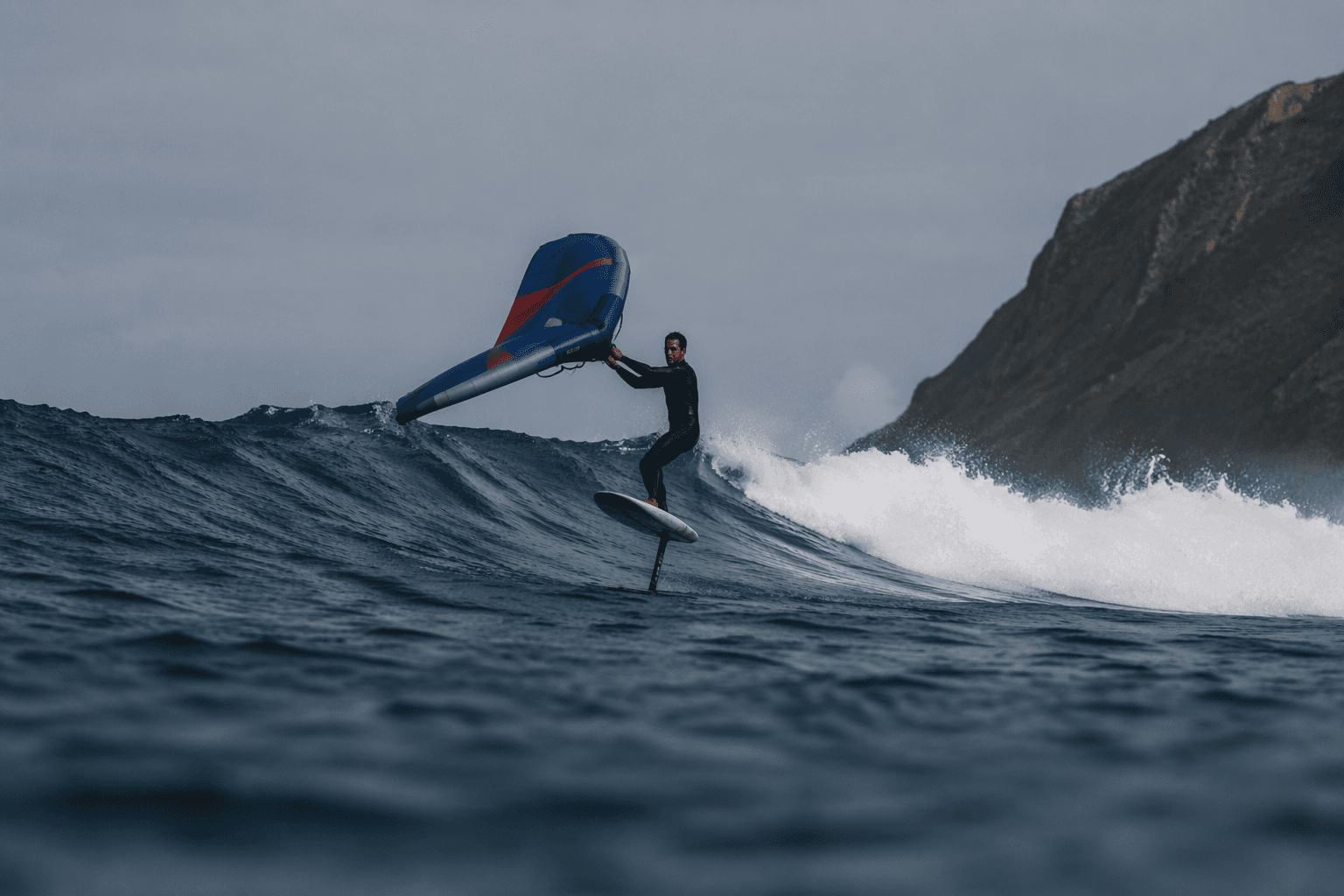
The foil hardware pushes in the same direction. GONG describes the Fluid front wing as ultra-maneuverable and built for tight turns, snaps, drifts, top turns, and airs. The Neutra wing is positioned as the ultimate wave wing for high-performance surfing and jumps. Pair that with the HM85 mast and you get a setup that is clearly meant to be reactive, not lazy: stiff enough to transmit pressure quickly, but tuned for direction changes and committed rail-to-rail movement.
A related GONG feedback post sharpens that picture even more. It identifies Benjamin on a Lemon FSP Pro board, Neutra wing, HM85 V3 mast, Fluid V3 front wing, and Ypra Surf-Freestyle V3 stabilizer. That combination reinforces the idea that this is not random footage. It is a current in-house performance template for riders who want surf control with freestyle range.
What intermediate riders can copy
The most useful lesson from the session is that modern wing wave-riding now depends on matching three things: the board, the foil, and the wave. A compact board like the Lemon FSP Pro helps the rider stay loose enough to pivot and redirect, while the Mint FSP Pro offers a little more bridge between freeride confidence and wave commitment.
For riders trying to move toward this style, the practical changes are straightforward:
- Choose a compact board if you want quicker rail transitions and easier top-to-bottom surfing.
- Look for a front wing that rewards pressure and release, not just glide.
- Use a stiff mast if you want cleaner feedback when loading turns.
- Keep the wing controlled enough that it supports the turn instead of interrupting it.
The skill side matters just as much. The riders in this session are not just going fast; they are managing wing position, board angle, and foil pitch at the same time. The wing has to be handled with enough discipline that it stays out of the way during the critical part of the turn, then re-engages cleanly when the rider needs to recover speed or launch into the next section.

That is where the sport starts to resemble real surfing. The wing stops dominating every frame and becomes a tool for timing, recovery, and expression. The rider is still foiling, but the movement pattern begins to look like wave craft.
Why this matters for the sport
The larger significance is that wing foiling is no longer just being sold as a transport or freeride category. The GWA Wingfoil World Tour now organizes competition around four World Sailing-sanctioned expression disciplines: Surf-Freestyle, FreeFly-Slalom, Wave, and Big Air. That structure shows where the sport is headed: toward specialization, judging criteria, and clearer technical identities.
The Wave side of that progression is especially important. The GWA introduced a dedicated Wave discipline in 2023, and by 2024 it was already calling wave riding “such an untapped area” in a piece centered on Cash Berzolla, who won the 2024 Wave world title. The tour ended that season with eight world championship crowns across eight events on three continents, which underlines how quickly the discipline is expanding.
That growth changes how sessions like GONG’s are read. They are not just style edits. They are evidence of an equipment and technique race that is pushing wing foiling closer to the language of surfing while keeping the aerial creativity of freestyle alive. The sport is becoming more legible, more specialized, and more demanding at the same time.
The bottom line
What GONG is showing on that long right-hander is a modern template for wave riding: compact boards, a highly responsive front wing, a stiff mast, and a wing that supports surfing rather than overpowering it. When the line is right and the swell gives enough face to work with, wing foiling can now look less like powered cruising and more like a true surf run with lift. That is the new benchmark, and the session makes a strong case that the benchmark is already here.
This article was produced by Prism’s automated news system from verified source data, official records, and press releases, then run through automated quality and moderation checks before publishing. The system is built and supervised by the people who set the standards it runs under. Read our full AI policy.
Know something we missed? Have a correction or additional information?
Submit a Tip