Whale surfaces beside foil surfer off Santa Barbara, knocks him off board
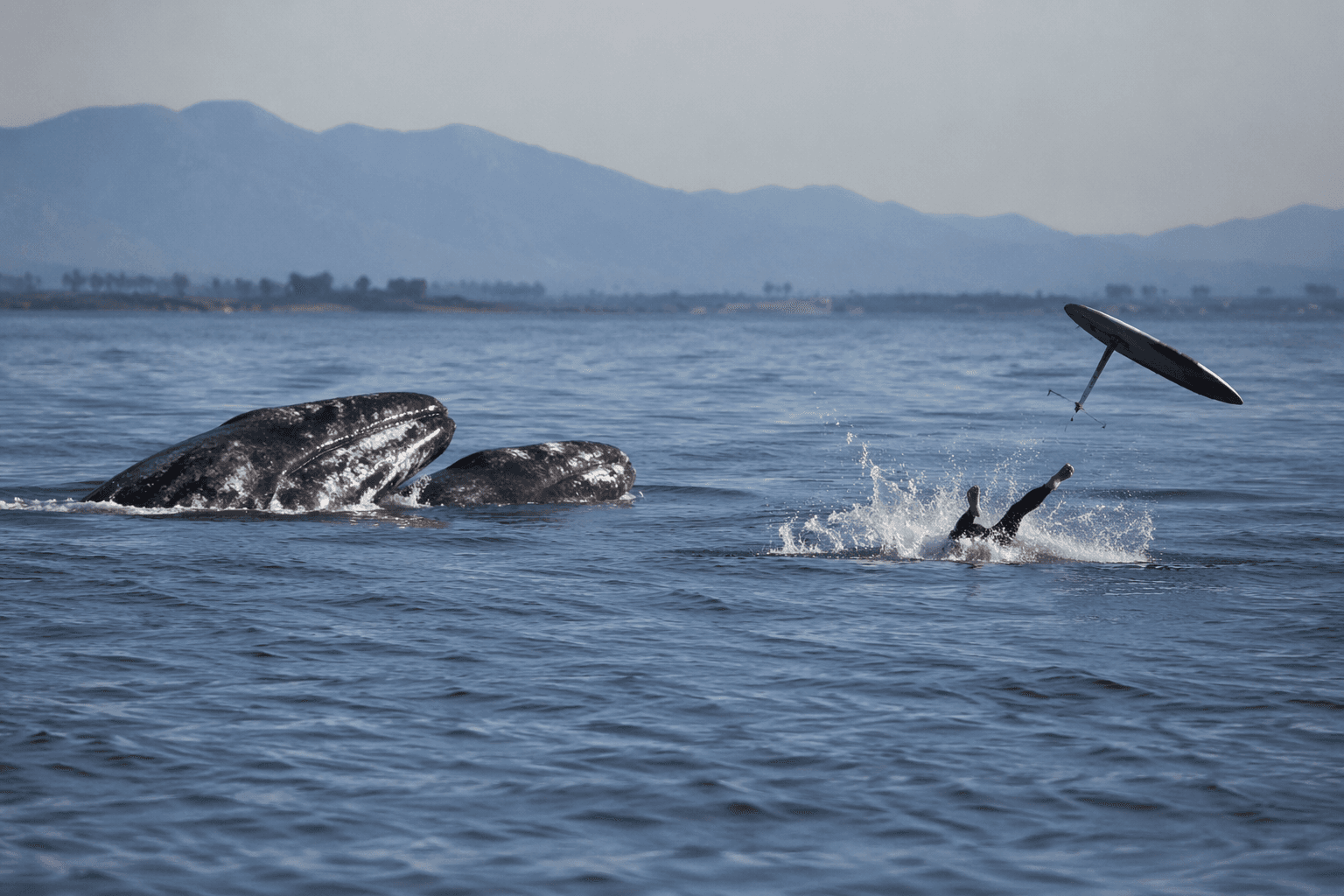
A downwind foiler off Santa Barbara was knocked off his board after a mother and calf gray whale surfaced beside him, a reminder to give marine life 100 yards.

A calm downwind run off Santa Barbara turned into a split-second whale encounter when a mother and baby gray whale surfaced right beside a foiler about a quarter-mile from shore, throwing enough wash to knock him off his board. He climbed back on and kept going, but the moment underscored how little warning riders get when they are gliding quietly over open water.
For downwind foilers, the lesson is not just that whales are out there. It is that route choice, scanning habits and reaction time all matter once a rider leaves the beach and starts linking bumps far offshore. Downwind foiling is a high-risk, self-rescue-oriented discipline, and losing the board can put a rider in immediate danger. In that setting, a whale surfacing a few feet away is more than a spectacle. It is a hazard that demands space, awareness and a plan before the encounter happens.
NOAA says whales should be observed from at least 100 yards away, about the length of a football field, and that distance becomes even more important in a quiet sport where speed and silence can bring a rider into close contact before either side has time to react. On an open-water foil run, that means reading the line ahead, avoiding blind pushes toward slicks or bait, and being ready to alter course early rather than late. If a large animal appears, the safest response is to give it room immediately and reset rather than try to thread past it.
The Santa Barbara coast sits inside a major migration corridor. NOAA says gray whales pass through Channel Islands National Marine Sanctuary during December through February on their way from Alaska to warm calving lagoons in Baja California, Mexico, and the sanctuary protects 1,470 square miles around the Northern Channel Islands. The eastern North Pacific gray whale also makes one of the longest migrations of any mammal, roughly 10,000 to 12,000 miles a year.
That migration is part of why encounters in the Santa Barbara Channel are not unusual, even if they are unforgettable when they happen at foil speed. NOAA says gray whale abundance surveys at Granite Canyon began in 1967, and the population has continued to decline after an unusual mortality event, with calf production still very low. A Santa Barbara Channel whale-heritage source said the population peaked above 27,000 in 2015-16 and is now estimated at 13,000 or less. For foilers heading offshore, the takeaway is clear: the channel is a runway for the sport, but it is also a living migration route that deserves distance.
This article was produced by Prism’s automated news system from verified source data, official records, and press releases, then run through automated quality and moderation checks before publishing. The system is built and supervised by the people who set the standards it runs under. Read our full AI policy.
Know something we missed? Have a correction or additional information?
Submit a Tip

