Essential Defensive Drills to Sharpen Indiana High School Basketball Skills
Ten tournament-pressure reps Indiana teams lean on when sectionals get tight, each tied to a specific late-game problem with a clear measurable standard to track daily.

Every February in Indiana, the window snaps shut. The IHSAA entry deadline passes, pairings drop, and suddenly every possession in practice carries the weight of a sectional bracket. The 2025-26 Boys Basketball State Tournament entry list closed February 11, sectional pairings were announced February 22, and games tipped off March 3: a timeline that leaves almost no room to fix structural problems once the calendar flips. The teams that survive into regional and semi-state play aren't just the most talented; they're the ones that trained at tournament tempo, addressed specific late-game breakdowns, and built measurable habits before March arrived. These ten drills are the reps that matter when the gym gets loud and the clock gets short.
The Defensive Foundation
Indiana's single-class sectional format compresses games into a pressure cooker. Teams often see fewer possessions per game than they do in regular-season play, meaning one bad defensive rotation or a missed closeout can swing an entire sectional matchup. The Game-Tempo Closeout and Recover Drill targets exactly that problem.
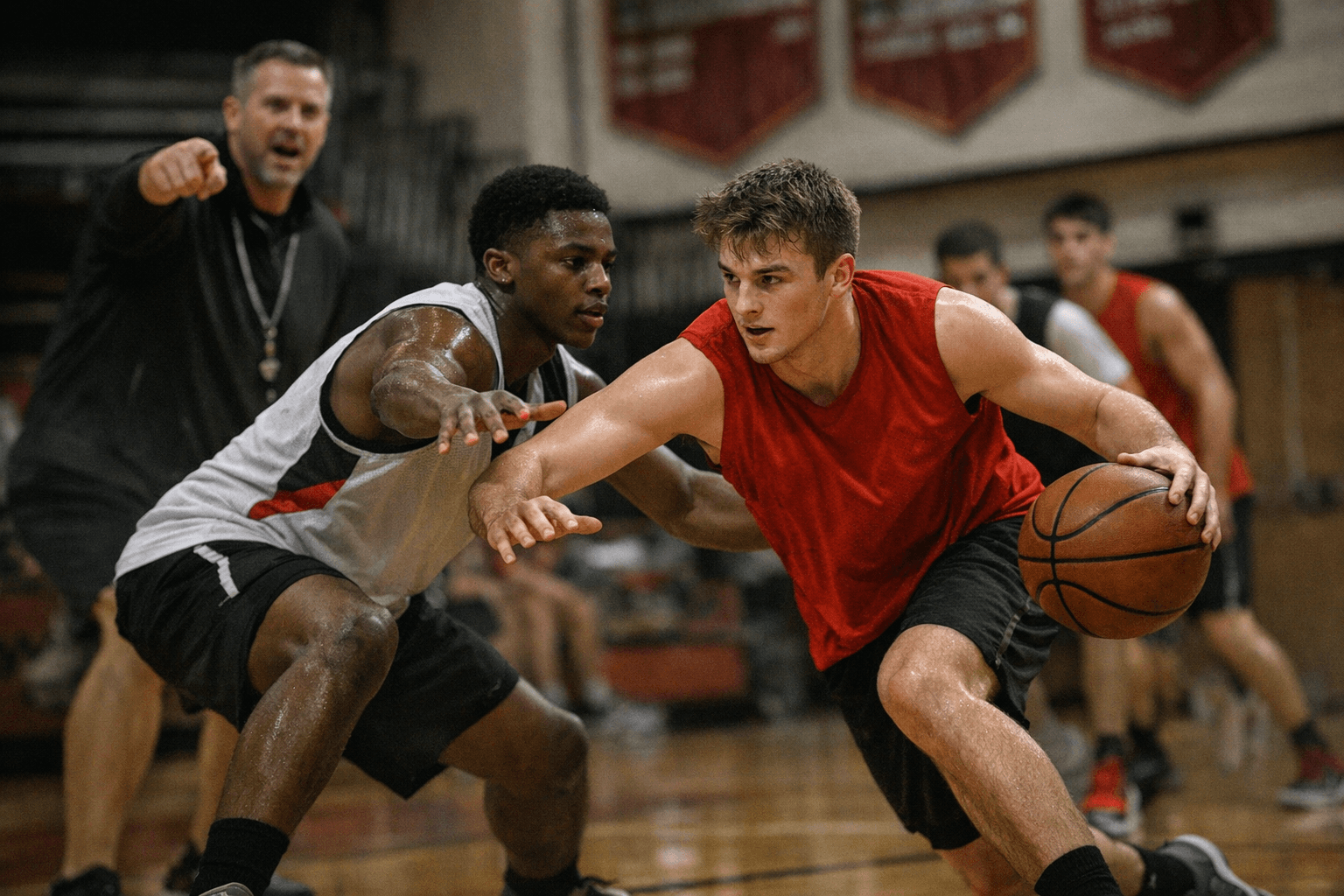
One defender starts at the top of the key while a rebounder or coach holds the ball on the perimeter. The pass goes to the wing, the offensive player attacks, and the defender must close out aggressively: chin up, hands active, sprinting then decelerating hard on contact. The recovery phase, denying the skip pass or cutting off the post, is where most high school defenders break down. The standard is clear: run 10 reps and count successful containments. If a defender is below seven out of ten, the footwork is not ready for tournament pace.
The Live 2-on-2 Weak-Side Recovery drill addresses a connected problem: what happens after the first rotation fails. Two defenders on half-court work help-side reads against a basic two-man game, forcing the baseline and sprinting to closeouts while communicating every switch. The progression adds a third offensive player to create a 3-on-2 advantage, which mirrors exactly the numerical disadvantage a trapping defense creates when a rotation is a step slow. Measure this one in successful stops per series, not individual possessions.
Rebounding circuits complete the defensive triad. A coach tosses live balls; the rebounder must secure possession and fire an outlet pass within three seconds. That window isn't arbitrary: a slow outlet in tournament play bleeds into a dead-ball situation or, worse, a turnover in traffic. Add opposition in the progression so players are fighting contact before the ball even arrives.
Handling Pressure and the Trap Problem
Indiana defenses love to press and trap in tournament games, especially once a team finds momentum. The Ball-Handling Under Pressure Progression builds the answer. Players navigate cone gates while a live defender applies on-ball pressure: the goal is a low stance, active dribble changes, and a head kept up to prevent tunnel vision. Turnover rate per drill set is the metric. A player committing more than two turnovers per ten pressured reps is not ready for a sectional trap situation.
The Transition 5-on-4 Advantage Drill trains both sides of that trapping coin. Five offensive players push pace against four defenders after a simulated rebound or turnover; the offense must attack the advantage immediately, and the defense must sprint back and communicate recovery lanes without the benefit of a set play or a timeout. Add clock constraints or a coach-triggered penalty on turnovers to simulate the exact stress of a late-game situation where fouling becomes strategic. Points per possession across transition reps is the benchmark, and it translates directly to game-day decision speed.
Possessions That Win Sectionals
Every drill above protects possessions. The next three create them.
The Pick-and-Roll Reading Series runs live 2-on-2, alternating the ball handler and screener to build dual-role fluency. Players work through the full read menu: when to slip, when to pop, when to bend and re-screen. Shoulder angles, contact initiation, and floor spacing are the coaching points. The meaningful measurement is assist-to-turnover ratio across a series of reps, not just whether a particular shot dropped.
The 3-Point Drive-and-Kick Shooting Circuit adds fatigue to the equation because tournament games in March are decided by players who can still shoot under physical stress. Five spots cycle through drives, kicks, and catch-and-shoot reps with a timed element layered in to replicate game-speed exhaustion. Shooting percentage across sets should be tracked alongside in-game correlation; the real question is always whether the practice number predicts the game number.
Post players working the Footwork and Post-up Finishing Ladder address a different kind of pressure. Drop-step, hook, up-and-under: all executed against a coach feeder, then against live defense, then against a double-team read. That double-team progression is critical for any program featuring a strong post player, because every tournament opponent will eventually send two defenders at them. Made shots on live reps is the only measurement that matters in that phase.
The Final Two Minutes
Two drills exist specifically for the moments that end seasons.
The Situational End-Game drill runs 24-, 16-, and 8-second scenarios from different court spots with live defense. Sideline inbounds, baseline inbounds, foul-and-shot situations: these are the plays coaches draw up in timeouts and players forget under noise. Clock awareness, composure, and best shot selection are the coaching points. Track successful execution percentage across scenarios; a team converting fewer than half its end-game sets in practice should not expect better results when a sectional crowd is at full volume and a season is on the line.
Free-throw shooting under pressure deserves its own daily block because tournament free throws come in the fourth quarter, when legs are heavy and distractions are real. Players shoot sets of ten while teammates create controlled noise. Pre-shot routine, breath pattern, and visualization must hold regardless of the chaos around them. Comparing pressured-set percentages against baseline practice percentages tells the true story of whether a player's routine is locked in or just practiced in silence.
The 10-Day Pre-Tournament Plan
The most efficient way to run these drills is in 15-minute daily blocks across two focused weeks before sectionals. Here is the breakdown:
- Monday: Footwork, ball-handling, and shooting mechanics (Drive-and-Kick Circuit, Ball-Handling Under Pressure, Post-up Finishing Ladder)
- Tuesday: Defensive rotations and closeouts (Game-Tempo Closeout, 2-on-2 Weak-Side Recovery, Rebounding Circuits)
- Wednesday: Pick-and-roll reads and transition work (Pick-and-Roll Reading Series, 5-on-4 Transition)
- Thursday: Situational scrimmage and end-game scenarios (Situational End-Game, Rebounding Circuits)
- Friday: Free-throw pressure and shooting circuit (Drive-and-Kick Circuit, Free-Throw Routine)
- Weekend: Light recovery, film study, and individual skill reps
Tracking Progress That Actually Carries Over
The Indiana Basketball Coaches Association, which recognizes coaches like Rob York of Greencastle, who has spent 19 seasons as a boys' assistant, understands what the state's most experienced staffs have learned over decades: practice data only matters when it predicts game performance. Keep a simple player-by-player database that records shooting percentages from drills and games, turnover rates, defensive stops, rebound-to-outlet times, and situational execution percentages. Compare weekly trends. If a player's drill free-throw percentage and in-game percentage are diverging, the routine is not transferring under real pressure. If turnover rates in ball-handling reps are improving but in-game turnovers are flat, the cone pressure is not closely enough replicating live defensive pressure.
Smaller Indiana programs benefit most from positionless skill development woven across all ten drills. A short roster still needs every player capable of closing out, surviving a full-court trap, and converting in the short clock. Conditioning should be integrated into every drill block rather than treated as a separate segment, because tournament fatigue does not pause for water breaks between the quarterfinal and semifinal on the same sectional Saturday.
The programs that reach semi-state aren't practicing more than anyone else in Indiana. They're practicing the right problems at the right tempo, with a number attached to every rep that makes honest self-assessment impossible to avoid.
This article was produced by Prism’s automated news system from verified source data, official records, and press releases, then run through automated quality and moderation checks before publishing. The system is built and supervised by the people who set the standards it runs under. Read our full AI policy.
Did this article answer your question?