Indiana High School Basketball Recruiting Guide: Key Steps, Timelines, and Strategies
Every Indiana high school basketball player has a shot at a college roster, but the ones who land offers follow a precise month-by-month plan most families never see.
Only one decision in a Hoosier player's career shapes the next four years more completely than the college choice, and most of the work that drives it happens years before any letter of intent lands on a table. Indiana is one of the most heavily scouted states in the country: Big Ten programs and regional mid-majors treat the IHSAA circuit as a reliable talent pipeline, and platforms like Prep Hoops track more than 450 players in a single recruiting class. The challenge is not visibility. The challenge is knowing precisely what to do, and when.
The Recruiting Calendar: A Freshman-to-Senior Roadmap
The timeline is not abstract. Each class year carries a concrete set of actions, and missing a window by even one semester can cost a player measurable ground.
Freshman and Sophomore Year: Build the Foundation Now
The first two years of high school are not too early to begin recruiting preparation; they are, in fact, the only years a player has to establish the baseline that every future evaluation will measure. Focus on fundamentals, accumulate in-game film, and attend local camps where college staffers occasionally scout. More importantly, treat academics with the same discipline as skill work. Coaches at Division I and Division II programs regularly run academic background checks before committing scouting time, and a thin transcript in ninth grade can quietly eliminate a player from consideration before a single coach ever sees them play.
By spring of sophomore year, a player should have at least two or three full-game clips archived in a cloud folder, a completed or in-progress NCAA Eligibility Center registration (required for Divisions I and II), and a working list of target programs sorted by realistic fit. This is not premature; it is the minimum that a recruited junior is expected to have already done.
Summer After Sophomore and Junior Year: The Make-or-Break Window
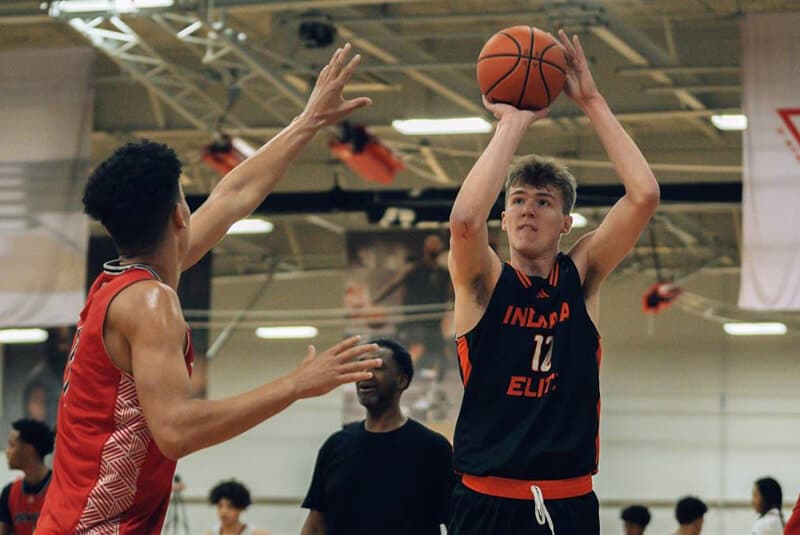
Indiana's recruiting leverage concentrates in the summer. This is when college coaches hit the road, when national circuits like the EYBL and Nike Nationals draw Division I evaluators, and when regional showcases fill with mid-major and D2 staff looking for program-ready players. Joining a well-run travel program matters here: Indiana Elite Basketball has been developing Division I talent since 2000, exemplifying the kind of established AAU infrastructure that keeps college coaches on their scouting calendars year after year. Trent Sisley, a 6-foot-7 forward who played for Indiana Elite before landing at Montverde Academy, earned an official visit to Indiana University on September 20, 2024, following the kind of sustained summer exposure that a credible travel program makes possible.
For players targeting mid-major or Division II programs, the EYBL is not the right venue. Consistent, high-quality film from a well-organized regional program will serve those prospects better than a roster spot on a national team where they log limited minutes.
Junior Year: Generating and Managing Real Interest
If summer exposure has worked, junior fall is when the first meaningful contacts arrive. This is the moment to have a polished 3-to-4 minute highlight reel ready, clearly labeled with name, graduation year, school, and position. A separate 10-to-15 minute full-game clip, accessible via a single cloud link, should accompany every outreach email for coaches who want more context than a highlight package provides. Coaches do not want a compilation of windmill dunks from open-gym sessions; they want to see decision-making under defensive pressure, shot mechanics from game spots, and consistent defensive effort.
Build a recruiting calendar that lists every target school, the date of initial contact, and any callback notes or next steps. This is not a luxury organizational tool; it is the only way to maintain professional follow-up without spamming multiple staffers at the same school, which is a known relationship killer. Send a concise introductory email: who you are, your position coach's contact, your grade, your stats, recent honors, and a direct film link. Follow up once after a showcase or camp appearance. Then let the performance do the talking.
Senior Year: The Signing Period and the Final Choice
Vaughn Karvala's path illustrates exactly how senior fall is supposed to unfold. The 6-foot-6 wing took an official visit to Indiana University on October 16, 2025, and committed on November 1, 2025, just as the Early Signing Period opened in mid-November. That compressed timeline, a visit, then a commitment before the signing window, is the sequence that top recruits follow. For prospects further down the recruiting ladder, the Late Signing Period and regular decision windows still carry real opportunity; use that time to evaluate playing time potential, academic support structures, and coaching stability rather than rushing toward a name-brand program that may not offer a clear path to the floor.
What College Coaches Actually Scout
Position-specific shooting range is the first filter at every level. After that, coaches evaluate ball-handling under pressure, defensive fundamentals, and rebounding instincts. For many Indiana prospects without high-major size, a demonstrable skill advantage (elite shooting or advanced ball skills) can offset modest athleticism. Coachability and basketball IQ are universally valued; how a player responds to in-game instruction tells a staff more about long-term development than any single highlight. Academic standing and character run on a parallel track throughout the process, and coaches look specifically for players who can clear admissions and fit the institutional profile of the program.
Film and Communication: Your Digital Handshake
A recruiting profile is judged in roughly the first 90 seconds of film review. Label every clip precisely: player name, graduation year, position, and school. Keep the highlight reel between three and four minutes, sourced entirely from game footage rather than camp drill work. A cloud-hosted full-game clip should load without any account login or download. Write direct introductory emails: your name, primary coach's contact, stats, recent honors, and a film link. Never send the same message to multiple staffers at the same school, and follow up only once after an event unless a staff member prompts further contact.
Indiana's Exposure Circuit: Matching the Venue to the Goal
State-based exposure through the IHSAA tournament circuit and sanctioned showcase events is the starting point. Indiana sits firmly in the Big Ten scouting footprint, and deep tournament runs generate legitimate recruiting attention at multiple levels. From there, the path splits by goal: D1-track prospects need a seat at national events like the EYBL or Nike Nationals, where top-level staffs concentrate their evaluation days. Mid-major and D2 prospects are better served by regional events where a player can be seen multiple times by the same staff over a weekend rather than once by a rotating group of assistants. Official and unofficial visits should be reserved for programs where mutual interest is already established, used to assess practice access, academic support, and realistic roster opportunity.
The Silent Killers: Academic and Eligibility Landmines
More offers are quietly withdrawn over eligibility problems than most families realize. Register with the NCAA Eligibility Center early, well before junior year, and monitor core-course requirements each semester rather than auditing them at graduation. Maintain updated official transcript copies and develop a standardized test timeline in coordination with a guidance counselor. Universities will not hesitate to pull a scholarship offer if eligibility looks uncertain at any point during the process. A player who has put in years of development work, earned genuine interest, and then allowed a transcript error to create doubt has given away something that cannot be recovered quickly.
Scholarship and Financial Realities
A full scholarship is not the only legitimate outcome, and families who reject partial offers or preferred walk-on opportunities without evaluating the complete financial picture leave real value on the table. At mid-major and small-college programs, academic merit aid can significantly close the gap with a partial athletic offer. Ask each program about summer expenses, textbook stipends, and post-eligibility academic support. NIL opportunities, where applicable, should be treated as a supplement to the evaluation, not a primary driver of the decision.
The Role of Club Coaches and Parents
Parents are most effective as organizers and logistical supporters. Initial outreach to a program is appropriate, but ongoing basketball conversations should flow through the player and their primary coach. College staffs prefer to build relationships directly with prospects, and parents who dominate correspondence can inadvertently signal organizational dysfunction. Club coaches add the most value by scheduling events with confirmed college attendance, maintaining professional relationships with recruiting staffs, and keeping film libraries current throughout the season.
Making the Right Decision
The central question is not which program has the most recognizable name; it is where a player will actually develop and compete. Ask each program directly: Where do you see me in two years? Who is the position coach responsible for my development? What academic support exists for my intended major? A strong fit at a mid-major with a clear role and an engaged staff routinely produces better developmental outcomes than a roster spot at a power-conference program where a player rarely sees the floor. Keep backup plans alive through the process: the academic outcome of the college choice matters as much as the athletic one, and players who have built strong transcripts and relationships with their guidance counselors will have real options at every level of the decision.
The players who navigate this process successfully are not always the most talented prospects in the IHSAA. They are consistently the most prepared ones, and that preparation begins with a calendar, a cloud folder, and a commitment to the process that starts long before any coach calls.
This article was produced by Prism’s automated news system from verified source data, official records, and press releases, then run through automated quality and moderation checks before publishing. The system is built and supervised by the people who set the standards it runs under. Read our full AI policy.
Did this article answer your question?