One-Hour Workout Sharpens Shooting, Finishing and Ball Skills for Prep Players
A 60-minute workout built on Pro Skills Basketball's template gives prep guards and wings a Division I training blueprint covering ball handling, finishing, shooting and conditioning.

Sixty minutes. Six segments. One workout designed to close the gap between where a high school player is and where Division I basketball demands they be.
The framework comes from Pro Skills Basketball's individual workout template, developed in alignment with the USA Basketball Player Development Curriculum's principle of progressions. The structure is deliberate: each segment builds on the last, layering skill complexity across an hour that mirrors the physical and mental demands college scouts expect to see in recruited prospects. The target athlete is specific, too. This program is built for explosive guards or wings aiming to become two-way threats, players who can handle pressure, shoot off movement, finish through contact, and defend multiple positions.
That profile matters because the workout's design reflects it at every turn.
The Blueprint: Six Segments, One Hour
The full 60-minute session breaks down as follows:
- Segment 1: Dynamic Warm-Up and Movement — footwork, mobility, activation — 5 minutes
- Segment 2: Ball Handling Under Pressure — pressure resistance, speed, change of direction — 10 minutes
- Segment 3: Finishing at the Rim — touch, angles, contact finishes — 10 minutes
- Segment 4: Shooting: Catch, Dribble, Movement — catch-and-shoot, off-dribble, off-movement — 15 minutes
- Segment 5: Game Reads — situational scoring and decision-making — 10 minutes
- Segment 6: Conditioning and Free Throws — mental toughness and poise — 10 minutes
Each segment builds essential skills to elevate game-readiness, physicality, and basketball IQ. The time allocations are not arbitrary. The shooting segment receives the largest block of time, 15 minutes, reflecting how central perimeter shooting has become to evaluating high-level guards and wings in the college recruiting process.
Segment 1: Dynamic Warm-Up and Movement (5 Minutes)
The session opens with five minutes dedicated entirely to preparation, not skill execution. The stated goal is to prepare for high-intensity training with mobility and reaction drills. This is a meaningful distinction from simply stretching and jogging. A dynamic warm-up at this level targets movement patterns that the rest of the workout will demand, footwork mechanics, lateral mobility, and neuromuscular activation that primes the body for explosive efforts rather than just loosening muscles passively.
Skipping or shortening this segment is a common mistake among high school players training independently. The five minutes here set the physical and mental conditions for everything that follows.
Segment 2: Ball Handling Under Pressure (10 Minutes)
The second segment shifts immediately into skill work, with ball handling structured around a clear objective: build tight control, rhythm, and change-of-pace under simulated pressure. The emphasis on simulated pressure is critical. Ball handling in isolation, without any resistance or decision-making component, produces results that rarely transfer to game situations.
The workout structures this segment with both intermediate and advanced drill tiers, acknowledging that players enter this program at different points in their development. Each drill runs approximately 90 seconds with a short rest between efforts. That timing mirrors the kind of sustained possession bursts that occur in actual game sequences, long enough to test conditioning alongside skill, short enough to maintain quality of movement.
Segment 3: Finishing at the Rim (10 Minutes)
Ten minutes of finishing work follows, built around the goal of developing creativity and confidence finishing against contact with both hands. The ambidextrous emphasis is significant: college defenders and shot-blockers force guards to finish away from their dominant hand constantly, and players who can only convert at the rim with one hand are easier to defend at higher levels.
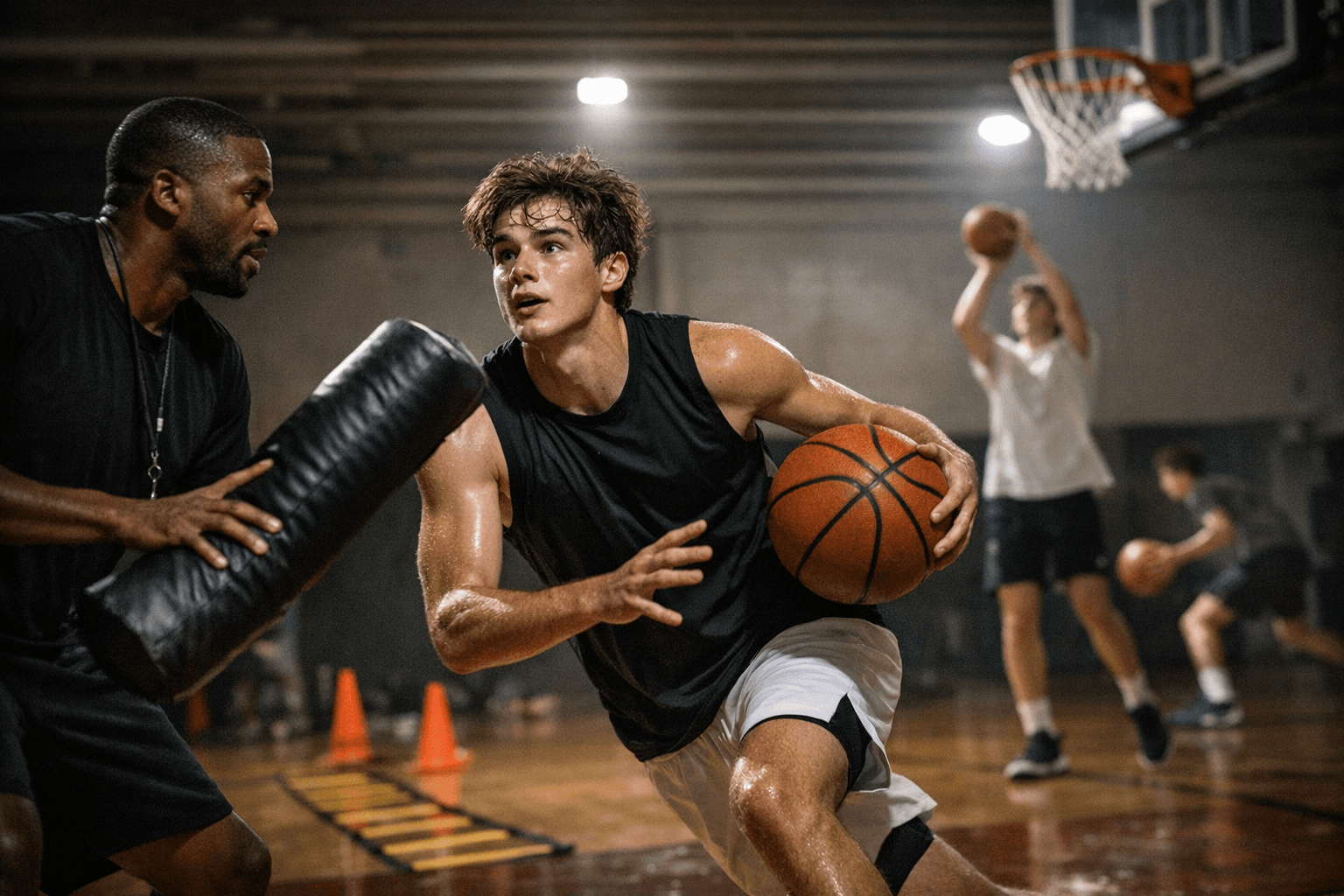
The coaching point embedded in this segment is worth highlighting directly: "Focus on decision-making at the rim, not just form." That instruction cuts against how many players approach finishing drills, where the tendency is to repeat a favorite move or polish a layup package without ever simulating the split-second read that determines which finish to attempt. As with the ball-handling segment, both intermediate and advanced drill options are built into the structure to accommodate different skill levels.
Segment 4: Shooting — Catch, Dribble, Movement (15 Minutes)
The shooting segment is the longest in the workout at 15 minutes, and its structure reflects the three-dimensional nature of perimeter scoring at the Division I level. The goal is to develop consistency and rhythm in game-like shooting situations, and the segment explicitly targets three distinct shooting contexts: catch-and-shoot, off-dribble, and off-movement shooting.
Each of those three categories represents a different problem set. Catch-and-shoot work trains a player to receive a pass with feet ready and release quickly, the foundation of spacing-based offenses. Off-dribble shooting develops the pull-up and mid-range game that creates separation when defenses close out aggressively. Off-movement shooting, the most complex of the three, requires footwork and timing to get into a clean shooting position after cutting, relocating, or coming off a screen. The workout addresses all three rather than letting players default to the type of shot they already make comfortably.
Drill progressions exist at both intermediate and advanced levels within this segment, building toward game-speed execution by the end of the block.
Segment 5: Game Reads (10 Minutes)
At the midpoint of the back half of the workout, the Game Reads segment shifts the training environment from isolated skill execution to situational decision-making. The focus is on situational scoring and decision-making, a category that encompasses the reads a player must make when the defense takes something away and a predetermined play breaks down.
This segment is where basketball IQ gets trained directly, not just physical skills. Division I coaches evaluate a player's ability to process information quickly, and 10 minutes of structured situational work within a broader skill session creates the habit of decision-making under fatigue, exactly the condition in which those reads have to happen in games.
Segment 6: Conditioning and Free Throws (10 Minutes)
The workout closes with a 10-minute block that connects physical conditioning to mental discipline. Free throw shooting at the end of an intense hour-long session replicates one of the most pressure-laden moments in basketball: shooting from the line while fatigued, with a game potentially on the line. The segment's dual focus on mental toughness and poise is intentional.
Conditioning work built into this closing segment means the free throws are shot after genuine physical stress, not after a casual walk to the line. That specificity is what makes the workout's design coherent across all six segments. Each piece reinforces another, and the final ten minutes demand that a player demonstrate composure precisely when composure is hardest to maintain.
Who This Workout Is Built For
The program is not a general fitness routine or a loose collection of basketball drills. It is designed for players with a specific aspiration: competing at the Division I level. More precisely, it targets the explosive guard or wing profile, athletes who need to demonstrate versatility on both ends of the floor to stand out in competitive youth basketball and college recruiting environments.
That framing should shape how any player approaches the hour. The goal is not just to complete the segments but to execute them with the intensity that Division I coaches will eventually evaluate. This routine mirrors the intensity and versatility needed to stand out in high-level youth basketball and college recruiting environments, which means bringing that standard to every 90-second drill set, every contact finish, and every late-workout free throw.
This article was produced by Prism’s automated news system from verified source data, official records, and press releases, then run through automated quality and moderation checks before publishing. The system is built and supervised by the people who set the standards it runs under. Read our full AI policy.
Did this article answer your question?