Vincennes Philanthropist's Legacy Lives On Through IHSAA Mental Attitude Award
A Vincennes businessman born in 1876 proposed the IHSAA Mental Attitude Award in 1916; today it honors 50 student-athletes across 24 sports every year.

Jacob "Jake" Gimbel had no state championship to his name, no scoring title, no tournament glory. What the Vincennes businessman had was a conviction that the most important qualities in a young athlete had nothing to do with the final score. He conceived the idea for a mental attitude award "in the days when Vincennes annually was producing state championship contenders and was riding a crest of hardwood power."
That's when Jacob (Jake) Gimbel, a Vincennes businessman and philanthropist, approached the IHSAA Board of Control with his idea. Born in 1876, Gimbel was the nephew of Adam Gimbel, a Bavarian immigrant who settled in Vincennes in 1842 and established a trading post that over decades grew into the famous Gimbel Department Store. Early in adulthood, Gimbel became interested in philanthropies. Hundreds of boys from poor families in Vincennes were encouraged to save their pennies and nickels and open savings accounts with the local bank, and for every first dollar they saved, Gimbel matched it with another.
In 1916, Gimbel presented to the IHSAA Board of Control a proposal to give a cash prize and medal each year at the State Basketball tourney to the boy who showed the best mental attitude throughout the tourney. "Mr. Gimbel did not have in mind the quality of the playing of any boy on any team but did have in mind the qualities that belong to a real gentleman." He clearly recognized the mental and moral strain under which players compete and the numerous opportunities for them to lose control and do something not conducive to true sportsmanship.
The IHSAA Board of Control meeting on November 17, 1916, included this item in its minutes: "A proposition presented by Mr. Jake Gimbel of Vincennes, to give a cash prize and a medal to the member of one of the teams at the Final Basketball Tourney who showed the best mental attitude during the tourney, was accepted."
The first recipient was not a player on the winning team. The Gimbel Prize for Mental Attitude was awarded to Claude Curtis of Martinsville, whose team had lost to eventual state champion Lebanon in the semifinals. In the semis, Lebanon sent Martinsville packing, 36-12. The lopsided score didn't matter. What Gimbel saw in Curtis was character under pressure, composure in defeat, the qualities he believed deserved recognition above all else.

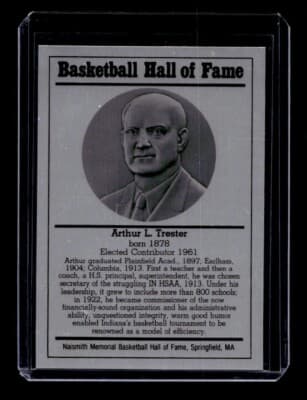
Gimbel either presented the award in person or corresponded with the honoree by hand-written letter every year through 1942, before passing away of a heart attack, just weeks before the 1943 state tournament. The 1942 Gimbel Medal went to Kenneth Brown, Jr. of Muncie Burris, one of the final recipients to bear the Gimbel name on the award. After awarding the Gimbel Prize for Mental Attitude from 1917 to 1943 and the IHSAA Medal for Mental Attitude in 1944, the IHSAA Board renamed the award the Arthur L. Trester Medal for Mental Attitude in honor of the man who served as first commissioner of the Association from 1929 to 1944.
The name on the hardware has changed. The spirit behind it has not. The presentation of a mental attitude award following a state championship event is a long-running tradition in Indiana high school sports. For decades, the first honor given during a post-game awards ceremony is announced by a member of the IHSAA Executive Committee, now via wireless microphone. A senior student-athlete, nominated by his or her principal and coach and selected for demonstrating excellence in mental attitude, scholarship, leadership, and athletic ability, has their parents invited to join them in the presentation, oftentimes in front of thousands of spectators. That student is then presented a walnut plaque in the shape of the state of Indiana and, depending on the sport, a $1,000 scholarship.
Today, the Mental Attitude Awards, several of which carry the names of former commissioners, assistant commissioners, and others who devoted many years to high school sports, are awarded to 50 Hoosier student-athletes in all 24 sports every school year. Out of Gimbel's first presentation in 1917, many schools began presenting their own similar awards to recognize the best student-athletes in their communities. During the 1960s, mental attitude awards were presented for the first time in sports other than boys basketball.
He never married and had no children, but Jacob Gimbel's idea, along with his generosity and benevolence, began a legacy that endures to this day and has become a unique tradition in Indiana high school athletics.
This article was produced by Prism’s automated news system from verified source data, official records, and press releases, then run through automated quality and moderation checks before publishing. The system is built and supervised by the people who set the standards it runs under. Read our full AI policy.
Did this article answer your question?