BloodHorse ties Memorial Day to racing’s long military legacy
Memorial Day becomes racing memory in BloodHorse's hands, from Alfred Vanderbilt's wartime Silver Star to Whittingham's Hollywood Park breakthrough.

Memorial Day before the paddock
Memorial Day 2026 falls on May 25, and BloodHorse treats that date as more than a three-day-weekend marker. The column reminds readers that the holiday, now observed on the last Monday in May, began as Decoration Day after the Civil War, when the nation had already suffered more than 620,000 military deaths.
That origin matters because the first national observance came on May 30, 1868, at Arlington National Cemetery, where more than 5,000 people gathered in Washington, DC. Congress did not move the holiday to the last Monday in May until the Uniform Monday Holiday Act took effect in 1971, and in 2000 Congress added the National Moment of Remembrance, asking Americans to pause at 3 p.m. on Memorial Day. In BloodHorse’s framing, that makes the holiday feel less like an extra day off and more like a national ritual still shaped by service, loss, and memory.
The horsemen who carried service back into racing
Jay Hovdey’s column works because it keeps returning to people, not abstractions. It names horsemen such as Charlie Whittingham, Noble Threewitt, Leonard Dorfman, Clement Hirsch, Nick Puhich, George Handy, Lou Rowan, Bill Boland, Bobby Ussery, Nashua, Greg Gilchrist, Tom Knust, John Shirreffs, and Don Brumfield, tracing how Thoroughbred racing has long been shaped by men whose lives touched military service as well as the shed row.
The National Museum of Racing and Hall of Fame gives that theme real weight through Alfred G. Vanderbilt. He became president of the Westchester Racing Association in 1940, then left racing to serve as a PT boat commander in the Pacific during World War II. The museum says Vanderbilt’s career on the water was not ceremonial: on the night of March 12, 1944, PT-196 was attacked by a Japanese float plane, his crew shot it down, and he received the Silver Star for that action. That kind of biography makes Memorial Day in racing feel earned, not borrowed.
Belmont Park, war service, and the public scale of the sport
The most vivid image in the column is Alfred G. Vanderbilt Jr. at Belmont Park for the 1956 Metropolitan Handicap, a scene that linked wartime experience directly to a marquee race day. More than 51,000 fans were on hand at Belmont Park, proof that the sport’s biggest afternoons have always doubled as civic gatherings.
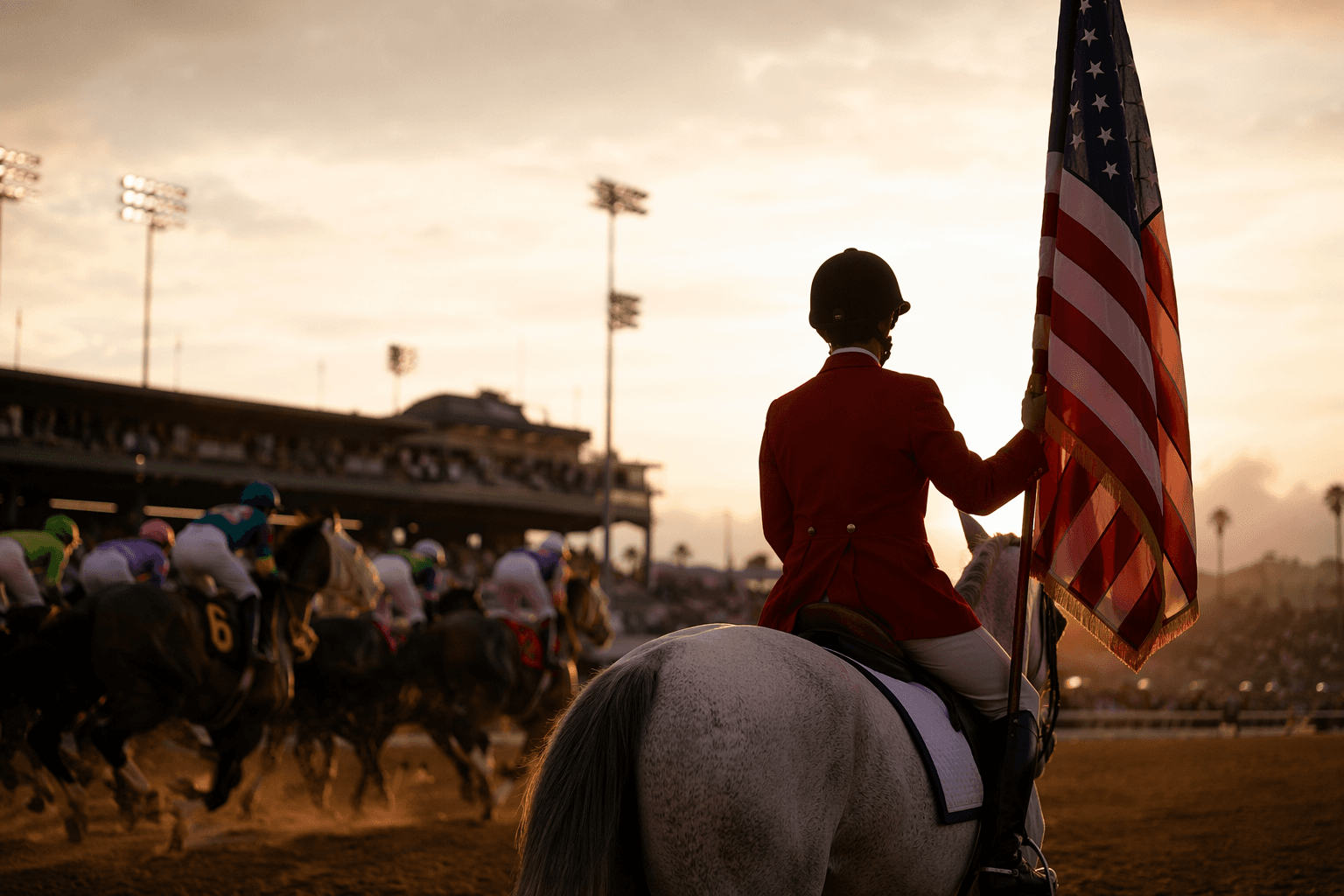
That crowd size matters because it shows how racing can absorb national memory without turning it into a slogan. A man decorated for service in the South Pacific stood at the center of one of New York racing’s major stages, and the public came not just for the horses but for the larger story they represented. BloodHorse uses that moment to show how the sport’s prestige has often rested on the people behind it as much as the finish order.
When holiday weekends told the country’s mood
The column then shifts to the 1966 Jersey Derby at Garden State Park, where 44,659 fans watched Creme dela Creme win by 2 lengths after veering toward the outside fence near the eighth pole. BloodHorse places that race against the background of Vietnam-era casualty totals and President Lyndon Johnson’s Memorial Day proclamation calling for a day of prayer for permanent peace. The result is a sharp reminder that holiday racing never exists in isolation. The roar of the crowd is always sitting beside the headlines of the day.
A decade later, Memorial Day weekend carried the same mix of sport and national feeling, only with a different cast. By 1976, after the holiday had been moved to the last Monday in May, President Gerald Ford marked May 31 as a day of prayer for permanent peace. On that holiday at Hollywood Park, Charlie Whittingham finally got a breakthrough with Dahlia, the European-bred filly who won the Hollywood Invitational Handicap, a Grade 1 turf race at a mile and a half, with Bill Shoemaker aboard. She defeated 11 rivals, including Caucasus, Avatar, One On the Aisle, Winds of Thought, and Top Command, which is a reminder that even on a reflective holiday, the sport still delivers elite competition.
Why Whittingham’s numbers still matter
Whittingham’s place in the column is not just ceremonial. The National Museum of Racing and Hall of Fame lists 2,534 wins for him, along with seven seasons as North America’s leading trainer in earnings. He also won Eclipse Awards for Outstanding Trainer in 1971, 1982, and 1989, numbers that turn him from a familiar name into a standard-bearer for the modern era of the game.
That is why Memorial Day resonates so strongly in racing when BloodHorse handles it well. The holiday is not being used as wallpaper. It becomes a way to remember that the sport’s history includes commanders, trainers, owners, and riders who lived through war, came home, and helped build the industry fans still follow at Belmont Park, Garden State Park, Hollywood Park, and beyond. In that sense, Memorial Day is not just adjacent to racing’s past. It is woven into it.
This article was produced by Prism’s automated news system from verified source data, official records, and press releases, then run through automated quality and moderation checks before publishing. The system is built and supervised by the people who set the standards it runs under. Read our full AI policy.
Did this article answer your question?