Debate Erupts: Is Horse Racing About Horses or Gambling Business?
U.S. horse racing handle has fallen for the third straight year to $11.27 billion, forcing a reckoning over who racing actually serves: the horse or the bettor funding its survival.

Every time a horse racing fan posts a passionate defense of the sport's equine athletes on social media, someone else fires back with a spreadsheet. That tension crystallized this week in a high-engagement X thread pitting horse-first advocates against business realists, but the argument is far older than the platform hosting it, and the numbers beneath it are getting harder to ignore.
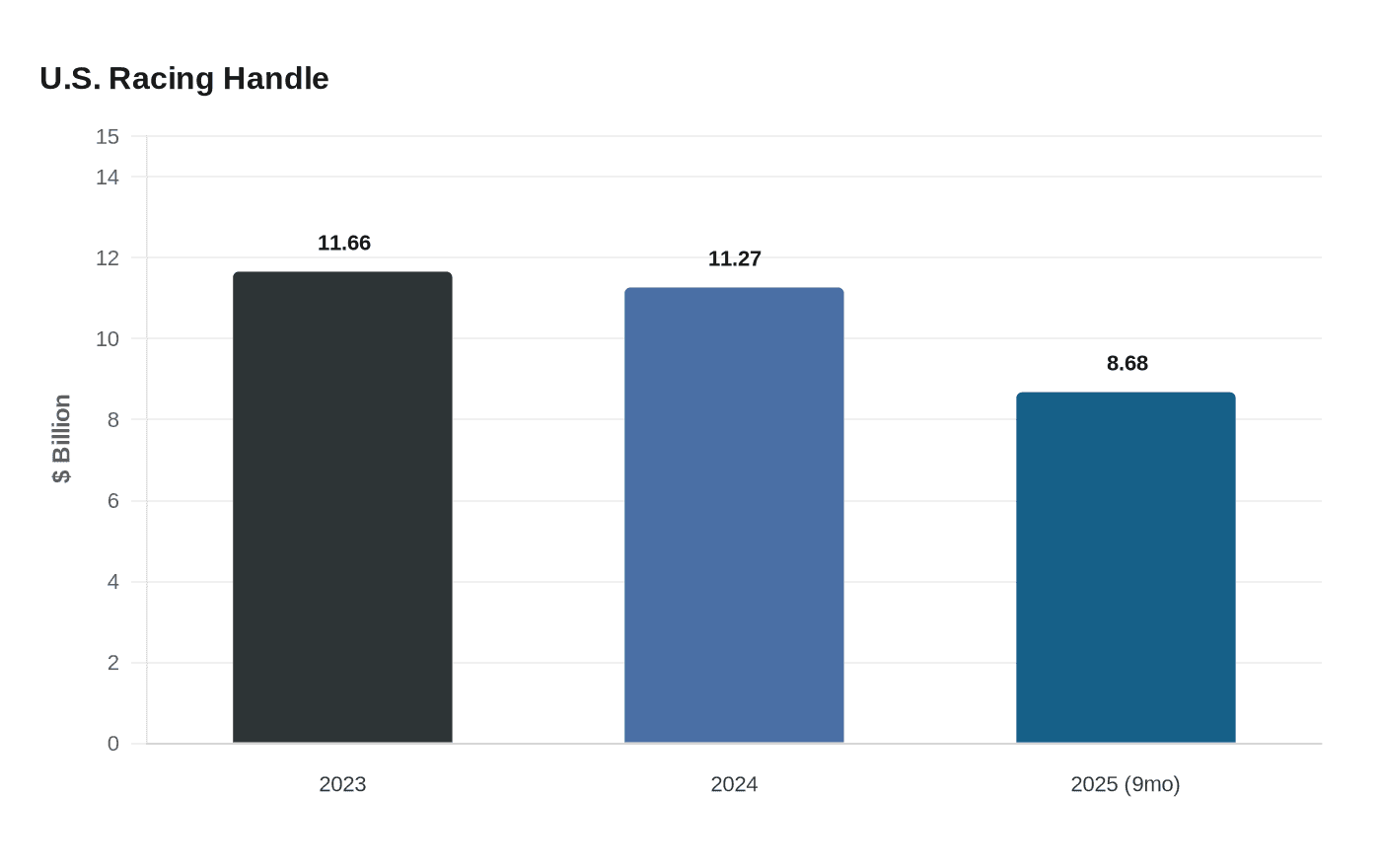
In what has become a familiar trend, betting in 2024 declined by 3.35%, with Equibase reporting an all-sources yearly handle of $11,265,210,514 for U.S. racing, down from $11,655,726,020 in 2023. Handle last rose in 2021, but that was a pandemic-distorted outlier; the previous organic increase came in 2018. The slide has not stopped in 2025. Through the first nine months of this year, handle is down another 2.1% to $8,679,660,193, and available purses have followed, dropping 2.4% to $975,527,036.
That purse figure is the hinge on which the entire debate swings. Paid purses are heavily bolstered by gaming revenue in most states, meaning the money owners and trainers compete for is structurally inseparable from wagering. Cut the betting, and you cut the livelihood of every horseman in the barn. In the first quarter of 2025 alone, paid purses fell 3.22% to $246,074,162.

The threat is not just from declining handle at licensed operators. Unregulated prediction markets have begun siphoning bets that, under the existing pari-mutuel framework, would flow back into the sport. Reports indicate that Polymarket alone handled around $1.2 million in wagers tied to the 2025 Kentucky Derby, money that under the existing system would have flowed back into the industry supporting purses, operations, and the broader racing ecosystem. When wagering happens outside that regulated framework, horsemen are cut out entirely, with others profiting from the races without sharing in the costs, the risks, or the responsibilities.
That argument represents the business realist position at its sharpest: racing's infrastructure, from grooms to track operators to state racing commissions, is funded by a betting tax. Drain that tax base through unregulated offshore or prediction-market wagering, and the horses everyone claims to love have nowhere to run. State regulators are also placed in a difficult position, responsible for overseeing a sport whose revenue model depends on jurisdictional boundaries that digital wagering ignores.
The horse-first camp is not wrong either. Attendance erosion and TV audience decline point to a sport that has lost casual fans who came for the spectacle, not the pools. An average of 5.9 million viewers watched the 150th Preakness Stakes on NBC and Peacock, down from a peak of 7 million the prior year, a drop accelerated by the absence of Kentucky Derby winner Sovereignty. Meanwhile, declines in horse populations and track closures have contributed to fewer race days, with Golden Gate Fields shuttered by 1/ST Racing in June 2024 and harsh winter weather canceling cards across the country in early 2025.
Fewer tracks, smaller fields, shrinking audiences: the business realists argue that without protecting the wagering revenue stream, there will be no horses left to champion. The horse-first camp counters that chasing bettors at the expense of equine welfare and competitive integrity is what drove fans away in the first place. Both sides are pointing at the same fire; they just disagree on which bucket to grab first.
This article was produced by Prism’s automated news system from verified source data, official records, and press releases, then run through automated quality and moderation checks before publishing. The system is built and supervised by the people who set the standards it runs under. Read our full AI policy.
Did this article answer your question?