Horse racing fatality rates fall, but non-fatal injuries demand focus
Fatality rates are improving, but the real test for racing safety is what official tallies still miss: serious injuries that shape public trust.

The headline number is moving the right way, but it is not the whole story
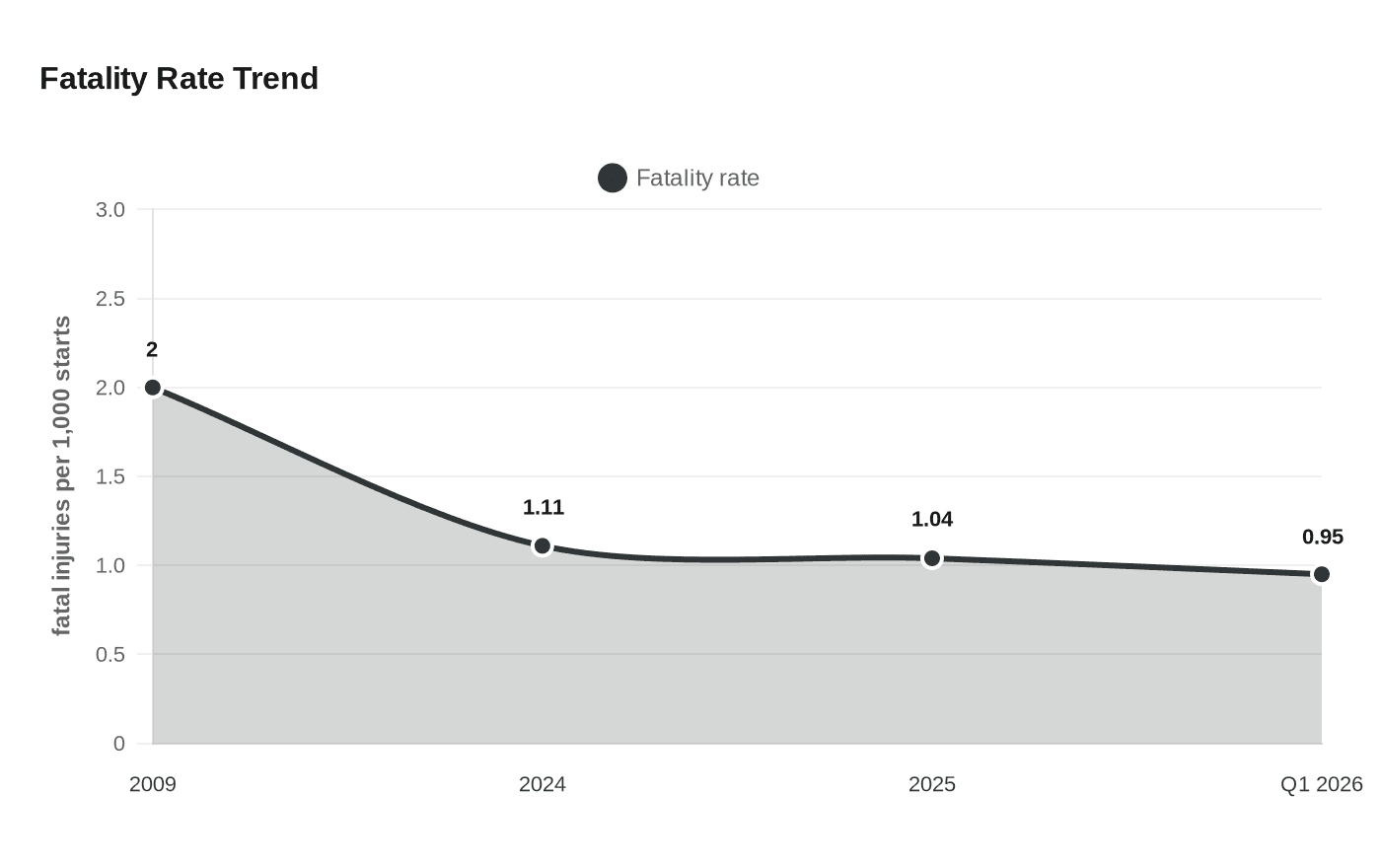
Horse racing can point to a stronger safety record than it had a decade ago. The latest figures show fatal injury rates falling, with The Jockey Club’s 2024 Equine Injury Database data at 1.11 fatal injuries per 1,000 starts, the lowest since the database began, and the Horseracing Integrity and Safety Authority reporting 1.04 racing-related equine fatalities per 1,000 starts under its jurisdiction in 2025. HISA’s first-quarter 2026 metrics pushed that rate down again to 0.95 per 1,000 starts, with 99.9% of starts ending without a fatality.
That progress matters. It gives the sport something concrete to point to when it argues that safety reforms are working. But the deeper question is not whether deaths are less frequent. It is whether the industry is accurately measuring the injuries that still shape horses’ lives, owners’ costs, trainers’ decisions, and the public’s judgment about whether racing deserves its social license.
Why fatality counts understate risk
The central warning from the current safety debate is simple: a lower fatality rate does not mean racing is safe enough to stop asking harder questions. Serious non-fatal injuries, especially those that remove horses from training or competition long before a fatal breakdown occurs, often disappear from the official conversation.
That gap matters because public trust is not built only on the absence of deaths. It is built on whether the sport can show that it sees the full burden of harm. A track safety system that counts only fatalities can miss the broader pattern of musculoskeletal damage, chronic welfare issues, and injuries that change a horse’s career even when they do not end it.
The point lands especially hard after the Derby, when welfare debates tend to widen and the sport’s scrutiny intensifies. Once the big race is over and the headlines move from celebration to accountability, the question becomes whether racing is merely reducing visible catastrophe or genuinely reducing injury at every level.
What the Equine Injury Database was built to do
The Jockey Club launched its Equine Injury Database in July 2008, and the national reporting program began in 2009. It was designed to identify the frequency, types, and outcomes of racing injuries using standardized data, which is exactly the kind of framework a sport needs if it wants to make safety more than a talking point.
The EID is also the first national database to record injuries occurring during racing and training. That distinction is important because injuries do not begin and end with what happens in a race. The database collects training and non-racing fatalities as well, even though those are not included in the annual EID statistics. In other words, the system already knows that the welfare picture is larger than the headline totals. The challenge is making the industry and the public pay attention to that broader picture.
The Jockey Club also defines a catastrophic racing injury in precise medical terms: it is a leg injury in which the stability of the leg is completely disrupted, consistent with triage scores IV and V. That definition underscores how severe the most visible injuries are, but it also shows why the sport cannot afford to focus only on the worst-case outcome. By the time an injury meets that threshold, the damage is already severe and often irreversible.
What HISA’s numbers add to the picture
HISA’s reporting reinforces the same trend line and the same caution. Its 2025 Annual Metrics Report showed racetracks under its jurisdiction recorded 1.04 racing-related equine fatalities per 1,000 starts last year. That is still roughly half the 2.00 rate when national tracking began in 2009, a sign that the sport has made material progress over time.
The first-quarter 2026 metrics report pushed the rate lower still, to 0.95 per 1,000 starts, with 99.9% of starts occurring without a fatality. Those are the kinds of numbers racing leaders want to show when they argue that rules, medication controls, surface management, and oversight are working.
But the same reporting also points to where the next layer of risk lives. HISA said musculoskeletal causes accounted for more than 75% of racing-related fatalities in the second quarter of 2025, up from approximately two-thirds in 2024. That is a major signal that the problem is not disappearing. It is concentrating in the body systems most associated with breakdown and structural failure.
HISA has also said microdamage and atrial fibrillation findings are among the issues being studied by its working groups. That matters because it shows the safety conversation is shifting from post-incident counting to early detection, injury prevention, and physiologic warning signs. The industry is no longer just asking how many horses die. It is also asking what precedes those deaths and how those warning signs can be caught sooner.
Why fuller injury reporting would change the sport
A more complete injury picture would affect more than data tables. It would shape policy, funding priorities, and how racing explains itself to the public.
- Track-level decisions could shift toward earlier intervention if training injuries and non-fatal breakdowns were more visible in annual reporting.
- Veterinary protocols could become more aggressive about identifying microdamage before it turns into catastrophic failure.
- Surface maintenance and race spacing could be evaluated against a broader injury burden, not just death totals.
- Public messaging would become more credible if it acknowledged that the sport is measuring harm honestly, not only celebrating lower mortality.
That is the social-license issue at the center of the debate. Racing does not keep public trust by saying deaths are rare and stopping there. It keeps trust by showing that it understands the full cost of participation, including the injuries that do not make the front page but still determine whether owners stay in the game, trainers change plans, and horses continue or end their careers.
The next phase of safety is prevention, not just counting losses
The direction of travel in racing safety is already clear. HISA’s Protocol for Catastrophic Injury and The Jockey Club’s injury-surveillance work both point toward a future where prevention carries more weight than reaction. That is the right shift. If the sport wants to prove that its progress is real, it has to show that it is watching for the injuries that precede catastrophe, not only the ones that confirm it.
Fatality rates are falling, and that is worth recognizing. But the sport’s credibility will rest on whether it can track the full injury landscape with the same seriousness it now applies to deaths. The next credibility test is not whether racing can count fewer fatalities. It is whether it can count, understand, and reduce the harms that still stay hidden behind those improving numbers.
This article was produced by Prism’s automated news system from verified source data, official records, and press releases, then run through automated quality and moderation checks before publishing. The system is built and supervised by the people who set the standards it runs under. Read our full AI policy.
Did this article answer your question?