How to Read 2-Year-Old Breeze Show Data Beyond Raw Times
A :10 1/5 furlong breeze can be the worst buy at the sale; the horse that goes a tick slower but gallops out long and straight is often the one worth doubling your budget on.
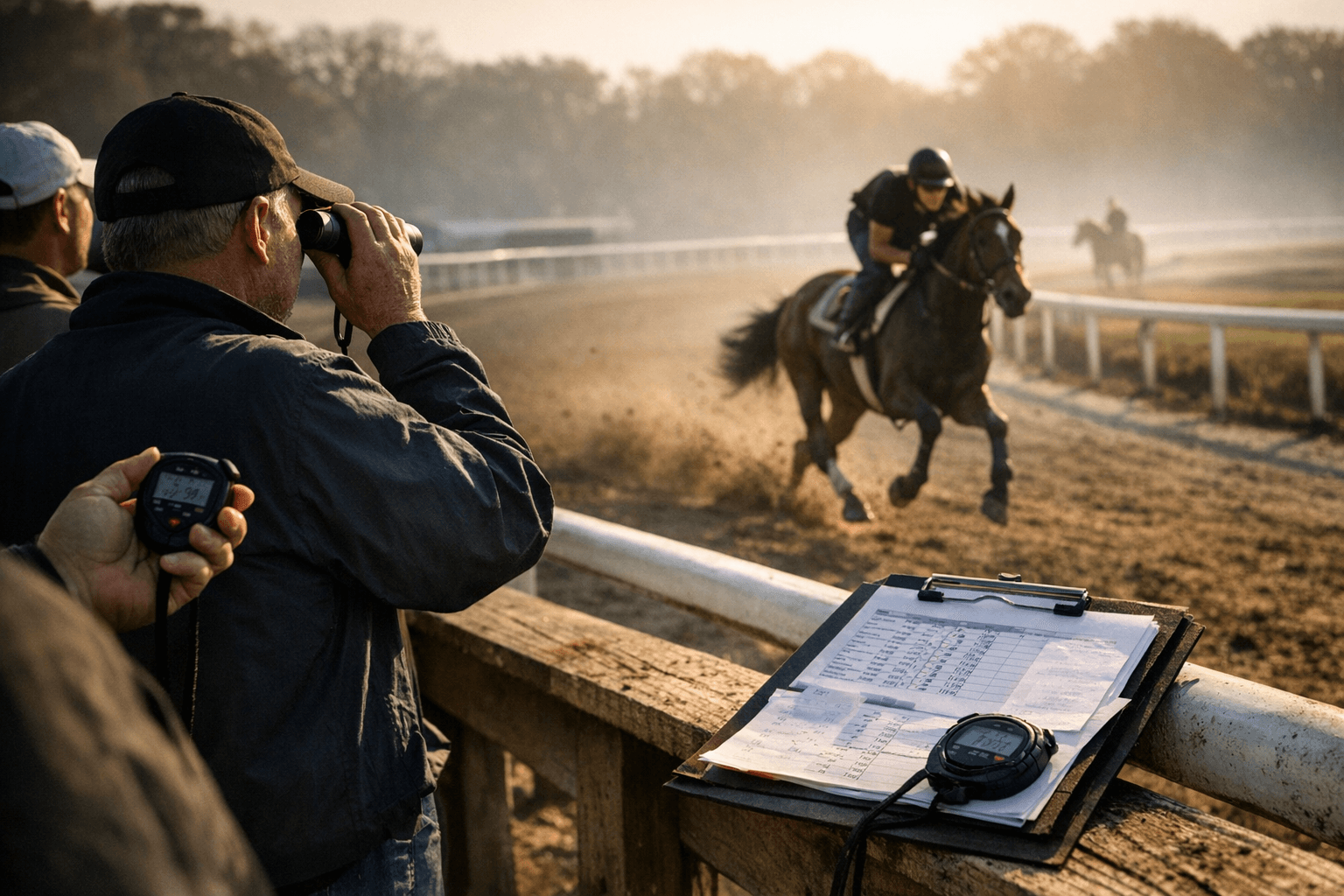
The Clock Is Lying to You
Every spring, buyers crowd the rail at OBS and Keeneland, eyes locked on the tote board as fractions flash. A colt clocks :9 4/5 for an eighth of a mile and the phones come out. Agents start triangulating. By the time the sale opens, that time has been photocopied, texted, and whispered across five different barns as if it settles the matter entirely. It does not. Raw times at 2-year-old breeze shows are a starting point, not a conclusion, and the buyers who treat them as the latter are the ones paying $500,000 for a horse that fades in its first maiden.
The counterintuitive truth is this: the slightly slower worker is often the better bet. A colt going :10 flat but galloping out long, moving in a straight line with fluid hind-end engagement, is telling you more about his future than the :9 4/5 horse that pulls up abruptly after the wire and needs two handlers to settle. Speed is easy to time. Durability, trainability, and genuine athleticism are what you are actually shopping for.
Context Is Everything: The Track Variant Problem
Before comparing any two works, understand what the track was doing that day. At the OBS March 2024 under-tack show, nearly 20 horses went in :9 4/5, prompting one consignor to publicly note that the surface was "rapid fast" and that nobody's feelings would be hurt if the times came back a tick slower. When a track is playing that fast, a :10 1/5 from a horse with a smooth, ground-covering stride can actually represent a more controlled, professional effort than a :9 3/5 from a scrambling, high-knee action horse catching a tailwind on a lightning surface.
The rule is strict: compare a horse's work only to other horses who breeced in the same session, on the same day, over the same listed distance. Apples-to-oranges comparisons across different sale venues or different weather days are how buyers get into trouble. Use relative ranks within the session first, absolute times second.
It is also worth noting how the time was recorded. Electronic timers are now standard at major sales, but the measurement point matters: some works are timed from the quarter-mile pole, others from the three-eighths. Some consignors annotate their catalog pages with notes indicating whether a work was done "with a pull." That annotation changes the interpretation entirely. A :10 flat "with a pull" from a horse sitting on energy is a very different animal than an all-out :9 4/5.
What to Watch Past the Wire
The gallop-out is where serious buyers separate themselves from the crowd. OBS has even introduced a formal "gallop-only" catalog designation for consignors who prefer to showcase their horses without a timed breeze, specifically because the industry acknowledges that how a horse moves matters as much as how fast it moves. Watch for:
- Gallop-out length and energy: A horse that continues willingly past the wire, extending stride and covering ground, is showing aerobic capacity and mental willingness.
- Straightness: Veering, lugging in, or fighting the rider signals training challenges ahead.
- Stride quality: Strong hind-end engagement and a fluid top line are preferable to a rapid cadence that looks busy but covers little ground per stride.
- Demeanor: A calm, workmanlike horse that settles quickly after the breeze is easier to train at two than one that exits wound tight and unmanageable.
None of this shows up on the tote board. It shows up in your own notes if you are watching carefully.
One Work Doesn't Make a Horse
A single blistering breeze is interesting. A pattern of progressively faster, consistent works paired with good behavior and a willing gallop-out is the actual signal. A colt who shows steady improvement across multiple under-tack sessions, maintains good demeanor throughout, and matches strong physical conformation in the catalog is giving you far more information than the one-hit wonder who posts a track-fast blowout and then stands in the barn looking hollow-eyed.
Physical maturity belongs in this conversation. A late-maturing individual with excellent movement and a measured work may be a better long-term investment than an early, short-striding juvenile who is already giving you everything he has just to run a furlong.
Pedigree as a Calibration Tool
Under-tack data does not exist in isolation from breeding. An Into Mischief or Gun Runner colt who breezes well at a 2-year-old sale deserves immediate attention for juvenile dirt campaigns, because those sire lines consistently translate early speed into real racecourse results. A $2.2 million Gun Runner colt topping the OBS sale is not just a number; it reflects the market's learned understanding that the sire's offspring tend to deliver on breeze-show promise.
Conversely, a horse from a Wavering Monarch family or a turf-oriented dam line showing similar times requires a different interpretation. That horse may breeze well precisely because it is big, scopey, and physically mature, but its ultimate ceiling might be a mile and a quarter on turf at three or four rather than a six-furlong dirt sprint at two. Same time, entirely different meaning.
How Handicappers Should Apply This
For early juvenile stakes and maiden special weight handicapping, sales works function best as a filter, not a final answer. The practical approach:
- Track horses who stood out in their sale session and then monitor their first public workouts after purchase. A sales standout who immediately shows a sharp, professional morning move is worth real attention.
- Cross-reference trainer patterns. Certain trainers convert breeze-show standouts into first-out winners at a consistently higher rate than the field. That edge compounds with a strong sale performance.
- In debut exotic wagering, use a two-group structure: key on sales standouts paired with trainers who carry strong first-out percentages, and use as secondary coverage any proven maidens dropping in class or showing strong recent public workouts.
For straight win wagering, avoid singling exclusively on sales times. The public often over-bets the fastest breezer in the catalog, suppressing value on the horse with the better gallop-out, the better pedigree fit, and the sharper post-purchase morning works.
The Discipline That Separates Buyers
OBS President Chad Wojciechowski put the framework plainly when discussing the sales process: "The time is just one metric that should be involved in that process." That is the whole argument in a sentence. The buyers and handicappers who build a multi-factor checklist around session context, gallop-out quality, work consistency, pedigree calibration, and trainer patterns are consistently better positioned than those chasing the fastest fraction of the day. The raw time gets you to the right page of the catalog. Everything else tells you whether to write the check.
This article was produced by Prism’s automated news system from verified source data, official records, and press releases, then run through automated quality and moderation checks before publishing. The system is built and supervised by the people who set the standards it runs under. Read our full AI policy.
Did this article answer your question?