Lucinda Finley on HISA enforcement fight as legal pressure mounts
Lucinda Finley says the HISA fight now reaches the barn, the entry box and the balance sheet, with every new ruling shaping enforcement on the ground.
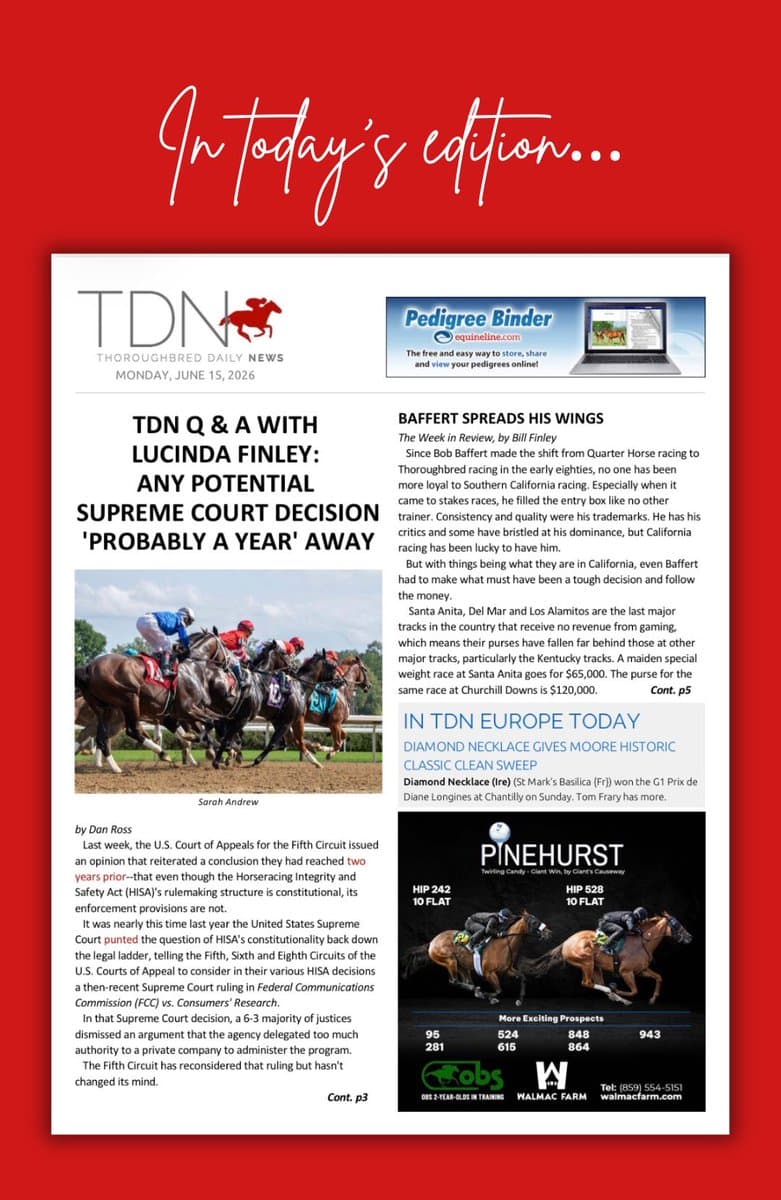
The HISA fight is no longer an abstract test case. Each new ruling now lands where horseplayers and horsemen actually feel it: in suspensions, in enforcement certainty, in track budgets and in whether the same rules really apply from one jurisdiction to the next.
Why this still matters on a racing day
Lucinda Finley’s latest take on the enforcement battle arrives as the sport keeps absorbing another round of legal pressure around the Horseracing Integrity and Safety Authority. HISA is a federally authorized, private self-regulatory organization overseeing most Thoroughbred racing in the United States, which means its reach is broad when it works and deeply contested when it does not.
That distinction is not academic. When enforcement authority is under attack, the practical question for the backstretch is whether a violation leads to a penalty that sticks, whether an appeal can unwind it, and whether the racing office can trust the system enough to build entries and suspensions around it. For horseplayers, the effect shows up in the integrity of the card; for participants, it shows up in whether the rules feel settled from one week to the next.
The enforcement fight is the part that bites hardest
The latest coverage around Finley, including TDN America’s Q&A and Bill Finley’s Week in Review, underscores the same point: the most combustible issue is not just whether HISA exists, but whether its enforcement structure can keep functioning as designed. That is the piece opponents have targeted most aggressively, and it is the piece that most directly shapes race-day operations.
If enforcement power weakens or gets carved back, the sport faces a more fragmented landscape. Fines, suspensions and other discipline can become harder to defend or more vulnerable to challenge, and the ripple effects run straight into entries and availability. A trainer sidelined by a suspension, or a stable waiting on an appeal, is not just a courtroom story. It changes who can run, who can train and which barn can keep a campaign on schedule.
The fee dispute that reached a federal court in Kentucky on April 1, 2026 adds a different kind of pressure. In that case, the court ruled HISA acted outside the law when it calculated fees partly based on purse sizes. Churchill Downs Inc. has framed HISA’s recent actions as overreach, while HISA has kept pressing for payment of millions of dollars in assessments from CDI-owned tracks. That matters because the fight is no longer only about discipline. It is also about who pays for the system and how much leverage the authority has over the industry it oversees.
How the case got to this point
The legal road has been long and uneven. In March 2023, the Sixth Circuit upheld HISA as constitutional, giving the authority a major early win. Then the legal map shifted in July 2024, when the Fifth Circuit ruled that HISA’s enforcement structure violated the private nondelegation doctrine.
The next month, the Eighth Circuit added a different note, saying in September 2024 that challenges to HISA had little likelihood of success. That split in tone helped keep the issue alive and gave both supporters and opponents reasons to keep fighting in multiple courts at once.
The Supreme Court then stepped in to preserve the status quo on Oct. 28, 2024, staying the Fifth Circuit mandate while it considered review. On June 30, 2025, the justices issued additional orders sending HISA-related cases back for further lower-court review, a move that prolonged the uncertainty instead of ending it. The Sixth Circuit heard oral argument again on Nov. 12, 2025, and then ruled again on Dec. 18, 2025 in favor of HISA’s constitutionality. That sequence tells the whole story: no single ruling has closed the door.
What horsemen should watch next
For participants, the immediate takeaway is that HISA is still operating, but its authority remains under sustained pressure. That means the sport is likely to keep living with a two-track reality: a national framework that governs most Thoroughbred racing, and pockets outside that system where litigation and injunctions have left West Virginia and Louisiana outside HISA jurisdiction.
That split matters because uniformity is the whole promise of the program. If one state is operating under HISA rules and another is not, trainers, owners and racetracks must navigate different enforcement expectations, different appeals paths and different levels of certainty. Even when the day-to-day card looks normal, the underlying rulebook can feel less stable than it did when the authority was launched.
The stakes are also financial. Churchill Downs Inc.’s fee fight shows that HISA’s reach is not limited to disciplinary matters. If the authority cannot defend how it assesses money, then the industry will keep seeing challenges to how the system is funded and who bears the cost. That, in turn, affects the operating environment at the tracks that have to write the checks.
The racing story is still moving forward
The legal noise has not stopped the sport from looking ahead to the next target on the calendar. Sovereignty’s Saratoga work for the Stephen Foster is a reminder that the horses keep training, the race plans keep forming and the practical side of racing keeps moving even while the courts grind through another round.
That is the real lesson in Finley’s read on the fight. HISA’s future is still being argued in federal courts, but the consequences are already in the barns, in the stewards’ offices and in the race cards that participants rely on every week. Until the legal picture settles, enforcement will remain a live issue, and the sport will keep feeling the tension between a national safety regime and a legal battle that refuses to stay in one lane.
This article was produced by Prism’s automated news system from verified source data, official records, and press releases, then run through automated quality and moderation checks before publishing. The system is built and supervised by the people who set the standards it runs under. Read our full AI policy.
Know something we missed? Have a correction or additional information?
Submit a Tip