May wagering falls 4.01 percent as purses edge higher, Equibase reports
Wagering slid to $1.39 billion in May, but purses still edged higher, a split that raises a bigger question about racing’s financial footing.
Horse racing’s money line split in May: wagering fell 4.01 percent to $1,387,522,075, even as available purses climbed to nearly $123 million. That mismatch matters because handle is still the sport’s clearest measure of commercial strength, and the latest numbers show the industry can support higher purse levels even while betting volume cools.
Equibase’s monthly economic report pointed to a sport that is still generating serious cash flow, but not at the same pace as a year ago. Available purses increased 0.12 percent from May 2025, while paid purses also edged up, topping $118 million after a 0.09 percent gain. Those increases were small, but in a game built on tight margins, even a slight move in the right direction can change how many horses get bred, stabled, entered and shipped.

The better purse picture is good news first for owners and trainers, who live and die by earnings opportunities. Higher purses can help keep horses in training longer, make it easier to justify the cost of a campaign and, in some circuits, encourage fuller fields. That last part matters to bettors too: more competitive fields usually make for a better wagering product, which in turn can help handle. The catch is that the loop only works if the betting side stays healthy enough to feed the purse structure.
May’s lower race-day total adds another wrinkle. Fewer cards mean fewer chances for bettors to play and fewer races to compare against the same month a year earlier, which can distort the year-over-year picture. Even so, a 4.01 percent drop in wagering is not a trivial dip. It suggests that softness in handle is real, not just a calendar quirk, and if it persists, tracks will feel pressure even as purses hold up in the short term.
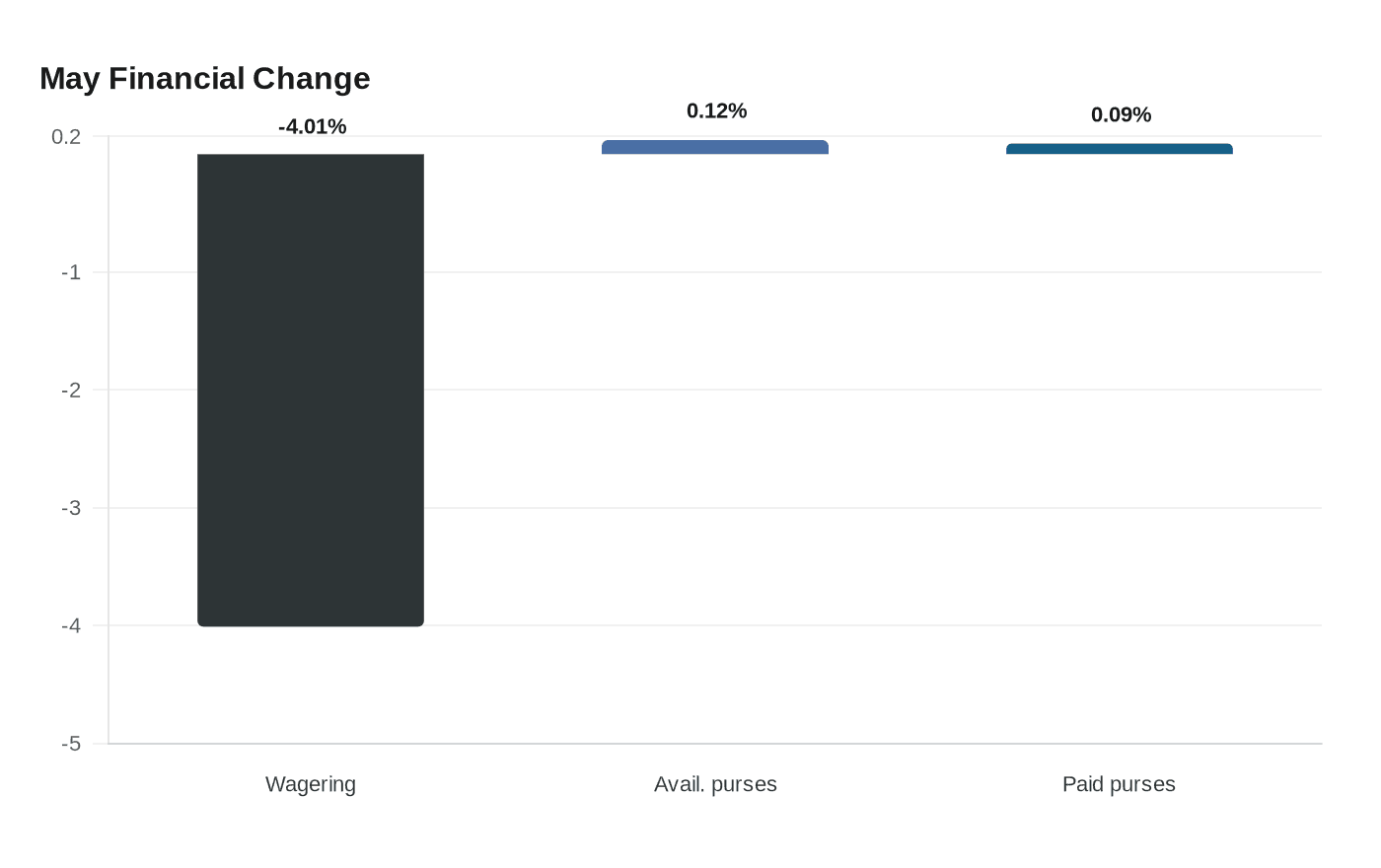
For now, the report tells a familiar story in racing: purses can rise, or at least stay firm, before wagering does. But if handle keeps slipping while race days shrink, the sport risks leaning on a support system that becomes harder to sustain. The numbers were stable enough to avoid alarm, but uneven enough to warn that racing’s financial balance still depends on bettors showing up.
This article was produced by Prism’s automated news system from verified source data, official records, and press releases, then run through automated quality and moderation checks before publishing. The system is built and supervised by the people who set the standards it runs under. Read our full AI policy.
Know something we missed? Have a correction or additional information?
Submit a Tip