Andre Agassi Backs Pickleball's Rise, Calls Malaysia a Prime Growth Market
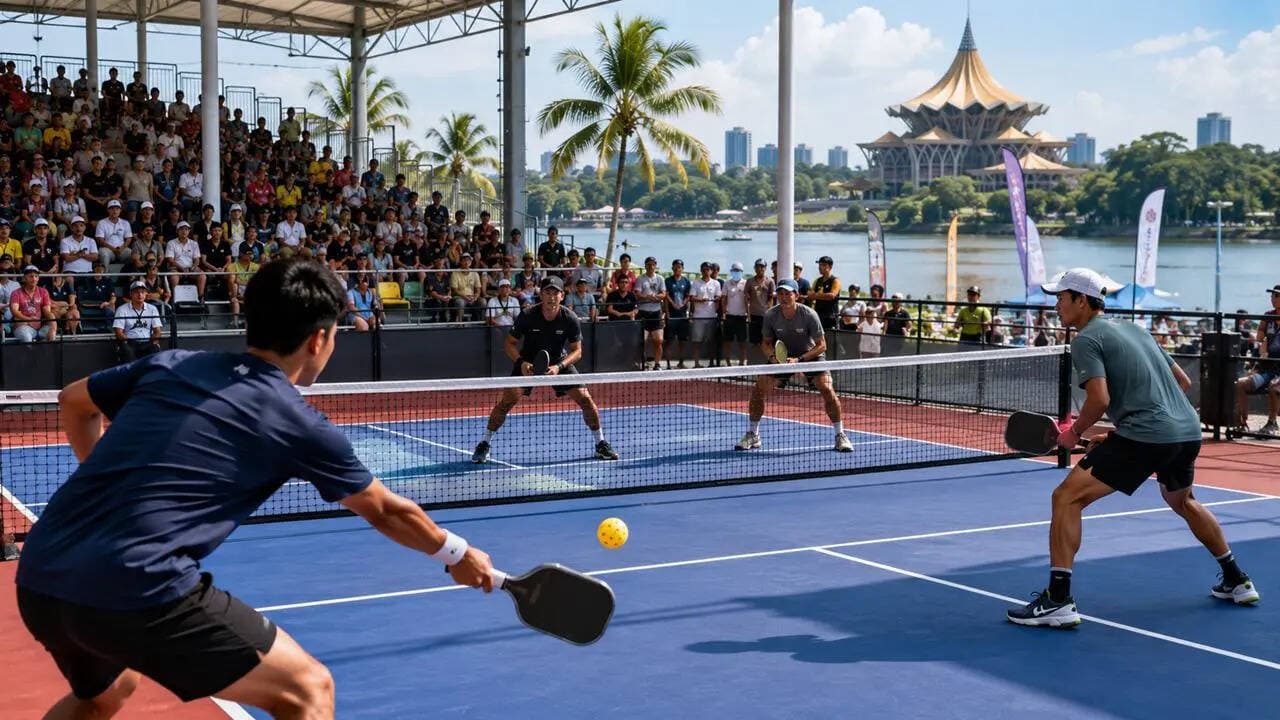
Agassi called Malaysia's pickleball scene a prime growth market at the JOOLA Titans Tour in KL, where World No. 1 Ben Johns headlined the highest match ever staged in the country.

Andre Agassi walked into Stadium Juara in Mont Kiara with a message that went well beyond exhibition tennis: pickleball's expansion across Southeast Asia is still in its earliest chapter, and Malaysia, he argued, is one of the best-positioned markets on earth to accelerate that story. Speaking at the JOOLA Titans Tour's Kuala Lumpur stop, the eight-time Grand Slam champion made the case that the sport's combination of smaller courts, minimal equipment requirements and a social-first playing culture gives it advantages in dense Asian cities that traditional racquet sports have never enjoyed.
The two-day event assembled a roster that would be competitive at any global tour stop. World No. 1 Ben Johns, who has accumulated more than 190 gold medals and holds the record for the most Triple Crown victories in professional pickleball history, headlined alongside Anna Bright, Federico Staksrud, Tyson McGuffin, Collin Johns, Brooke Buckner and Kate Fahey. The Kuala Lumpur stop also featured a strong Asia-Pacific contingent: Andie Dikosavljevic of Australia, Vietnam's Ken Tam, and Japan's Kenta Miyoshi and Aiko Yoshitomi gave the field genuine regional texture rather than token representation.
The marquee moment arrived at Merdeka 118, where Team Agassi faced Team Ben Johns in what organisers billed as the highest pickleball match ever staged in Malaysia. The rooftop setting turned a sporting exhibition into a city-scale spectacle, engineered for reach well beyond the attending crowd. Tickets for the Stadium Juara sessions started at RM169.
Agassi praised the event's community architecture as much as its headline draw. Organisers built the Kuala Lumpur stop around a dual agenda: April 7 delivered high-quality exhibition content and player meet-and-greets designed to give fans a world-class product, while April 8 will shift focus to grassroots development, with international pros scheduled to visit courts across the Klang Valley and university pickleball clubs engaged as part of a broader campus outreach strategy. That structure, Agassi argued, reflects how the sport has to grow everywhere it lands. Building a culture of weekly play matters more than any single celebrity showcase.

The commercial signals in Kuala Lumpur were deliberate. Brands, local organisers and media partners invested to ensure the event extended beyond the venue, and the pairing of community programming at Stadium Juara with a global-landmark activation at Merdeka 118 reflected a strategy of positioning pickleball as both competitive sport and lifestyle property simultaneously.
Agassi's involvement carries weight that pure sporting credentials cannot manufacture. His name draws in sponsors, broadcasters and venue operators who read his endorsement as a market signal. For Malaysia, that attention lands at exactly the moment when infrastructure decisions are still being shaped.
What the country builds from here is the real test. The Titans Tour can generate awareness in a weekend, but sustaining that into permanent courts across residential areas, a certified coaching pipeline, sanctioned amateur competition ladders and embedded youth programmes requires investment long after the tour moves on. Malaysia has the urban scale, the sporting appetite and now the global attention. The next twelve months will show whether the infrastructure follows.
This article was produced by Prism’s automated news system from verified source data, official records, and press releases, then run through automated quality and moderation checks before publishing. The system is built and supervised by the people who set the standards it runs under. Read our full AI policy.
Did this article answer your question?