Dubai's Picklers Club Offers Six Courts, Full Amenities, and Community Programming
Picklers has quietly built the Gulf's most complete pickleball operation: six purpose-built indoor courts in Dubai where 290+ members play year-round, impervious to summer heat.
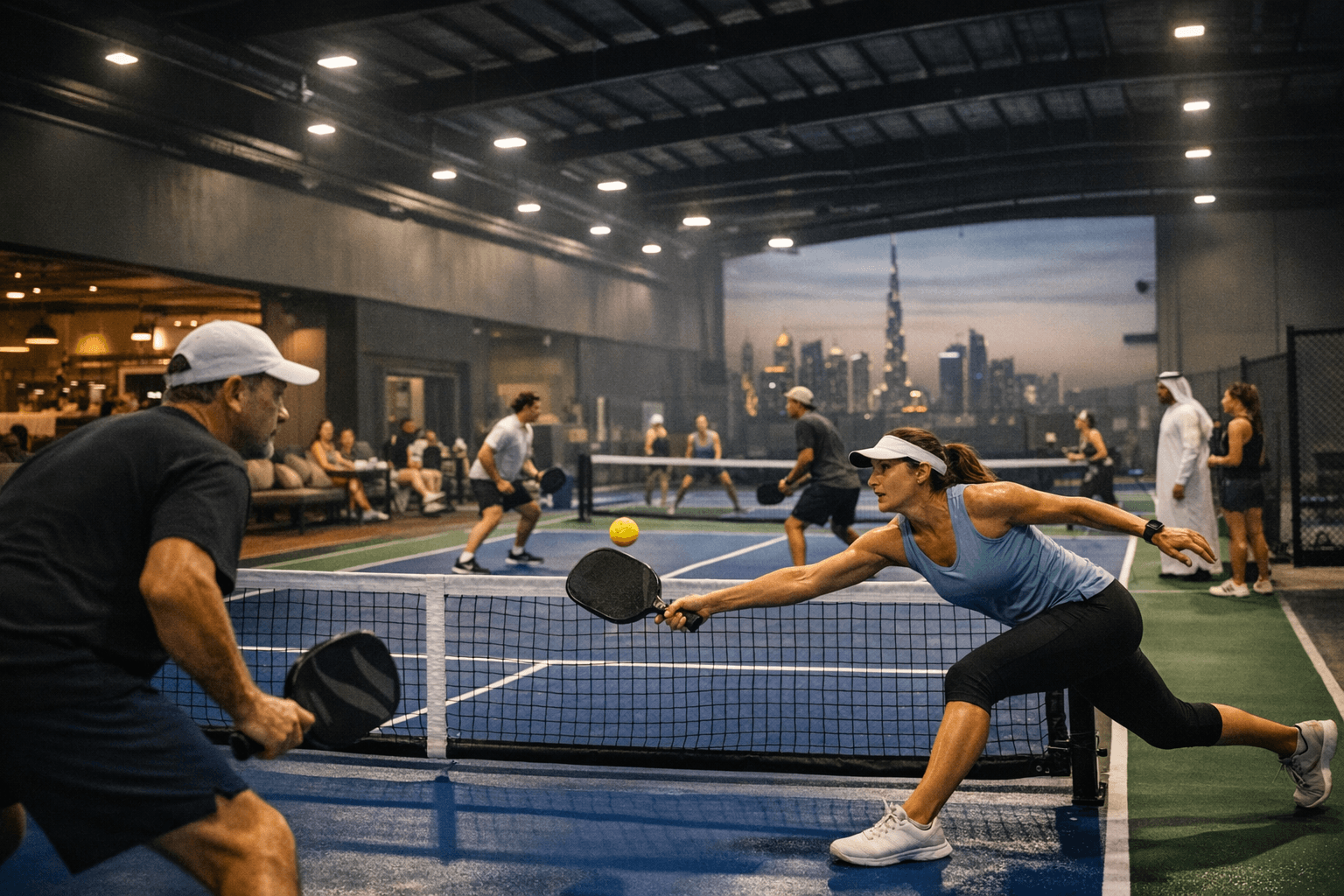
When Dubai's summer arrives and outdoor sport becomes genuinely dangerous, with temperatures regularly exceeding 45 degrees Celsius from June through September, most recreational facilities either thin their programming or close altogether. Picklers, the city's purpose-built indoor pickleball club, treats those months as peak season. That design choice, a six-court climate-controlled venue with permanent infrastructure rather than a seasonal pop-up, is not just a comfort amenity; it is the economic foundation that makes professional-grade community sport viable in the Gulf year-round.
Why Indoor Infrastructure Changes the Business Model
An outdoor or semi-covered court in Dubai can generate revenue for roughly six to seven months before heat, humidity, and wind render play unattractive. An indoor venue with professional-grade lighting and acrylic hard-court flooring operates on a twelve-month calendar. That sounds obvious, but the consequences compound quickly: coaches can offer consistent weekly session schedules without weather cancellations, league organisers can sell season-long competitive brackets to corporate sponsors, and juniors can develop technique across an uninterrupted programme year. None of that is reliably possible in a heat-exposed environment.
Picklers' six courts are all permanent installations, meaning dedicated acrylic and hard-court surfaces with fixed lines and nets. There is no setup or teardown overhead per session, no shared-use compromise with other sports, and no variation in court quality from one booking to the next. For players tracking improvement, that consistency matters as much as the air conditioning.
The Amenity Stack That Supports Serious Play
The physical infrastructure at Picklers goes well beyond court surface and lighting. The facility includes a dedicated pro shop stocking equipment and apparel, a bistro and café for pre- and post-play socialising, and full locker rooms with showers. Those three elements together signal something specific: this is a venue designed for people who treat pickleball as a regular fitness and social commitment, not an occasional drop-in.
The pro shop in particular matters for the club's coaching economy. When certified instructors operate inside a facility that also retails paddles, strings, and apparel, new players can progress from a first lesson to a first equipment purchase without leaving the building. That seamless pathway from curiosity to equipped participation is how well-run racket clubs have converted casual visitors into committed members for decades, and Picklers has replicated it for pickleball.
The bistro extends the dwell time of every visit. Players arrive, compete, then linger for a meal or coffee, and those additional minutes in the club are additional minutes building the social glue that drives word-of-mouth growth. The more than 290 players currently connected to the Picklers location on the Pickleheads platform are a direct product of that environment: a community that organises, socialises, and recruits inside the facility rather than dispersing the moment a session ends.
Programming: From First Serve to Competitive League
The member journey at Picklers is structured as a progression rather than a simple court-rental transaction. Open play sessions are the entry point, scheduled regularly and reservable so that first-time visitors can arrive knowing they will find partners at an appropriate level. That reservability is significant: it reduces the uncertainty that deters beginners, who often abandon a new sport when they show up at an unfamiliar venue unsure whether courts will be available.
From open play, players move into the lesson ecosystem. Private and group lessons connect members with on-site trainers, and those coaching relationships typically accelerate the progression into the club's organised league offerings. Leagues at a six-court venue can run multiple divisions simultaneously, grouping players by skill bracket so that competitive matches are meaningful rather than lopsided. This structure is what converts a recreational visitor into a member with a long-term stake in the club calendar.
Corporate and team-building events extend that programming model into a B2B revenue stream. A fully staffed, six-court indoor venue with catering, locker facilities, and instructors on hand is a straightforward corporate events package: Dubai-based businesses can book court time, bring a group of colleagues, and receive a structured competitive experience delivered entirely on-site. For a club covering the fixed costs of a purpose-built facility, that corporate booking segment is the difference between a venue that operates at thin margins during business hours and one that generates consistent weekday revenue.
Youth and adaptive programming round out the offering. Junior programmes create a long-term membership pipeline as young players age into adult participation, while wheelchair-accessible courts and adaptive sessions signal that the club's growth model is rooted in broad community reach rather than a purely elite demographic.
The Booking Logic and Peak Demand
Court reservations are available at Picklers, and open play access is built into the club's programming architecture. In Dubai's broader pickleball market, the peak-versus-off-peak dynamic is pronounced: weekday daytime slots draw lower demand from working professionals, making them the accessible entry point for retirees, freelancers, and visitors, while evenings and weekends generate higher demand and fill fastest. At a six-court venue, that surge can be absorbed through reservation windows rather than the first-come queuing that frustrates players at smaller facilities.
That reservation architecture is part of why a six-court model outperforms a two- or three-court setup in economic terms. With six courts running simultaneously, the club can absorb league programming on courts one through three while running open play on courts four and five and holding court six for a private lesson, all in the same time block. A smaller venue must choose; Picklers does not.
Dubai's Position in the Regional Circuit
For event organisers eyeing the Gulf for tournament stops, the operational calculus at Picklers is straightforward. Six permanent indoor courts with professional lighting, spectator capacity, on-site food service, and locker facilities remove the main logistical friction points from staging a multi-day event during Dubai's hottest months. Tournaments that would be unworkable outdoors in July or August become routine at a climate-controlled venue of this scale.
That positions Picklers as one of the most credible local partners in the region for visiting professional coaches, cross-border club competitions, and regional exhibition events. Clubs capable of hosting multi-day events need physical capacity, customer service infrastructure, and an existing participant community to populate the draws; Picklers holds all three.
Across Asia's other major hub cities, the pickleball scene is developing rapidly but the purpose-built indoor model remains rare. Singapore's growing pickleball community largely operates across converted multi-sport halls and shared badminton-court facilities. Bangkok and Kuala Lumpur have seen significant uptake, primarily through club-nights at existing sports centres rather than dedicated venues. Tokyo's pickleball infrastructure skews towards urban court-rental operators working within multi-use spaces. Dubai's Picklers, with its six-court dedicated layout, integrated retail, food and beverage, and full community programming stack, currently offers the most complete purpose-built pickleball bundle operating under a unified brand among any of these hub-city comparators.
The sport is growing fast enough across all these markets that dedicated venues will follow. But the six-court indoor model that makes Picklers commercially viable year-round in a desert city stands as the clearest proof of concept available for what a purpose-built pickleball facility can look like at scale.
This article was produced by Prism’s automated news system from verified source data, official records, and press releases, then run through automated quality and moderation checks before publishing. The system is built and supervised by the people who set the standards it runs under. Read our full AI policy.
Did this article answer your question?