Philippines pickleball boom draws Friday Pickleball as market grows
Packed courts and 1,049 courts make the Philippines a real test case for Friday Pickleball. The bigger question is whether brand money widens access or just chases demand.
The Philippines is now a live test for pickleball’s next phase
Pickleball has moved well past curiosity in the Philippines. Open play is packed, new courts keep appearing, and players who used to come from basketball, tennis, badminton, or no organized sport at all are asking where to buy paddles and what DUPR means. That matters because it shows the sport is crossing from early-adopter circles into everyday recreational life, which is exactly the kind of momentum international brands want to see before they commit.
The country already has the structure brands look for
This is not an empty market with a few scattered pick-up games. The Philippine Pickleball Federation lists 423 clubs and 1,049 courts, along with a player registry that connects clubs, tournaments, and communities nationwide. It also ties sanctioned events to ranking points and qualification pathways, which gives the sport a real competitive ladder instead of just a social scene.
That structure has been building for years. Pickleball first took root in the Philippines in 2016, the first club followed in 2017, and the number of clubs later jumped from 13 in 2021 to 123 nationwide by August 2024 as demand expanded beyond the original pockets of play. Major malls have also started allocating space for courts because weekend demand has been so strong, a sign that the sport is no longer living only inside niche athletic circles.
Friday Pickleball is betting on fit, not just flash
Friday Pickleball’s move into the Philippines is best read as a long-term market bet. The U.S.-based brand has built its identity around making pickleball feel fun-first, social, and accessible, and that positioning lines up neatly with a Philippine scene that is community-driven and eager to welcome new players. The company’s own messaging also stresses that beginners do not need to spend $250 or more on their first paddle, which fits a market where price still shapes how fast participation can spread.
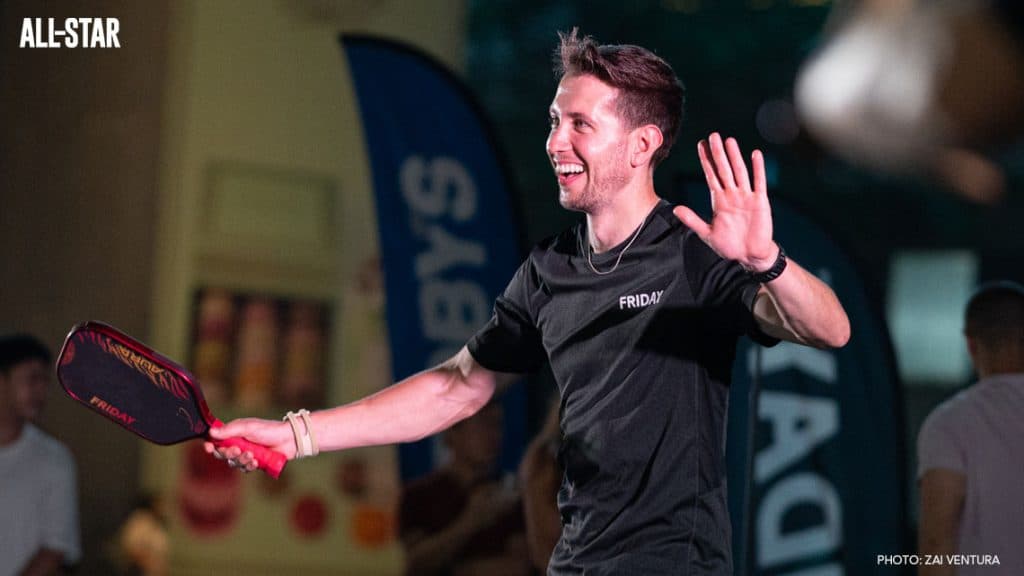
The Manila launch itself reinforces that this is more than a simple product drop. Friday staged a weekend-long takeover on May 16 to 17, 2026 at 5th Ave. Central, Bonifacio High Street in BGC, with co-founders Jake Triplett, Isaac McDonald, Scott Peck, and Matt Czarnecki in town alongside ambassadors Kyle Koszuta, Kevin Dong, and James Lin. Toby Claudio, president and COO of Toby’s Sports, was also part of the launch picture, which matters because retail channels are often the bridge between buzz and real consumer adoption.
Price sensitivity will decide how broad the boom becomes
The biggest question for the market is not whether pickleball is hot. It is whether that heat reaches beyond players who can comfortably buy premium gear, pay for coaching, and book court time on a regular basis. In Cebu, one player said she started with about P3,000 for two paddles, then quickly upgraded to a P16,000 paddle, added a P3,000 sports bag, P6,000 shoes, P6,000 protective eyewear, and coaching that cost about P500 per hour, while a coach in the city charges P1,300 for a two-hour session before court rental.
That same Cebu report shows the sport’s accessibility problem in plain terms. With the minimum wage in Expanded Metro Cebu set at P540 a day, or roughly P11,880 a month before deductions, even a single mid-range paddle can exceed a worker’s monthly take-home pace. Players who cannot afford court rental often lean on free open play, but those sessions can come with long waits because demand is so high.
What everyday players stand to gain
If Friday and other international brands invest the right way, the immediate winners could be ordinary players. More brands can lower the intimidation factor by bringing in clinics, open-play activations, and easier entry-level gear, while the federation’s registry and ranking system give newcomers a clearer path from casual games to sanctioned competition. That combination can deepen grassroots participation instead of leaving the sport trapped in premium urban pockets.
The risk is just as clear. If outside money only targets the already-hot crowd in Manila, Cebu, and other dense urban centers, the boom becomes a retail story rather than a real growth story. The better outcome is broader access, more court inventory, and a stronger bridge from community play to club competition, because that is where pickleball stops being a fad and starts becoming part of the national sports fabric.
Why the Philippines matters for Asia
The Philippines is emerging as one of Asia’s most promising pickleball markets because the ingredients are already in place: visible demand, expanding courts, a dense club network, and a formal pathway for rankings and national selection. That makes it a more convincing expansion market than places where the sport is still searching for a base of regular play, and it explains why brands are starting to treat the country as a strategic foothold rather than a curiosity.
Friday Pickleball is arriving at the right moment, but the real verdict will come from what happens after the launch photos fade. If the brand helps widen access and supports the local ecosystem, it can ride the Philippines’ momentum into something durable. If not, it will still have identified the market, but the country’s players will keep deciding how far the boom can go.
Know something we missed? Have a correction or additional information?
Submit a Tip