USITC opens Section 337 case on imported pickleball paddles
USITC has opened a Section 337 public record targeting 12 paddle brands, a first procedural step that can end with U.S. import bans on specific pickleball paddles.
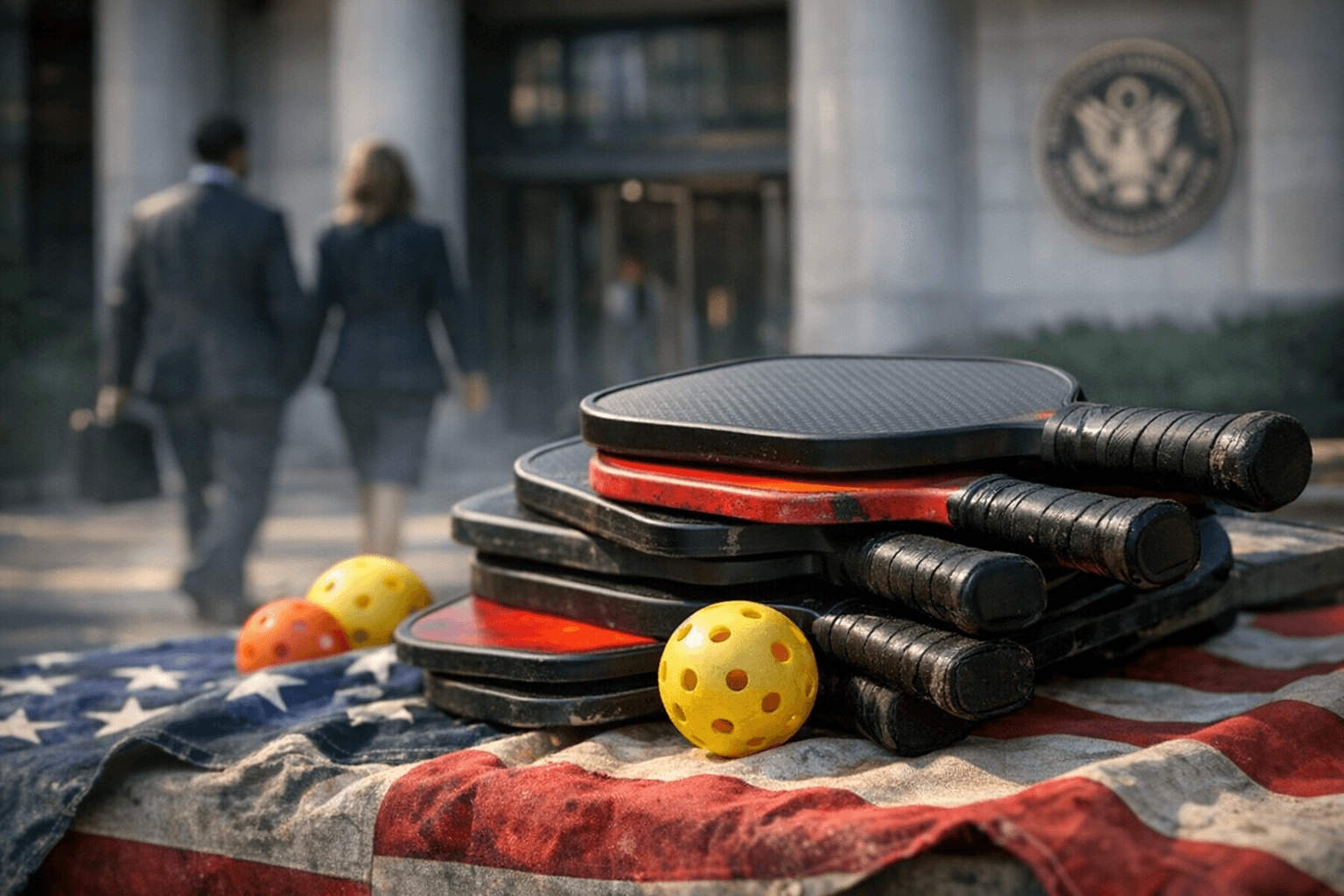
The U.S. International Trade Commission has opened a Section 337 public record that puts the North American paddle supply chain, and the Asia factories feeding it, on immediate alert: a patent-based complaint titled “Certain Pickleball Paddles” (DN 3898) that can ultimately lead to U.S. import exclusion orders blocking specific paddle models at the border.
Sport Squad, Inc., doing business as JOOLA and based in Rockville, Maryland, filed the complaint and the required §210.8(b) submission on April 7, 2026. The Commission’s Federal Register notice published April 10 formally acknowledged receipt, created the public docket, and solicited public-interest comments on the required factors, including effects on U.S. consumers, competitive conditions, domestic production of like articles, and public health and welfare. The matter appears on the Commission’s investigations portal as “In the Matter of Certain Pickleball Paddles; Inv. No. 337-TA-3898,” listed as “Pre-institution” in early April.
The notice identifies the alleged unfair act as patent infringement tied to importation and sale of “certain pickleball paddles,” and it names 12 respondents: Franklin Sports, Inc.; Proton Sports, Inc.; Vegas Pickleball LLC, doing business as RPM Pickleball; Engage Pickleball, LLC; Friday Labs, LLC; Diadem Sports LLC; Facolospickleball LLC; Paddletek, LLC; ProXR, LLC; All Racquet Sports, LLC; All For Padel S.L. of Spain; and Volair C Corp., Inc. The remedies requested are the ITC’s most commercially disruptive tools: limited exclusion orders, which direct U.S. Customs to stop covered imports, and cease-and-desist orders, which can restrict certain domestic commercial activities involving already-imported inventory.
For Asia-based paddle manufacturers and OEM factories, the threat is not abstract. A “limited” exclusion order is still a practical import ban on the named articles from the named respondents, which can cascade into last-minute production holds, relabeling decisions, or rapid reallocation of factory capacity to non-impacted product lines. It also hits brands selling into the U.S. that rely on Asia for cores, face materials, layup labor, finishing, and packaging, even when the brand’s headquarters and marketing are U.S.-based.
Timeline-wise, the critical dates on the record are already set: April 7 for filing and April 10 for the Commission’s notice and public-interest solicitation. The next procedural hinge is whether the Commission institutes an investigation, moving the case from “pre-institution” into the full discovery-and-hearing track that can end with exclusion or cease-and-desist remedies, followed by the statute’s Presidential review window and potential bond requirements for continued importation during that review period.
What changes tomorrow is commercial behavior. Expect cautious distributors to slow U.S.-bound purchase orders for any paddle families that could be implicated, while leaning harder on “clean” SKUs that are clearly outside the asserted patent scope. If U.S. demand pauses, inventory can slosh back into Asia: excess stock that was earmarked for American launches may be re-routed into Singapore, Malaysia, Vietnam, Japan, and South Korea, creating short-term discounting and abrupt price spreads between models that are seen as low-risk versus high-risk. Clubs and tournament operators planning demo days and prize tables should also brace for substitutions, because a Section 337 case pressures brands to avoid shipping anything that might later be accused of violating an order.
The timing is especially sensitive because Asia’s player base is no longer a rounding error. UPA Asia and YouGov Singapore have reported headline estimates across 12 territories of about 1.9 billion people aware of pickleball, about 812 million who have tried it at least once, and about 282 million who play at least monthly, from a survey described as 14,000-plus respondents with at least 1,000 per market. In a fast-commercializing region, a U.S. import-battle over paddle technology can quickly become an Asia retail and sponsorship story, with factories, endorsers, and event partners all adjusting before any final ruling is even on the table.
This article was produced by Prism’s automated news system from verified source data, official records, and press releases, then run through automated quality and moderation checks before publishing. The system is built and supervised by the people who set the standards it runs under. Read our full AI policy.
Did this article answer your question?