ITTF approval system keeps table tennis racket coverings fair and legal
A racket covering can tilt spin, deception, and legality in elite matches. The ITTF’s approval system keeps the list tight, the checks visible, and the equipment fair.
A single layer of rubber can decide how much spin a serve carries, how easily a defender reads the bounce, and whether a racket survives an equipment check. That is why the International Table Tennis Federation built a formal approval system around racket coverings, turning a small piece of gear into one of the sport’s most closely regulated competitive edges.
How the approval system works
The ITTF says racket coverings are governed by a structured chain that includes standards, Technical Leaflet T4, T4 approval, a get-authorized form, tests, a test protocol, and the List of Authorized Racket Coverings, known as LARC. That matters because manufacturers do not simply put a new rubber on the market and let elite players use it in competition. They submit coverings for review, and only approved models make the official list.
For players, the practical limit is simple: if a covering is not approved, it is not legal for competition use. That is where the fairness question begins, because the surface of the racket shapes grip, spin, speed, and how much a player can disguise the ball. In a sport where a few millimeters of contact can decide a point, the approval list is as much a competitive filter as a paperwork system.
Why a covering can change a match
Table tennis is built on tiny variations, and racket coverings can amplify them. Surface friction alters how much the ball bites on contact, sponge behavior affects pace and dwell time, and those two details can change the entire rhythm of a rally. A player with the right rubber can load more spin onto a serve, absorb pace on the backhand, or create deception that forces a late read from the opponent.
The ITTF’s own history shows that equipment control has always followed innovation. In the late 1970s, long-pimpled rubber and anti-spin coverings started appearing on the market, and those developments helped drive rule changes. The point was not to stop innovation, but to keep innovation from outrunning fair competition.
That is why the federation has treated racket rubber differently from an ordinary consumer product. At the elite level, equipment is part of strategy, not decoration, and a small manufacturing difference can become a real tactical advantage.
From red and black to a wider legal palette
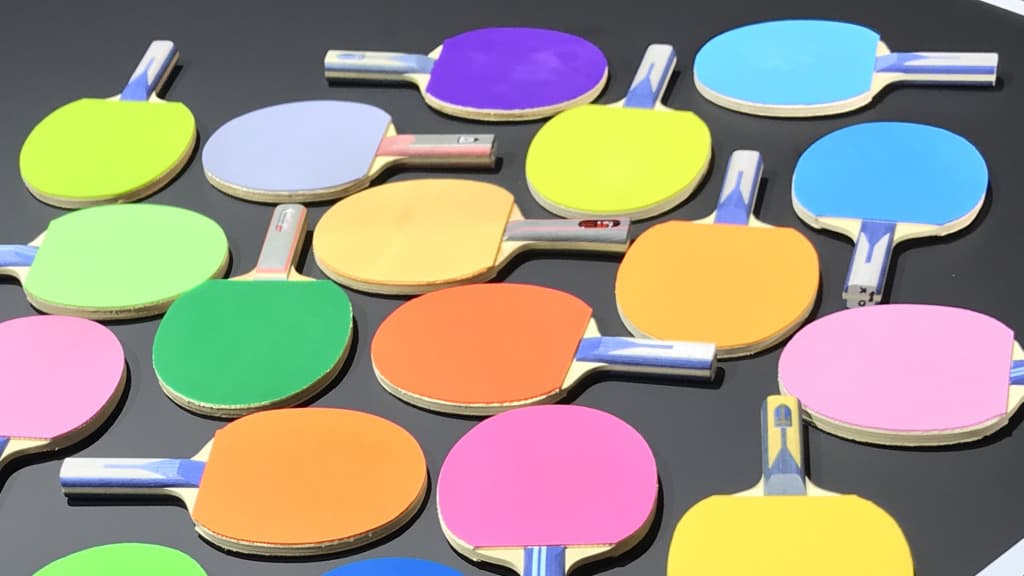
The best-known racket colors remain red and black, but the modern rules allow more. In 2019, more than 75% of delegates voted at the ITTF Annual General Meeting in favor of extending the colors of racket coverings, a sign that the sport wanted broader equipment options without loosening control. On 7 December 2020, the ITTF Board of Directors approved green, blue, violet and purple/pink as the new colors.
Manufacturers were then allowed to submit racket coverings in pink, purple, green and blue from 1 April 2021. The ITTF said those colors would become officially authorized from 1 October 2021, and by 30 September 2021 it described the change as a refinement of a regulation passed by Congress at the 1983 World Championships in Tokyo. That detail matters because it shows the color expansion was not a break from tradition, but an update built on an older framework of control.
The sport’s color rules also reflect the need for visibility. New shades can widen design choices for manufacturers and players, but the racket still has to remain readable in play for opponents and officials. The change opened the palette; it did not open the door to unregulated equipment.
What officials inspect
The approval list is only one side of the check. Officials also test rackets to make sure the rubber on the blade still matches the rules on match day. In September 2021, the ITTF said its new T Laboratory had been approving racket coverings since August and was measuring dimensions, colors, gloss and volatile organic compounds.
That testing became even more explicit in January 2025, when the ITTF said designated racket testers would check flatness, covering thickness, VOC levels and conformity with the approved LARC list. Those categories go straight to competitive fairness. Flatness affects how the racket sits and plays, thickness can influence speed and feel, VOC levels reflect the material composition, and LARC conformity ensures the exact covering has already cleared the approval process.
The effect is straightforward for a top-level player. A racket can look fine in a bag and still fail if it does not match the approved entry, if the rubber has been altered, or if it does not pass the technical inspection. That makes the equipment check part of the match environment, not a background administrative step.
What the approved list shows about the sport
The size of LARC reveals how broad the market has become. In October 2019, the ITTF said more than 1,600 different rubbers were on the List of Authorized Racket Coverings for the first time ever. That is a huge catalog, but it is not a free-for-all. The list exists because table tennis keeps evolving, and the federation needs a single reference point for what is allowed in international play.
A January 2024 LARC document listed authorized colors as red, black, green, blue, pink and violet. That confirmed the new color policy had moved into the competition system itself. The same documents also show that authorization periods are limited and refreshed, which keeps the list current as products change and new models arrive.
For a sport governed worldwide, that structure has real reach. The ITTF Statutes 2025 say the federation has 227 member associations and sanctions around 120 international tournaments each year. When one rule has to work across that many members and events, the equipment standard becomes a global language for fairness.
Why this stays central to elite table tennis
The racket covering is where technique, technology and regulation meet. Players can choose among approved models and authorized colors, but they cannot step outside the list, and they cannot assume a visually normal racket will pass inspection if it fails the technical checks. That is the competitive edge hidden in plain sight: the best gear is not just the fastest or most deceptive, it is the gear that survives the ITTF’s approval system and still performs at the top level.
This article was produced by Prism’s automated news system from verified source data, official records, and press releases, then run through automated quality and moderation checks before publishing. The system is built and supervised by the people who set the standards it runs under. Read our full AI policy.
Did this article answer your question?