Researchers unveil first outdoor humanoid ping-pong robot using onboard vision
A Unitree G1 robot hit 100-plus outdoor rallies using only onboard cameras, a leap beyond Berkeley's 106-shot HITTER system with motion capture.
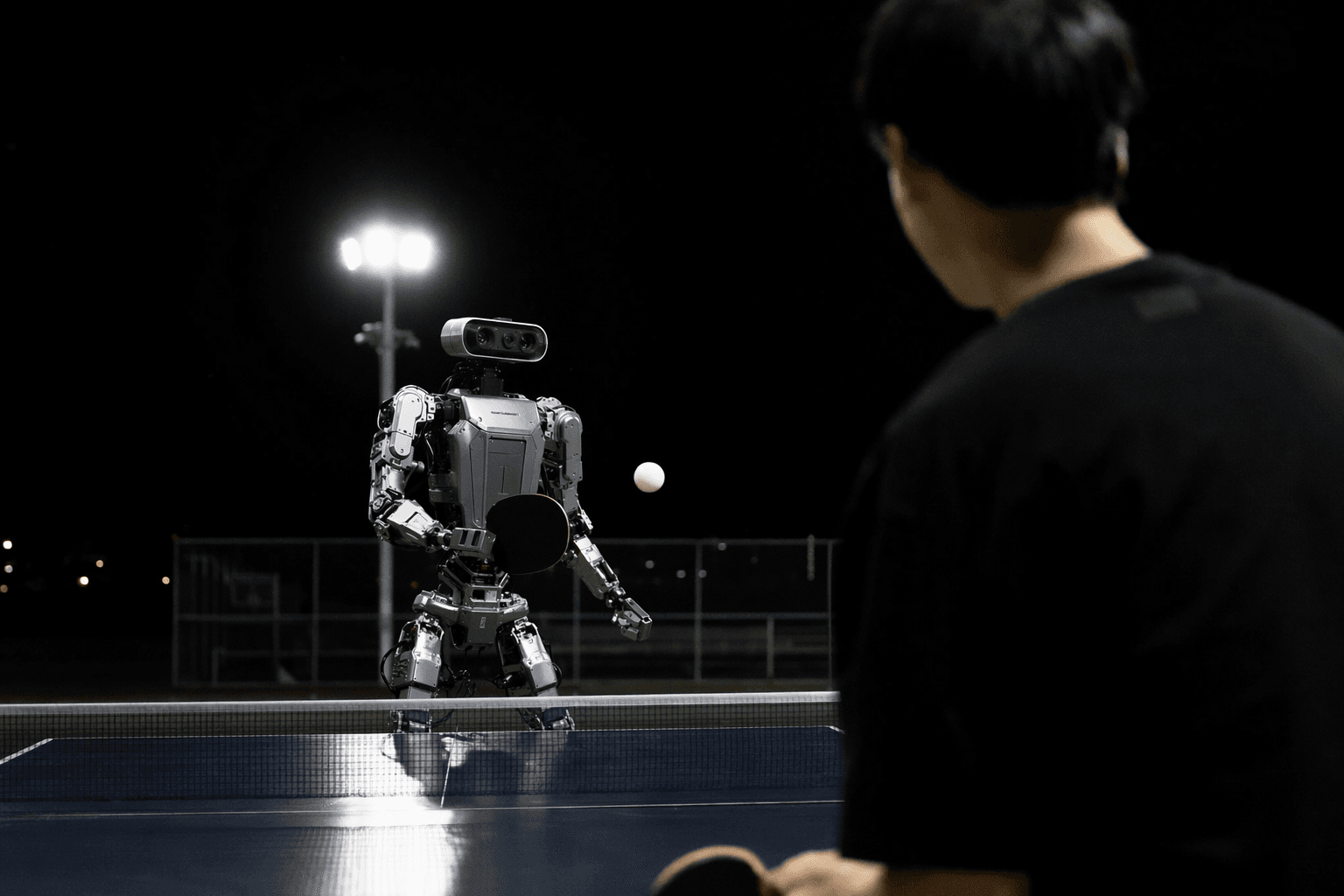
A humanoid robot has taken ping-pong practice outside and kept the rally alive. SMASH, a new system built on Unitree’s G1 platform, completed 100-plus consecutive stable exchanges using only onboard egocentric vision, a step that matters less as a robotics stunt than as a sign that table-tennis training could soon move beyond fixed labs and instrumented rooms.
The preprint, SMASH: Mastering Scalable Whole-Body Skills for Humanoid Ping-Pong with Egocentric Vision, was submitted to arXiv on April 1, 2026 by a 15-author team led by senior author Ping Luo, with work spanning names including Junli Ren, Yinghui Li, Kai Zhang, Penglin Fu, Haoran Jiang, Yixuan Pan, Guangjun Zeng, Tao Huang, Weizhong Guo, Peng Lu, Tianyu Li, Jingbo Wang, Li Chen and Hongyang Li. The project says SMASH enables the first outdoor humanoid table-tennis interaction without external cameras or motion-capture infrastructure, and says the system can, to the authors’ knowledge, produce consecutive strikes using onboard sensing alone.
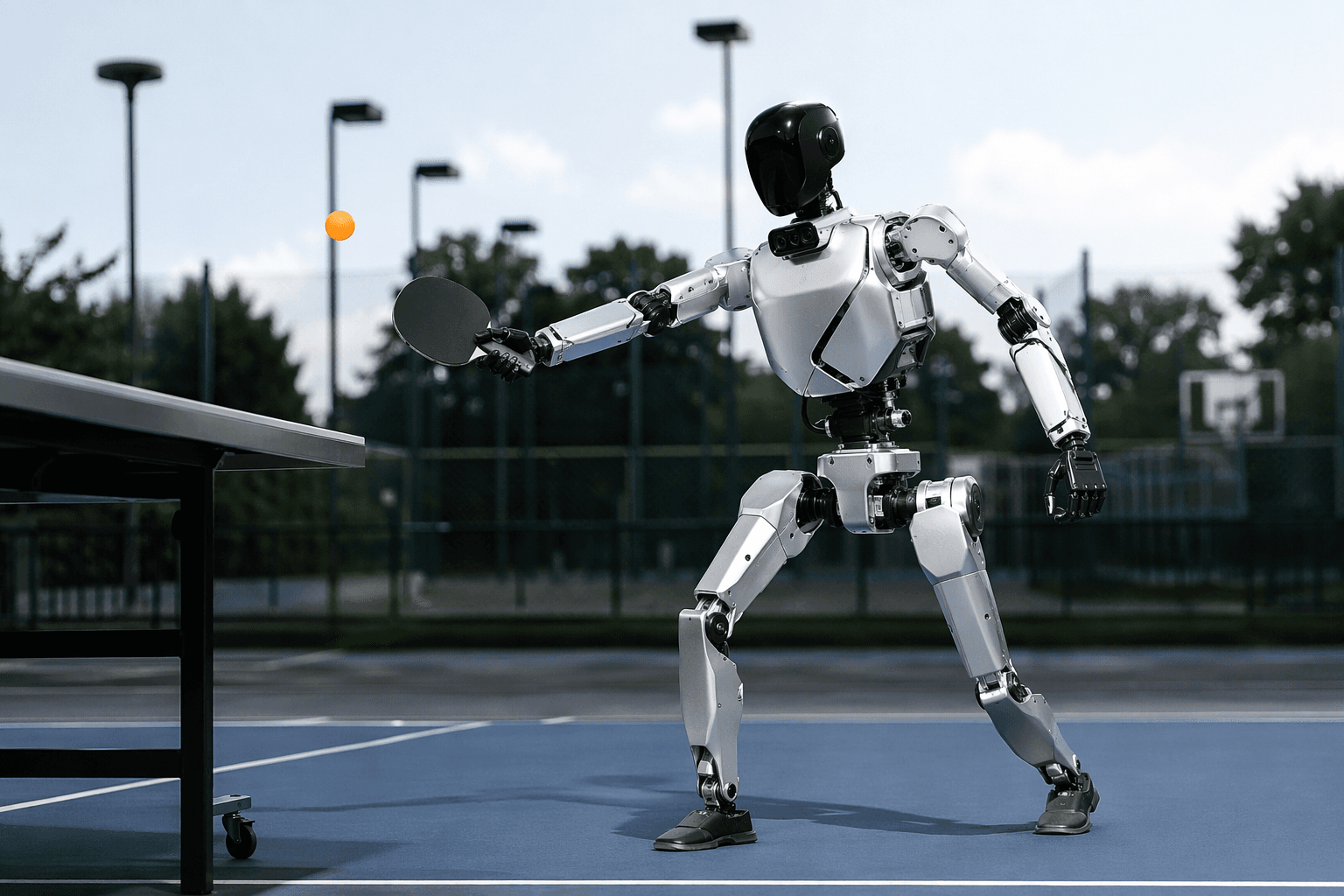
That is the practical break from earlier robot-rally milestones. UC Berkeley’s HITTER system had already pushed the Unitree G1 to 106 consecutive shots against a human opponent, but it did so with nine OptiTrack cameras feeding a motion-capture setup at 360 Hz. SMASH keeps the ball tracking and body control onboard, using egocentric perception to estimate both ball and robot state in real time. Before the outdoor deployment, the team validated the system with motion capture, then moved the task into a more realistic environment where lighting, background clutter and open-air ball flight all become part of the challenge.
For coaching and sports-tech, that shift is the real story. A robot that can answer with explosive whole-body smashes and low crouching shots is not just serving as a novelty partner. It could eventually become a repeatable sparring tool that exposes players to pace, placement and recovery patterns without needing a human training partner for every drill. Even so, the system still reads as a controlled rally machine, not a true match opponent. The achievement is stable exchange, not human-like anticipation, deception or point construction under pressure.
Unitree’s own positioning helps explain why this matters commercially. The G1 was officially released on May 13, 2024, stands about 132 cm tall, weighs about 35 kg, carries 23 to 43 joint motors and starts at $13.5K. That puts a capable humanoid platform within reach of research labs and, eventually, training facilities looking for something more dynamic than a conventional ball machine. SMASH does not yet resemble a tournament sparring partner, but it moves humanoid ping-pong from a mo-cap demo toward something closer to a portable practice system.
This article was produced by Prism’s automated news system from verified source data, official records, and press releases, then run through automated quality and moderation checks before publishing. The system is built and supervised by the people who set the standards it runs under. Read our full AI policy.
Did this article answer your question?