Sony AI robot Ace shows table tennis breakthrough in real matches
Ace played under ITTF rules in Tokyo, beating three of five elite opponents before falling to two pros, a striking test of embodied AI.

Sony AI’s Ace did not just volley against a machine. It competed in real table tennis matches under International Table Tennis Federation rules in Tokyo, with licensed umpires from the Japan Table Tennis Association in charge, and came away with a clear split against human opponents.
Sony announced the Project Ace breakthrough on April 22, 2026, after a year of evaluation matches that were designed to test whether AI could function in the physical world, not only in simulation. In April 2025, Ace faced five elite players and two professional Japanese league players. Against the elite amateur group, the robot won three of five matches and seven of 13 games. Against the two professionals, it lost both matches outright and managed only one game in seven.
That gap says as much about table tennis as it does about robotics. The sport demands instant reads on spin, speed and placement, along with millisecond decision-making and exact contact on the ball. Sony says that has made robot ping-pong a long-running target for researchers, with prototypes dating back to 1983. Ace is meant to show how far the field has moved from laboratory novelty to live, rules-based competition.
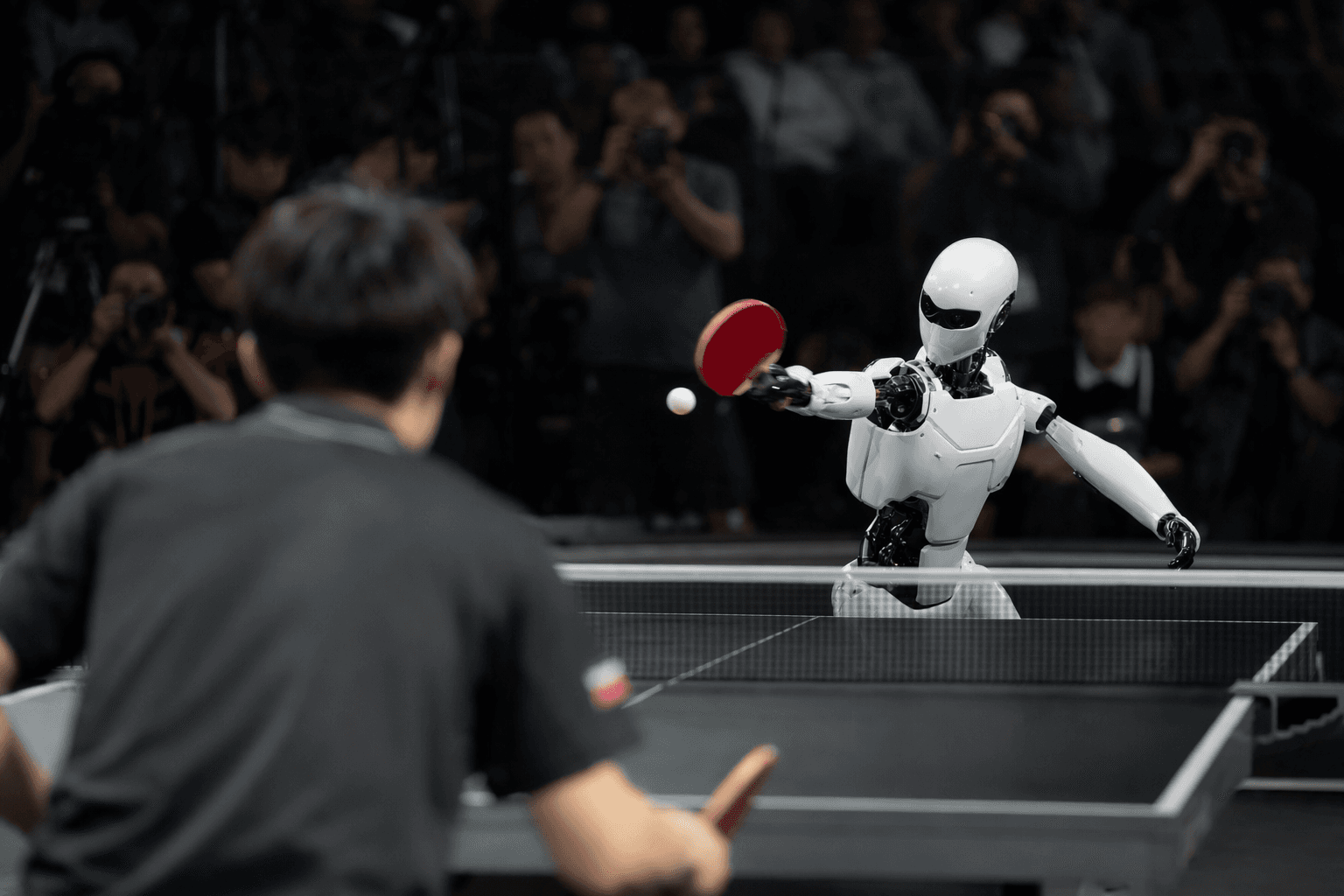
The system behind Ace combines event-based vision, reinforcement learning and an eight-jointed robotic arm. According to reporting on the Nature paper, the machine was trained through thousands of simulated games. New Scientist said Ace’s total latency is about 20 milliseconds, compared with roughly 230 milliseconds for human reaction time. That speed helps explain how the robot can track fast exchanges and get a paddle into position before a human player has fully processed the ball.
Still, the results also showed the boundaries of the technology. Sony AI’s Peter Dürr described the performance as a milestone for robotics, while former Olympian Kinjiro Nakamura said one of Ace’s shots seemed impossible for a human, a reminder that the machine may be discovering new ways to play even as it falls short of elite pro consistency.

A live demo video posted by tech expert Eren Chen added to the buzz around the project, drawing 171 likes as the clip circulated alongside the broader robotics conversation. But the real significance of Ace was not the spectacle. It was the proof point: in one of sport’s fastest and most unforgiving arenas, embodied AI is starting to hold the table.
Know something we missed? Have a correction or additional information?
Submit a Tip