How flat-track roller derby works, from jams to the pack
Roller derby is won by timing and terrain, not just hits. One jam can hinge on the pack, the lead jammer call, and a 30-second reset.

A flat-track roller derby bout can look like controlled chaos until you watch one jam closely. The hits matter, but the real battle is for position, for the pack, and for the right to end the jam at the perfect moment. That is where the sport stops being a skating race and becomes a game of spacing, timing, and rule awareness.
The shape of a bout
Flat-track derby is played on a flat, oval track across two 30-minute periods. Action comes in jams that last up to two minutes, with 30 seconds between jams for a brief reset. Every jam starts with each team fielding up to five skaters, but only one of them is the jammer, the skater marked by the star on the helmet cover.
The other four skaters are blockers, and together they form the pack. That pack is the center of the sport’s strategy, because it sets the pace, controls where the action can happen, and determines how hard it is for a jammer to score. The current WFTDA rulebook is dated January 1, 2025, and separates skater roles, the pack, scoring, penalties, and officiating into distinct sections.
Start with the pack, not the hit
If you are new to derby, it is easy to think the biggest collision decides everything. In practice, the pack often decides everything before the hit even arrives. The blockers are not just there to absorb contact; they are there to define the lanes, slow the opposing jammer, and create openings for their own jammer to escape the crowd.
A single jam usually begins with both teams stacked near the front of the pack, with the jammers starting behind them. From there, the jammer has to thread through legal contact and shifting bodies to make the initial pass. That first trip through the pack is not about scoring yet. It is about earning the right to score.
How a jammer scores
Points in derby come from lapping opponents after the jammer has cleared the pack once. That means the first pass through is a gate, not the finish line. Once the jammer is through, every opposing blocker they pass on later laps becomes a point opportunity, and that changes the entire rhythm of the jam.
This is why experienced teams care so much about control, not just speed. A fast jammer who cannot find a line through the pack is stuck. A slower jammer who reads space well can turn a crowded track into a scoring window.
Why lead jammer is the most powerful call on the track
The first jammer to clear the pack becomes the lead jammer, and that status changes the jam’s economics. Lead jammer can end the jam whenever they choose, which turns the final seconds into a tactical decision rather than a sprint to the whistle. Instead of simply racing to score as much as possible, the lead jammer has to decide whether to keep the jam alive for more points or shut it down before the other team can answer.
The best offense is not always more offense. Sometimes it is restraint, especially if your blocker line has already created a narrow scoring margin or if the opposing jammer is only a step away from breaking loose.
What the contact rules actually do
Roller derby is full contact, but the contact is tightly bounded. Skaters cannot use heads, elbows, forearms, hands, knees, lower legs, or feet to make contact, and they cannot contact opponents’ heads, backs, knees, lower legs, or feet.
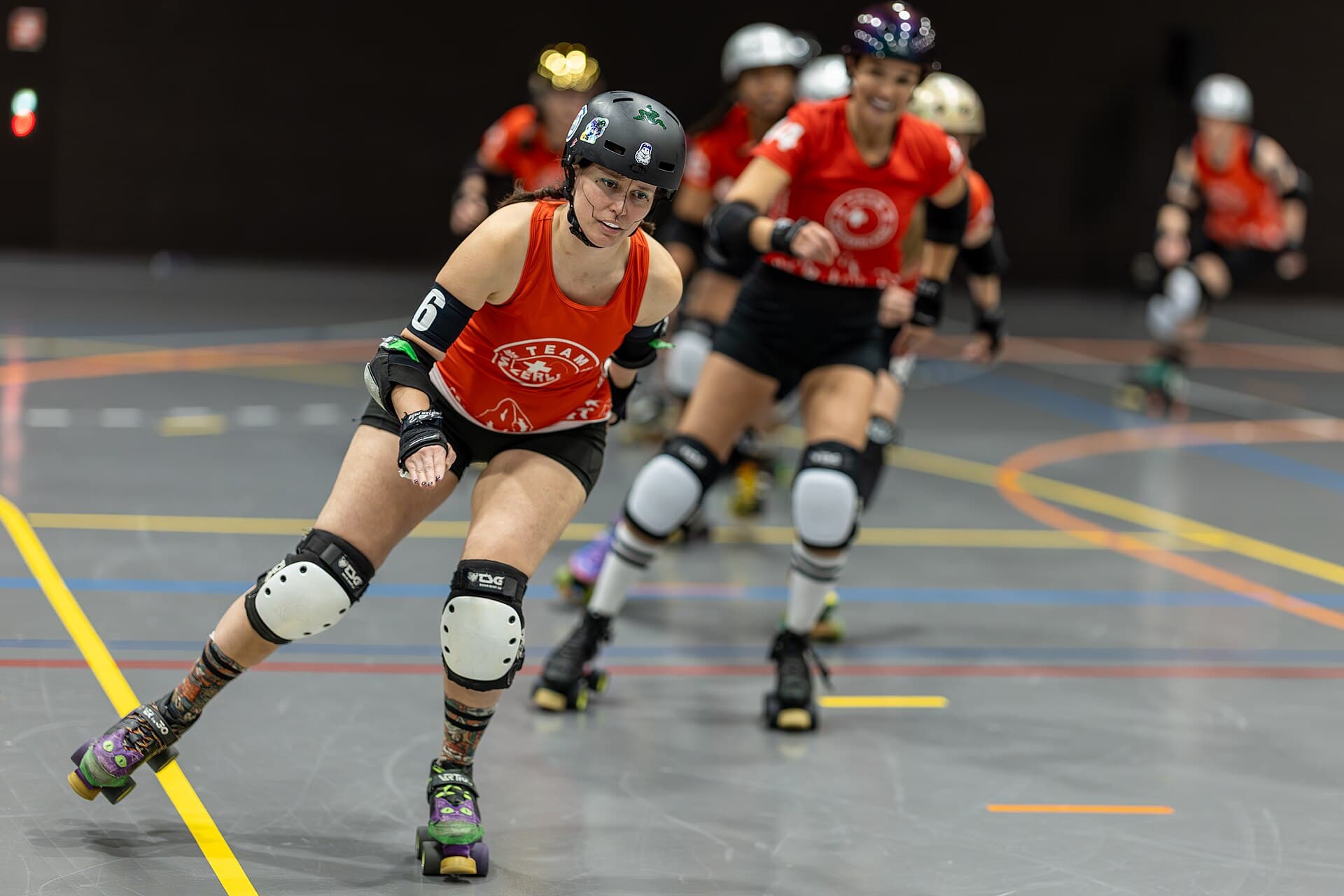
Illegal or unsafe play sends a skater to the penalty box for 30 seconds of jam time. That penalty box functions like a release valve and a strategic trap at the same time. Losing a skater for 30 seconds can blow open a pack, scramble a blocking formation, and hand the other team a scoring edge that no big hit can erase.
Why the rules reward discipline as much as force
The ruleset is the eighth full revision since the first shared rules were developed in 2005. The sport’s best teams are usually the ones that can do several things at once: hold the pack shape, protect their jammer, force the opponent into bad lanes, and stay out of the penalty box.
The governing body behind the modern game
The Women’s Flat Track Derby Association is the international governing body for women’s flat-track roller derby and represents 408 member leagues on six continents. Its modern history began in 2004 as the United Leagues Coalition, with 20 flat-track leagues represented at the first ULC meeting in 2005. WFTDA opened to new members in September 2006.
WFTDA’s rankings system is regionally based, teams can enter more than one charter team into competition, and skaters may skate for a maximum of two charter teams at any given time.
Postseason and the return of major play
WFTDA postseason tournaments were on hold from 2020 through 2023 because of the COVID-19 pandemic. They resumed in 2024 with regional and global championships across North America, Europe, and Oceania.
The championship trail has included stops in State College, Pennsylvania, Malmö, Sweden, Wayville, South Australia, Mesa, Arizona, Austin, Texas, and Portland, Oregon. The Hydra remains the trophy that teams are chasing.
A sport built on inclusion and community
WFTDA’s gender statement welcomes and encourages any individual of a marginalized gender to participate in WFTDA in any capacity, and participation as a volunteer or employee is open to individuals of all genders. On February 6, 2025, WFTDA published a clarification update and said it would proceed with that clarification despite the U.S. administration’s newest executive order.
Why the body still matters
A 2018 Kansas City injury study found injuries were reported by 79% of respondents, 50% had multiple injuries, and 64% required medical attention. A 2022 international concussion study surveyed 665 players from 25 countries and found 790.98 concussions per 1,000 athletes, with current players averaging 2.2 concussions and former players 3.1.
This article was produced by Prism’s automated news system from verified source data, official records, and press releases, then run through automated quality and moderation checks before publishing. The system is built and supervised by the people who set the standards it runs under. Read our full AI policy.
Did this article answer your question?