How roller derby officials communicate the game in real time
One short whistle starts the jam, two rapid whistles name lead jammer, and a shared codebook turns derby’s noise into instant, readable action.
Roller derby looks like controlled chaos until you know what the officials are saying. At trackside, the game is being narrated in whistles, hand signals, and penalty codes that let referees, skaters, coaches, and fans track a jam in real time, even inside a loud venue where music and crowd noise can swallow ordinary conversation.
What you hear at trackside
The whistle vocabulary is the fastest way into the sport. WFTDA’s current officiating procedures, updated in April 2024, use one short whistle to start a jam, two rapid whistles to identify the lead jammer, one long whistle to signal a penalty, and four rapid whistles to call a timeout, whether team or official. Once you hear those four sounds a few times, the rhythm of a bout becomes much easier to follow: start, status, stoppage, reset.
That sound system matters because flat track roller derby is built around short bursts of action. A game is played on a flat, oval track in two 30-minute periods, with jams that last up to two minutes and 30 seconds between jams. During each jam, each team fields up to five skaters, four blockers and one jammer, so every whistle is doing immediate tactical work.
How the pack is being read live
Officials are not just watching for big hits. WFTDA officiating standards say games must staff enough on-skates officials to track the pack and engagement zone, blockers who are out of play, who the jammers are, which jammer is lead jammer, and each jammer’s points in real time. That is why roller derby can feel so fast and still remain legible: the officiating crew is constantly translating movement into status.
For a newcomer standing near the track, the key is to notice what changes after each whistle. A jam-start whistle puts five skaters per side into motion, the two rapid whistles point to lead jammer status, and the long penalty whistle stops the game’s momentum for enforcement. The sport’s pace only works because those signals are standardized across WFTDA-sanctioned play, including post-season tournaments.
What the hand signals mean
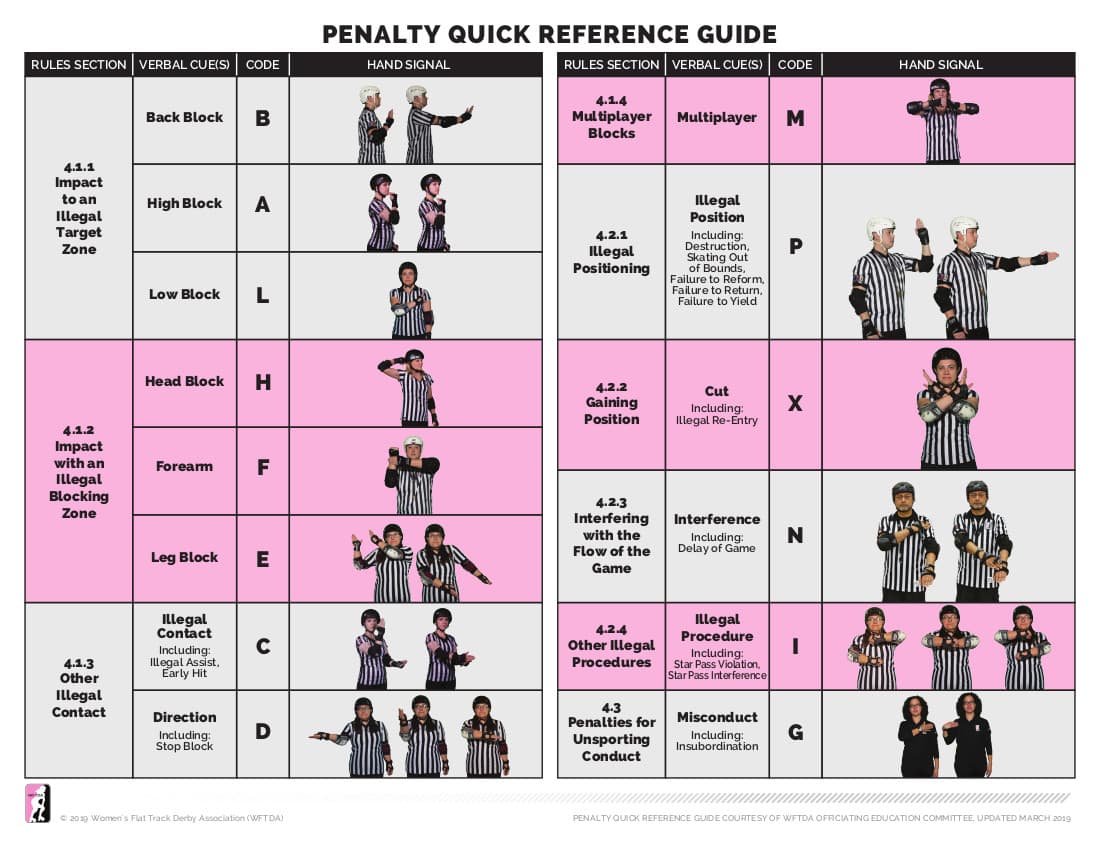
The visual language is just as important as the whistle language. WFTDA’s officiating cues, codes, and signals document, updated in December 2018, defines standardized hand signals and penalty codes for common infractions such as back block, high block, low block, head block, forearm, illegal contact, multiplayer blocks, and out-of-play issues. Once you know even a few of them, you can start reading why a jammer was sent to the penalty box or why a blocker was waved off a scoring attempt.
The quick-reference guide gives the shorthand that appears over and over. Back Block is code B, High Block is A, Low Block is L, Head Block is H, Forearm is F, Multiplayer Blocks are M/P, and Illegal Positioning is identified with the verbal cue Out of Play Block. That shorthand turns a chaotic-looking collision into a specific call, which is exactly what makes the game teachable in real time.
How officials announce penalties
WFTDA’s verbal cues document, updated in January 2015, gives officials a strict announcement format: team color, skater number, then penalty type. The document’s example is “Gold, eight-two, Out of Play Block.” That structure is not decorative; it is designed so skaters, coaches, and penalty trackers hear the same information in the same order, every time.
The key detail for a first-time observer is that the system is built for clarity under pressure. Officials announce and report skater penalties by team color and charter number, with skater numbers spoken as single digits, then the penalty type. In a packed venue, that consistency keeps the penalty box from turning into guesswork and lets the bout continue without slowing the whole floor down.
Why standardization changes the game
Roller derby’s communication system is not just administrative. Because lead jammer status, penalties, and timeouts are all signaled quickly and in a shared language, teams can adjust tactics almost immediately, whether they are choosing to call off a jam, stretching a scoring chance, or resetting a defense after a penalty. A single call can change whether a jammer keeps an advantage or whether the other bench has time to reorganize.
That is why the officiating language matters to play itself. The whistle and code system does not sit outside the action; it shapes the action by telling everyone when the jam is live, who has control, and when a penalty changes the numbers on track. In a sport where a jammer’s points can hinge on a few seconds of open track, communication becomes part of strategy.
How the language became official
The standardization did not appear overnight. WFTDA’s archived rules documents show standardized flat track roller derby rules in place by 2007, with published rulebooks in 2009, 2010, 2013, and 2014. The May 26, 2010 rules update is part of that paper trail, and the later 2015, 2018, and 2024 officiating documents show how the language was refined and formalized over time.
That history matters because it turns derby jargon into a governed system rather than local folklore. WFTDA is the international governing body of women’s flat track roller derby, so its cues and procedures function as the reference point for sanctioned play rather than a one-club habit. The result is a shared officiating language that can travel from one venue to another without losing meaning.
What this means for new officials and new fans
The standardized system also lowers the barrier to entry for people learning the sport from the outside. When the same whistle patterns, penalty codes, and verbal cues appear across venues, new officials can train faster and spectators can start recognizing the same signals from one bout to the next. The game becomes easier to follow not because it slows down, but because the language around it stays stable.
WFTDA and the Men’s Roller Derby Association have also announced plans for a roller derby officiating certification program, which pushes that same idea of shared training even further. For the sport, that points toward a future where the real-time language of whistles and hand signals remains one of its strongest tools for keeping the game fast, fair, and readable wherever the track is set up.
This article was produced by Prism’s automated news system from verified source data, official records, and press releases, then run through automated quality and moderation checks before publishing. The system is built and supervised by the people who set the standards it runs under. Read our full AI policy.
Did this article answer your question?