How roller derby’s track lines shape every jam
The track is not background in roller derby. Its lines decide who can start, who can block, and who gets called out of bounds before the jam even opens.
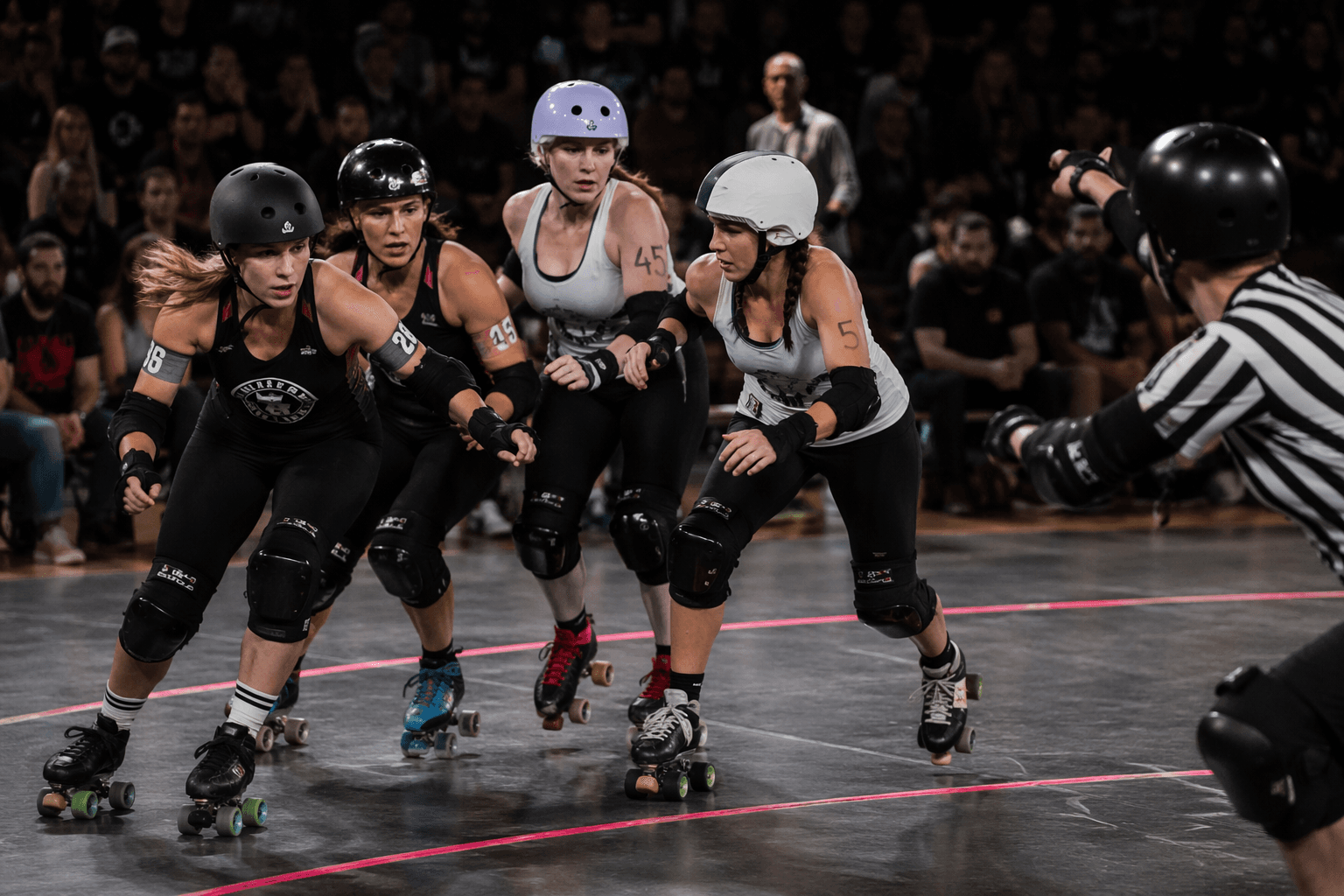
In roller derby, the track boundary counts as in bounds. With two 30-minute periods, jams that run up to two minutes, and only 30 seconds between jams, the sport compresses every decision into a tight restart cycle where a few feet of floor can change the whole jam.
The oval is the battlefield
The modern WFTDA format is built around a flat, oval track that can be laid down on a skating rink floor or any sufficiently large flat surface. The geometry still has to be standardized: the track must be clean, flat, and suitable for skating, and the boundary has to stand out in high contrast against the floor. Derby is played inside a defined field where the markings control everything from starts to scoring lanes.
Roller derby is a restart-heavy sport. A jam is short, the break between jams is shorter, and the next pack has to organize almost immediately. The track lines tell skaters where the jam begins, where the pack may form, and where referees draw the line between legal contact and a foul.
The opening linework decides the first scrum
The most important marks are the jammer line and the pivot line. The pivot line sits exactly 30 feet behind the jammer line, and at the start of a jam blockers line up between those two marks while jammers begin behind the jammer line. That spacing determines the distance a jammer has to cover before making first contact, and it gives blockers a preset lane to build the opening wall.
Historical WFTDA rulebook language required the jammer and pivot start lines to be clearly demarcated and consistently colored, with widths between one and three inches. A line that is too thin disappears in motion; a line that is too broad muddies the start point. The first few steps of the jam are governed by exact paint and exact inches.
The blockers are trying to lock a legal formation in a confined lane between two lines. The jammer is trying to exploit the geometry, find a gap, and avoid getting trapped on the wrong side of the pack before the first scoring opportunity even exists.
The boundary is live space, not dead space
A skater who touches the line is still in bounds. The same principle applies to the penalty box and team area boundaries, which are treated as part of those areas too. The outside of the track is a legal edge that skaters can use, test, and sometimes skate directly against.
For jammers, the boundary creates one of derby’s signature decisions: whether to ride the edge and squeeze past a blocker or abandon the line and take a wider route. For blockers, it changes how walls are built. A pack can pin a jammer against the line without automatically forcing a cut, because the line itself still belongs to the track. The result is constant micro-adjustment, with skaters trying to weaponize inches rather than feet.
Out-of-bounds judgment is baked into the floor. A player who leans too far, plants a wheel beyond the legal edge, or misreads the line can turn a promising attack into a penalty in a split second. Every contact with the boundary is legible to the skater, the officials, and the pack around them.
The penalty box and team areas belong to the map
Derby’s spatial logic does not stop at the oval. In WFTDA’s regulation track layout guide, placement of the penalty box and team benches must conform to risk management guidelines, and the penalty box may not sit closer than 15 feet from the outer track line in tournament play. It keeps the off-track areas distinct from active play and preserves room for skaters, officials, and bench traffic to move without collapsing into the track itself.
The sport treats every marked zone as functional territory. The penalty box is not a side room, and the team bench is not a decorative sideline. Their placement affects flow, communication, and the pace of the game when skaters are sent off.
Why flat track changed the sport
Flat-track derby spread because the format could be standardized without building a banked surface. WFTDA began as the United Leagues Coalition in 2004, and 20 flat-track leagues were represented at the first ULC meeting in 2005. The shared track format made it possible for leagues to play the same game in different cities without needing a custom-built banked track.
The current Rules of Flat Track Roller Derby are the eighth full revision since the first shared rules for women’s flat-track roller derby in 2005.
Why the lines matter on every jam
Every jam starts with the same shapes, but the game inside those shapes is different each time. The jammer line, the pivot line, the boundary, the penalty box, and the team areas all impose limits before a single hit lands. Those limits create derby’s most recognizable tactics: blocker walls that lock into place between the start lines, jammer approaches that hug the edge, and last-second decisions about whether a wheel is still in bounds.
This article was produced by Prism’s automated news system from verified source data, official records, and press releases, then run through automated quality and moderation checks before publishing. The system is built and supervised by the people who set the standards it runs under. Read our full AI policy.
Did this article answer your question?