Jersey Shore Roller Derby blends local pride, hits and community
Jersey Shore Roller Derby survives by fusing hard hits with hyperlocal identity, from derby alter egos to a roster of teachers, nurses and business owners.

At Winding River Skating Center in Toms River, the floor still fills with speed, contact and the kind of self-made swagger that only roller derby can produce. Jersey Shore Roller Derby has held onto its edge by staying deeply local, turning every bout into a mix of sport, social scene and identity play that makes the league feel larger than its record.
Names, hits and the personality of the track
The league’s character starts with the names. Bettie Rage, Chesty McBruiser, Mighty Mouse, Care Bear Carnage, Jack N Choke and J9 Jolter are not just aliases, they are part of the show, carrying the old derby tradition of larger-than-life alter egos into a flat-track setting that still prizes speed and contact. Those names tell fans exactly what kind of night they are buying into: a hard-edged game where personality matters as much as points.
J9 Jolter carries that history even further. Jeanine Longobardi’s derby name honors her grandfather Joe, who skated decades ago with the Jersey Jolters, tying a current roster to a local skating lineage that stretches back generations. That kind of family connection gives the league a rootedness that cannot be manufactured, and it helps explain why the stands still feel like a neighborhood gathering as much as a sporting event.
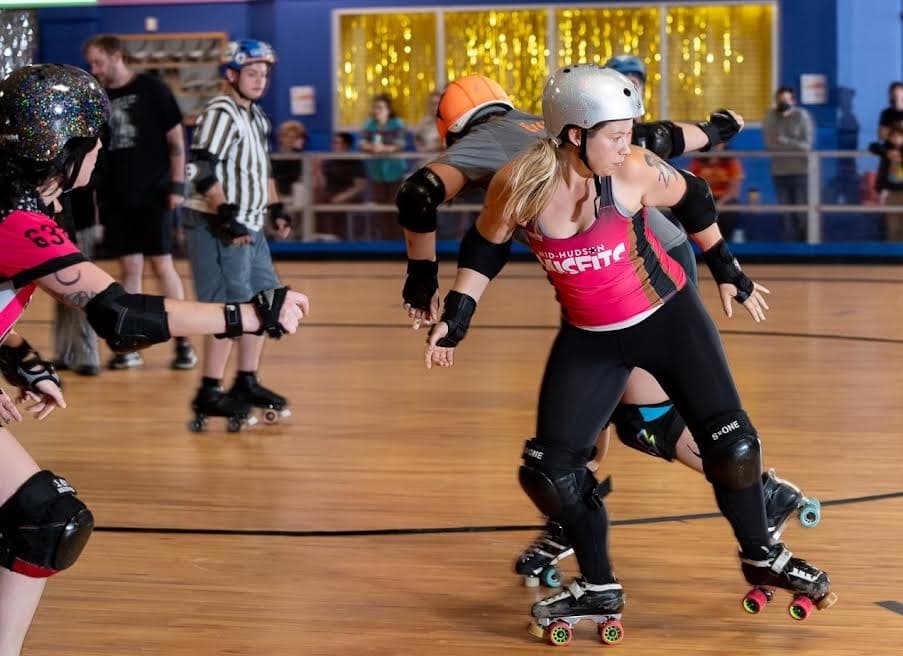
The action matches the branding. In the recent bout against the Connecticut Cutthroats, referees skated backward to keep pace with the play, blockers formed walls across the polished floor and wheels rattled in a blur as jammers hunted for openings. The key move is still the classic one: a gap appears where none seemed possible, and a jammer darts through before the defense can reset. That combination of speed, contact and timing is what keeps derby distinct from other indoor sports.
A league built from local lives
Jersey Shore Roller Derby was founded in 2007 by four women, and the league’s growth since then says as much about community as competition. The roster now draws members from Ocean, Monmouth, Middlesex and Atlantic counties, stretching the league’s reach across a broad slice of central and South Jersey while keeping the whole operation anchored at a local rink. About 25 active members take part now, which keeps the group small enough to feel personal and large enough to stay competitive.
The range of day jobs on the roster matters. Teachers, counselors, nurses, professors and business owners all share the same track, and that mix turns the league into something between a sports team and a civic club. Derby in this form is not isolated from ordinary life; it sits alongside it, with practices and bouts serving as a release valve, a workout, a social circle and a place to build confidence.
That blend helps explain the league’s endurance. When a roster includes people with such different careers and schedules, the common language has to come from the rink itself. The shared rituals of practice, travel, blocking and jamming become the glue, and the sport’s DIY structure makes room for players who want to compete without shedding the personalities that brought them there in the first place.
Rebuilding without losing the scene
Like many community sports groups, Jersey Shore Roller Derby had to recover after membership declined during the pandemic. The rebuilding has not been about starting over so much as restoring momentum, getting bodies back on the track and reassembling the kind of energy that makes a league feel alive. The recent bout against the Connecticut Cutthroats showed that the intensity is still there, even as the roster continues to grow back into itself.
That matters because derby’s competitive edge depends on continuity. The league can only keep its pace, its communication and its contact discipline if members keep showing up week after week, skating together and learning how each blocker reads the floor. The comeback is not just about numbers on a roster; it is about reestablishing timing, trust and the physical confidence that lets a jammer see a seam and commit to it.

The local identity also does work that pure competition cannot. Fans are not only watching for wins and losses, they are watching for familiar names, familiar faces and the energy that comes from a league that knows where it lives. In Toms River, the rink becomes a place where the sport’s old image, loud, bruising and theatrical, meets a newer reality built on friendship, inclusion and people who found derby later in life.
Why fans keep showing up
Jersey Shore Roller Derby keeps drawing attention because it offers more than a box score. The league delivers the full derby package, hard hits, frantic pace and the constant possibility of a momentum swing, but it also offers a community that looks and sounds like the Shore and the surrounding counties around it. That is a rare combination: a contact sport with a strong local accent.
The setting helps. Winding River Skating Center gives the league a home where the action is close enough to feel immediate and the personalities are close enough to matter. A bout there is not just about watching someone score, it is about seeing how a team built from teachers, nurses, business owners and longtime skaters holds together under pressure.
That is the league’s formula for survival. It has kept the nicknames, the contact and the DIY spirit, while building a competitive group that still belongs to its neighborhood. Jersey Shore Roller Derby thrives because it has never tried to become generic, and that stubborn local identity is what keeps the hits meaningful and the community invested.
This article was produced by Prism’s automated news system from verified source data, official records, and press releases, then run through automated quality and moderation checks before publishing. The system is built and supervised by the people who set the standards it runs under. Read our full AI policy.
Did this article answer your question?