Joanie Weston and Ann Calvello shaped roller derby’s star power
Joanie Weston and Ann Calvello made roller derby a two-act drama: the dominant champion and the defiant outlaw. Their personas still define the sport’s spectacle-first DNA.
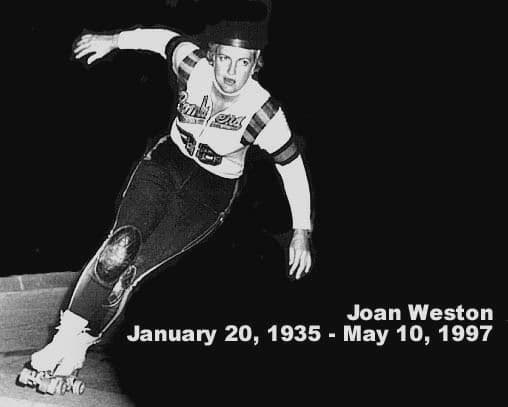
Joanie Weston and Ann Calvello gave roller derby its most durable script: the clean-cut champion and the unruly antagonist, each built for crowds that wanted more than laps and lead changes. Weston, the “Blonde Bomber,” was remembered as a fierce competitor whose size and athleticism made her impossible to miss. Calvello was the sport’s mischievous counterweight, a dyed-hair, tattooed, profanity-ready “bad girl” whose defiance made her a magnet in rink after rink.
How roller derby learned to sell characters
The sport was built for spectacle long before it was built for subtlety. Leo Seltzer created roller derby in the 1930s as a banked-track endurance attraction in Chicago, and the format’s indoor setting, speed, and visual chaos fit early television almost perfectly. One reference source says roller derby was the most popular show on ABC during the network’s infancy, and another says the playoffs sold out Madison Square Garden for a week in 1949.
That television-friendly environment shaped the public identity of the sport. As television ownership surged in the 1950s, roller derby could travel far beyond local rinks, and the product that reached living rooms depended on instantly readable drama. Weston and Calvello were not just excellent skaters in that system. They were the shorthand that made the sport legible: hero versus villain, control versus rebellion, order versus chaos.
Joanie Weston as the prototype star
Weston entered the original Roller Derby in 1954 and quickly became one of the sport’s defining figures. She skated for the Los Angeles Braves, was appointed captain of the San Francisco Bay Bombers in 1965, and appeared on 19 consecutive all-star teams. In her heyday, she was listed at 5 feet 10 inches and 160 pounds, a frame that made her look as imposing as she was effective on the track.
The Seattle Times described her as one of the fiercest competitors in the sport and called her “the core of this game.” That is the right frame for Weston’s place in derby history. She was not just a dominant athlete; she was the center of gravity around which the sport’s celebrity machine could spin. Reference sources also describe her as the highest-paid female athlete in the 1960s and 1970s, a reminder that roller derby could turn a star skater into a marquee attraction with real commercial value.
Ann Calvello and the power of the anti-hero
Calvello’s rise followed a different script, but it was just as important to derby’s public image. Born on August 1, 1929, she graduated from Presentation High School in San Francisco in June 1947 and broke into roller derby in 1948, when she was 18. She later skated for the San Francisco Bay Bombers and remained in the sport across seven decades, which made her one of the rare figures whose name stayed relevant long after the original boom had passed.
Her reputation rested on attitude as much as achievement. Calvello embraced the role of the sport’s volatile foil, and the crowd response followed. The Mercury News obituary noted that she kept entertaining audiences in later life, skating charity events well into her 60s. That longevity matters because it shows the persona outlasted the era that created it. Even after the old banked-track spectacle faded, Calvello remained the kind of name fans could still recognize immediately.
The Hall of Fame turned spectacle into canon
The Roller Derby Hall of Fame gives this history its institutional seal. Founded in 1952 by the editors of Roller Derby News, and initially displayed at Madison Square Garden, it shows that derby’s celebrity culture was formalized early. Weston and Calvello were not accidental fan favorites drifting through the margins of the sport. They were part of the original canon.
Calvello is listed among the original Hall of Fame members, while Weston appears in later inductee records. That split tells its own story. Calvello’s rebellion was part of the sport from the start, while Weston’s rise confirms how thoroughly derby rewarded athletic authority when it was packaged in a memorable persona. The Hall of Fame did more than archive careers. It preserved the idea that identity was central to the product.
What modern derby still borrows from that era
The clearest modern inheritance is the way derby still leans on character, rivalry, and crowd psychology. The sport’s early architects knew that fans needed a face to cheer, a foil to boo, and a story they could follow without a scoreboard tutorial. Weston and Calvello delivered exactly that, turning competition into a form of theater that worked on radio, in arenas, and especially on television.
That legacy still shows up in the details that endure: nicknames that stick, league rituals that reward reputation, and local trophies such as the Calvello Cup in Austin, Texas. The names have changed and the structure of the sport has evolved, but the marketing lesson remains intact. Roller derby became memorable when it gave the crowd someone to love, someone to oppose, and a reason to keep watching the next jam.
This article was produced by Prism’s automated news system from verified source data, official records, and press releases, then run through automated quality and moderation checks before publishing. The system is built and supervised by the people who set the standards it runs under. Read our full AI policy.
Did this article answer your question?