Queen City Roller Derby spotlights Shock-Her in 20th-anniversary profile
Shock-Her’s profile turns Queen City’s 20th-anniversary season into a story about officials and organizers, not just skaters. It traces how Buffalo’s derby culture was built from the ground up.

Published June 25, 2026, Shock-Her’s 20th-anniversary profile puts one of Queen City Roller Derby’s early officials and league builders at the center of the league’s history. It puts a spotlight on the officials, volunteers, and league builders who made the sport workable in Buffalo long before the current generation of skaters inherited a steadier structure.
The feature is part of Queen City’s 20th-anniversary alumni series and arrives just as the league’s anniversary season has wrapped. It places her in the center of the league’s institutional memory, where learning rules, refereeing bouts, and helping run the league’s non-skating officials became part of how Queen City survived and grew.
How Shock-Her entered the sport
Shock-Her’s path into roller derby began with a casual backyard conversation in the league’s early days. She came into the sport through people already connected to the league, then quickly moved into refereeing and into helping run The Herd, Queen City’s skating and non-skating officials group.
In those years, the sport was still new enough that many people were learning it at the same time, which meant the line between fan, volunteer, official, and organizer was unusually porous. People did not just show up to watch. They learned, stepped in, and helped keep the whole operation moving from week to week.
Officials often enter the sport through paths that do not look like a traditional player pipeline. Some come from the fan base, some are skaters who were not drafted, and some simply want to be part of the action. Shock-Her’s story folds all of that into one career arc.
Why officiating became part of the league’s foundation
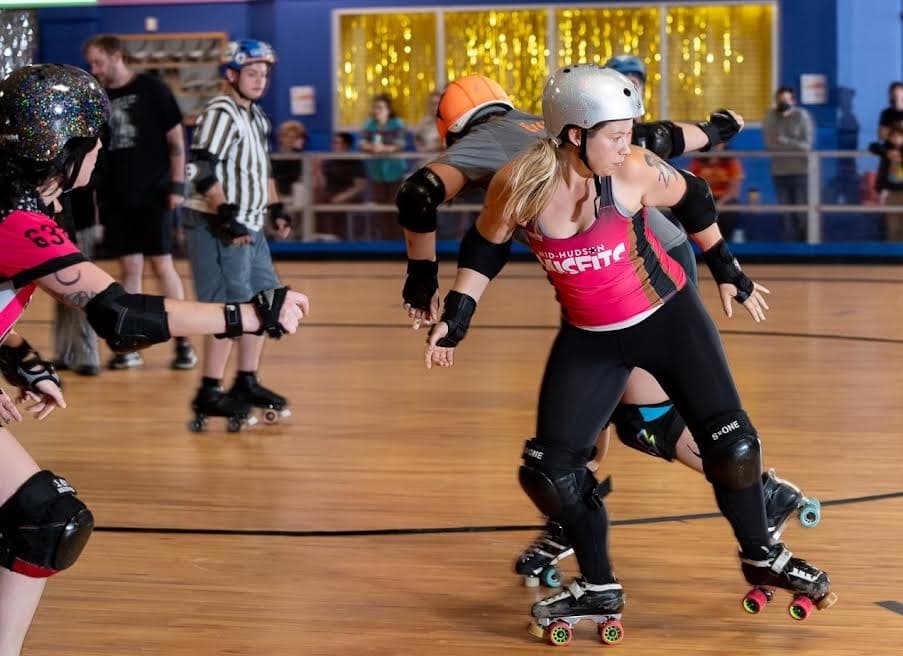
Shock-Her describes derby as simple in theory but fast and constantly shifting in practice. A sport that moves at high speed and changes shape every few seconds depends on people who know the rules well enough to make them function in real time.
On Queen City’s Buffalo Herd page, officials help ensure games are played safely and are clearly officiated. In a league environment where skaters, officials, and volunteers often grow alongside the game itself, that work lets the sport hold together.
Leagues rely on officials to keep games safe and fair, and the Women’s Flat Track Derby Association supports that work through standardized officiating practices, training documents, certification, and officiating clinics for referees and non-skating officials. Queen City operates within that larger system, and local leagues depend on the same kind of rulekeeping and training culture that national derby organizations have built around the sport.
Queen City’s origin story
Queen City Roller Derby was founded in 2006, and WFTDA lists the league as established that year, with apprentice status in 2010 and full WFTDA status in 2011. The league came together while flat-track roller derby was still formalizing its structures and building durable institutions around the sport.
Queen City began as Queen City Roller Girls, was inspired by the A&E series *Rollergirls*, and was built from the ground up by recruiting like-minded skaters and volunteers. The early league culture was never just about athletic talent. It was also about who was willing to learn rules, keep score, skate, officiate, and do the unglamorous work that makes bouts possible.
Queen City is skater-owned and operated. In a skater-run league, the same ecosystem that produces star blockers and jammer highlight reels also has to produce the administrators, officials, and logistics people who keep nights at Buffalo RiverWorks running cleanly.
How the profile handles derby memory
The Shock-Her feature treats early officiating as part of the league’s identity, not as an administrative footnote. In a sport whose public memory often centers the skaters scoring points, the people who stabilized the rules, trained the officials, and kept bouts credible enough to grow can disappear from view.
It records how a Buffalo league moved from Queen City Roller Girls to a skater-owned, officially recognized organization. The local derby scene in Buffalo and Western New York was shaped by people who were willing to do the work behind the scenes before the structure of the sport was fully settled.
This article was produced by Prism’s automated news system from verified source data, official records, and press releases, then run through automated quality and moderation checks before publishing. The system is built and supervised by the people who set the standards it runs under. Read our full AI policy.
Did this article answer your question?