Roller derby was invented in Chicago in 1935
Chicago’s 1935 roller derby was a 57,000-lap endurance stunt first. The modern game still carries the collision, but it was rebuilt from a marathon into a point-scoring sprint.
In Chicago, roller derby started as a spectacle built for exhaustion, not the jam-heavy chess match fans watch now. Leo Seltzer sketched the idea in the spring of 1935 on a restaurant tablecloth at Johnny Ricketts restaurant, then turned it into the first Transcontinental Roller Derby at noon on August 13, 1935, inside the Chicago Coliseum. The original race sent male-female couples around a banked track for 57,000 laps, a format so relentless it looks more like a Depression-era endurance gimmick than the sport that eventually took over rinks and flat tracks.
The Chicago invention that set the template
Seltzer’s pitch landed because the country was already primed for skating spectacle. Smithsonian traces his thinking to a simple numbers-driven insight: more than 90 percent of Americans had tried skating at least once, which made the sport feel familiar enough to sell as mass entertainment. The National Museum of Roller Skating places the origin in that spring 1935 brainstorm, and the Rollerskating Hall of Fame timeline frames Seltzer as a promoter looking for an attraction to fill the Chicago Coliseum. This was not a spontaneous backyard sport. It was a deliberately engineered show, built in the middle of a city that knew how to package noise, crowds, and novelty.
That first event also mattered because it was organized as a marathon-style race, not the modern jam format. Britannica describes the debut as an endurance competition between male-female couples on a banked rink, with the teams circling for 57,000 laps. The design borrowed from the era’s appetite for long-haul contests, the same cultural lane as bike races and dance marathons. In other words, roller derby did not begin as a fight on skates. It began as a test of stamina that happened to be staged like a show.
Why the first format was so different from today
The old derby was about attrition. Teams stayed in motion for long stretches, and the whole point was to keep going when other people would have quit. That is a long way from the modern derby model, where short bursts, tactical positioning, and scoring windows matter more than simply surviving the distance. The sport’s early identity was endurance theater, and the track was the stage.
The same-rules setup also gave early derby a surprising social edge. Smithsonian notes that men and women competed under the same rules, which was unusual for the time and gave American audiences one of their first chances to see women compete directly under the same conditions as men. That detail is one reason roller derby still carries a different cultural charge than many other contact sports. From the beginning, it blurred the usual lines between men’s and women’s competition instead of reinforcing them.
The 1938 pivot that made derby hit harder
By 1938, the sport had already started to evolve away from pure endurance. Smithsonian says sportswriter Damon Runyon suggested leaning into the violence to draw bigger crowds, and that advice changed the whole product. The promotion introduced a point system: pass an opponent, earn a point. Roughing them up along the way was encouraged. That is the hinge moment in roller derby history. The sport did not just become more physical. It became legible to spectators in a new way, because the action now had a clear payoff attached to contact.
This is the part that still echoes in modern derby. Fans do not come only to see who can skate the longest. They come to watch blockers control lanes, jams turn messy, and one move create a swing in the score. The modern game has rebuilt the rules, but it kept the idea that bodies colliding is not a sideshow. It is the engine.
How Chicago derby became a national phenomenon
The speed of roller derby’s rise is almost as striking as its origin. By early August 1935, the National Museum of Roller Skating says 50 skaters had already been selected for 25 male-female teams. That is an enormous amount of structure to build almost immediately around a brand-new attraction. The event had enough momentum to move from concept to a fully staffed roster in the same summer.
Its popularity followed fast. One historical account puts the professional game at more than 5 million spectators across about 50 American cities by 1940. That scale tells you the experiment worked. Chicago’s invention was not a one-city curiosity. It became a touring professional attraction, and the early expansion is why roller derby matters as more than a nostalgic footnote. It was one of the early roller sports to turn professional, which helped set the template for the theatrical, crowd-facing version that followed.
What the modern game still carries from 1935
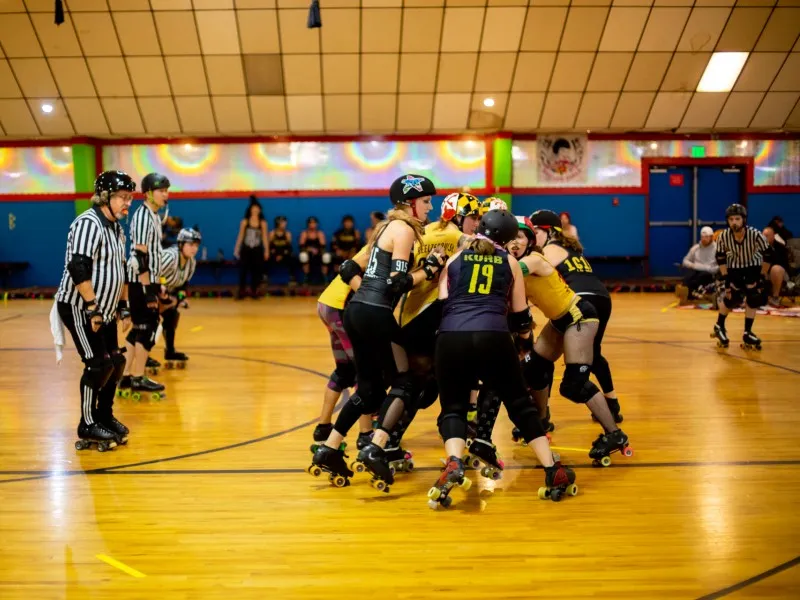
Look closely at today’s derby and the Chicago DNA is still there. The sport remains built on speed, contact, and public theater. It still treats skating as something the crowd can understand instantly, even if the strategy underneath gets complicated fast. What has changed is the structure: the old transcontinental marathon has given way to short, scored bursts and more specialized roles, especially on flat-track surfaces where modern leagues play.
What has not changed is the central contrast that made the original invention work. Derby still lives in the tension between athletic skill and spectacle. Seltzer’s first version leaned on endurance and novelty. The 1938 shift added scoring and violence. Modern derby kept the scoring logic, added tactical depth, and moved further from the marathon roots, but it never abandoned the core promise that made the first Chicago event sell: skaters would keep going, and the crowd would not look away.
Why this origin still matters now
The clearest way to understand modern roller derby is to see both versions at once. The 1935 Chicago debut tells you where the sport came from: a promoter, a tablecloth sketch, a banked rink, 57,000 laps, and a mixed-gender endurance race staged like a city-sized stunt. The 1938 rules shift tells you how derby became the collision-heavy, point-driven sport people recognize today. Put those pieces together and the modern game makes sense. It is not a relic of the original format, but it still carries the same instinct that built it in the first place: make skating fast, make it physical, and give the crowd a reason to keep score.
This article was produced by Prism’s automated news system from verified source data, official records, and press releases, then run through automated quality and moderation checks before publishing. The system is built and supervised by the people who set the standards it runs under. Read our full AI policy.
Did this article answer your question?