WFTDA manual standardizes roller derby scorekeeping for 2025 statsbook
WFTDA’s 2025 StatsBook manual turns derby’s fast, messy jams into a standardized record that rankings, suspensions, and history can actually use.
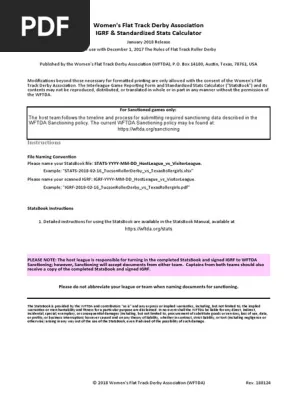
The 2025 February 1 StatsBook is listed for WFTDA-sanctioned games. Behind every jam, the Women’s Flat Track Derby Association has built a paperwork system that turns fast-changing rosters, penalties, and score corrections into one official record, and the 5th Edition StatsBook Manual is the instruction sheet for doing it right. The score sheet is not just a bookkeeping habit. It is part of how a bout becomes legible to rankings, archives, and the sport’s disciplinary machinery.
The manual at the center of the bout record
The current manual is titled the WFTDA IGRF and Standardized Stats Calculator StatsBook Manual, 5th Edition, and it is built for use with the 2025 February 1 StatsBook. The manual directs officials and home teams through pregame paperwork setup, the correct filename, and the standardized calculator so every bout produces data in the same format.
Derby is scored in short bursts, not long runs. Jams are quick, rosters can shift, and one penalty or official correction can change the final line. The manual makes those changes traceable, so the final record matches what happened on the track.
How a jam becomes an official record
One bout runs from the first whistle to the final paperwork. Before play starts, officials and team reps handle roster and lineup management, then carry that information into the stats system. During the game, the score and penalty records move period by period, and the same bout can produce a later adjustment if an official score correction is required.
A jammer picks up points in a jam, a blocker earns a penalty, and the scoring picture changes before the period ends. That on-track chaos is not left as memory or a hand-tallied note. It becomes a sequence of entries that ultimately lands in the StatsBook’s score-and-penalties section, where the bout’s result can be audited against the play-by-play record.
The manual also makes room for the paperwork that follows unusual outcomes. If an official score adjustment is needed, that gets its own documentation. If there is a suspension or expulsion issue, the record does not stop at the final whistle.
What gets tracked, and when
The StatsBook tracks the bout on a timeline.
- Before the first whistle: roster and lineup management
- During play: period-by-period points and penalties
- During the bout or immediately after: score-and-penalties completion
- After an unusual ruling: official score adjustment paperwork
- If discipline is involved: suspension or expulsion notes
Why rankings depend on the paperwork
The stakes are bigger than a clean archive. WFTDA’s Sanctioning Policy says sanctioning means registering a game with the WFTDA Sanctioning Committee for the purpose of obtaining WFTDA Ranking game points. It also says that if a game fails to meet the requirements in the policy, sanctioning can be rescinded and the game can lose eligibility for WFTDA Rankings points.
The StatsBook is part of competitive access, not just administration. A sanctioned game has to be recorded in a way the rankings system can use, and the 2025 workbook is listed for use in WFTDA-sanctioned games for exactly that reason.
The disciplinary record is part of the same system
The modern StatsBook does more than capture points. WFTDA’s Expulsion and Suspension Policy, updated in June 2023, covers foul-outs and expulsions, the StatsBook Expulsion-Suspension Form, the suspension recommendation process, a suspension meeting if one is recommended, one-game suspensions in tournaments, and review and appeals. In other words, the same record that tells you who won also documents when a game crossed into disciplinary territory.
A penalty can affect a jam, but a foul-out or expulsion can alter the administrative record after the bout is over. The StatsBook gives those outcomes a place in the official file, which keeps the competitive result and the discipline record aligned.
How the system got here
On March 31, 2015, WFTDA’s Statistics Committee updated the StatsBook and moved all instructions into a new, comprehensive StatsBook Manual.
The document kept evolving. On February 7, 2018, WFTDA released a new StatsBook and supporting documentation that incorporated updated penalty codes. In 2017, WFTDA also released updated games policies and track setup materials to support the February 15, 2017 Rules of Flat Track Roller Derby.
A parallel in junior derby
JRDA uses the same basic logic, but with a stricter clock. The Junior Roller Derby Association requires score and stats reporting within 48 hours after the game, and the submission must include the official score, the signed IGRF, and any expulsion forms.
This article was produced by Prism’s automated news system from verified source data, official records, and press releases, then run through automated quality and moderation checks before publishing. The system is built and supervised by the people who set the standards it runs under. Read our full AI policy.
Did this article answer your question?