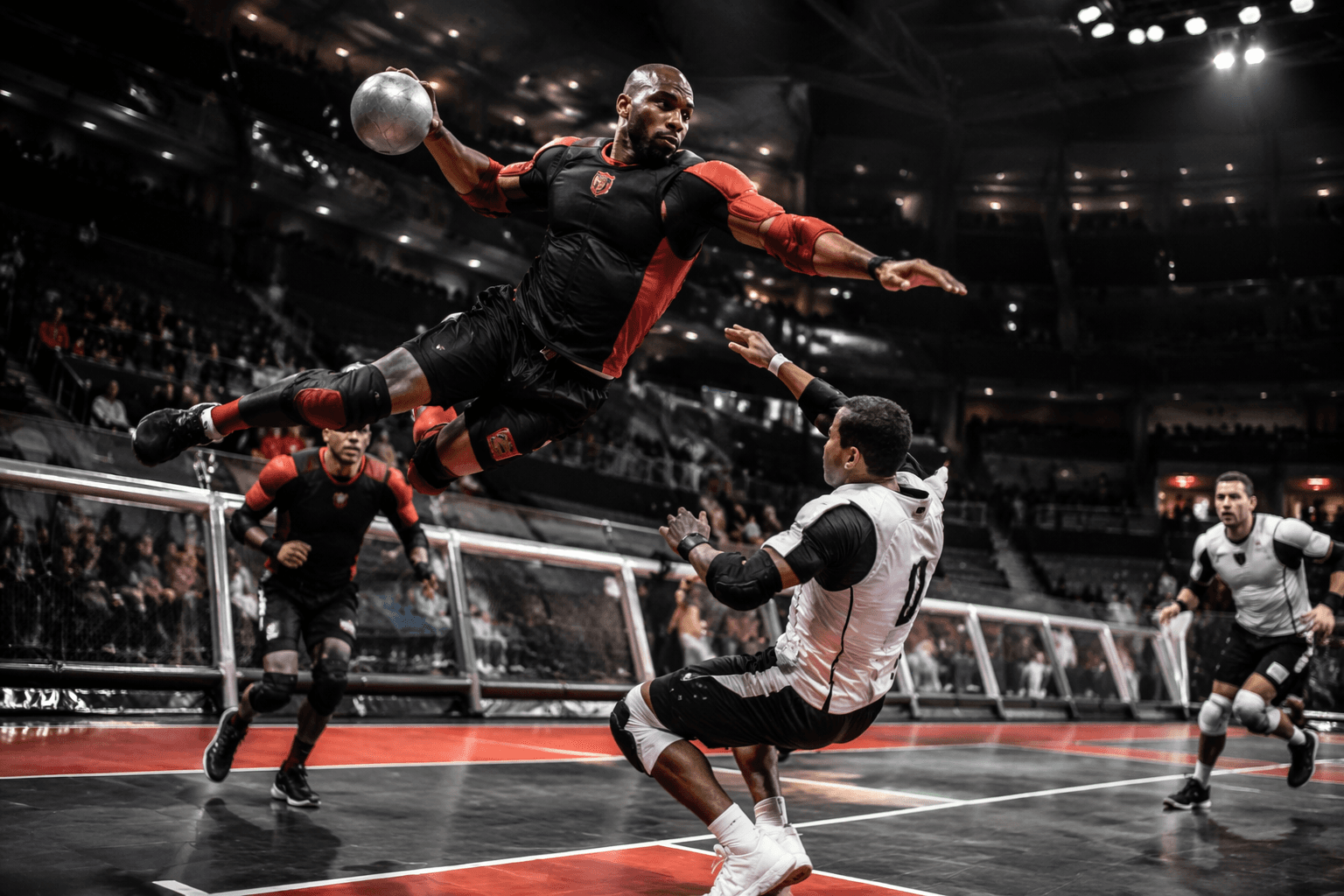
How SlamBall’s Island shapes spacing, timing and scoring chances
SlamBall’s Island is the sport’s hidden engine, turning spacing, timing and live substitutions into real scoring value.

On a 96-foot-by-64-foot court with three identical springbeds at each end, a larger scoring bed, 10-foot rims and an 8-foot plexiglass wall, every inch changes how fast a team can attack and how quickly a defense can recover. Add four players on the floor, seven active players on the roster and four five-minute quarters, and the game becomes a series of compressed decisions rather than a loose, up-and-down version of basketball.
The court changes the math
The court layout is the first reason SlamBall plays differently from anything on a hardwood floor. The walls keep the ball in the playing area, the springbeds create vertical danger at both ends, and the smaller on-court numbers mean space opens and closes faster than most basketball fans expect. Because each half begins with a throw down, an inverse tip-off, the first possession already has a different rhythm from the opening jump in basketball, with immediate pressure on who can control the first contact and the first lane.
Four players are responsible for nearly every defensive rotation and every attacking angle, so a single hesitation can expose the lane, the bed, or the rim.
The Island is the sport’s real scoring engine
The Island is the most important space in SlamBall because it creates a brief no-contact advantage in the middle of a contact-heavy game. The rules define it as the padded area between the springbeds where offensive players can momentarily establish position to receive, redirect or move the ball, while defenders cannot make contact there, cannot draw a charge there and cannot remain in that area longer than three seconds while moving through the spring area. Two offensive players also cannot occupy the Island at the same time.
That combination makes the Island less like open court space and more like a timed tactical checkpoint. Offenses are not simply trying to jump higher, they are trying to arrive first, arrive legally and arrive with enough spacing that the defender is late by a step. If the ball enters the Island with the offense already organized, the advantage can turn into a pass, a redirection or a quick scoring chance before the defense can reset its body position.
The cleanest possessions are the ones that treat the Island like a shortcut with rules attached. A team that staggers its movement can use one player to occupy a lane outside the Island while another cuts into the protected zone, creating a moment when the defense has to choose between protecting the angle and protecting the bed. Because only one offensive player can be there at a time, spacing is not optional. It is the mechanism that lets a possession survive long enough to become dangerous.
Violations change everything. A bad arrival, a crowded lane or a defender who disrupts the sequence can lead to a face off or a change of possession.
Substitutions happen at game speed
The substitution rule is another reason SlamBall feels so different from basketball. Changes happen hockey-style, while play continues and the clock never stops. Coaches cannot lean on the same dead-ball management that basketball teams use to organize lineups, catch breathers or slow the game down during a run.
Conditioning becomes part of strategy, not just preparation. If a unit is gassed, the opponent can keep the pressure on because there is no natural pause to rescue a tired lineup. Coaching decisions are therefore tied to live-read substitutions, with the bench serving as an active extension of the offense and defense rather than a place to wait for a whistle.
The clock rules sharpen that pressure even more. Teams get only one timeout per game in the fourth quarter, so there is little room for repeated resets when the game tightens. A coach has to manage line usage with an eye on who can survive the next sequence, not just who can win the next possession.
How to watch a SlamBall possession
The best way to read the sport is to follow the sequence, not the spectacle. A throw down starts the half, but the real test comes when the offense tries to move from spacing into advantage. Watch for the player who creates the first clean line into the Island, then look at how the second attacker positions away from it, because the rules punish crowding and reward separation.
A good possession often has three visible stages:
- The entry, when the ball is advanced toward the spring area and the offense tries to earn a clean lane.
- The Island touch, when the protected space becomes a passing or redirection point.
- The finish or turnover, when the defense either recovers in time or gives away possession through a violation, a stop or a forced reset.
This article was produced by Prism’s automated news system from verified source data, official records, and press releases, then run through automated quality and moderation checks before publishing. The system is built and supervised by the people who set the standards it runs under. Read our full AI policy.
Did this article answer your question?