Mason Gordon sketched SlamBall on a napkin before building it in a warehouse
Mason Gordon turned a napkin sketch into a warehouse-built sport that fused trampolines, collisions, and TV pace into SlamBall’s durable formula.

Mason Gordon did not begin with a league, a logo, or even a court. He started with a napkin in Hollywood and a question: what if a sport could feel like a video game, hit like football, and still move fast enough for television? That idea became SlamBall, a game built to be immediately readable on screen and wild enough to look unlike anything else.
From napkin to warehouse
Gordon came up with the concept in 1999 while working for Tollin/Robbins Productions in Hollywood. He sketched the sport on a napkin, then kept refining it until Mike Tollin took the idea seriously enough to help finance a prototype court. Gordon later described SlamBall as a “real-life human video game,” and that framing was not just a pitch line, it became the sport’s design brief.
The first version was built in a warehouse out of discarded gymnastics parts, which tells you everything about how scrappy the invention really was. SlamBall’s official history says the sport was invented in 1999 and first played in Los Angeles, turning one warehouse experiment into a city-born creation with a clear identity from the start. The origin matters because it shows the sport was engineered, not stumbled into.
The court solved the problem
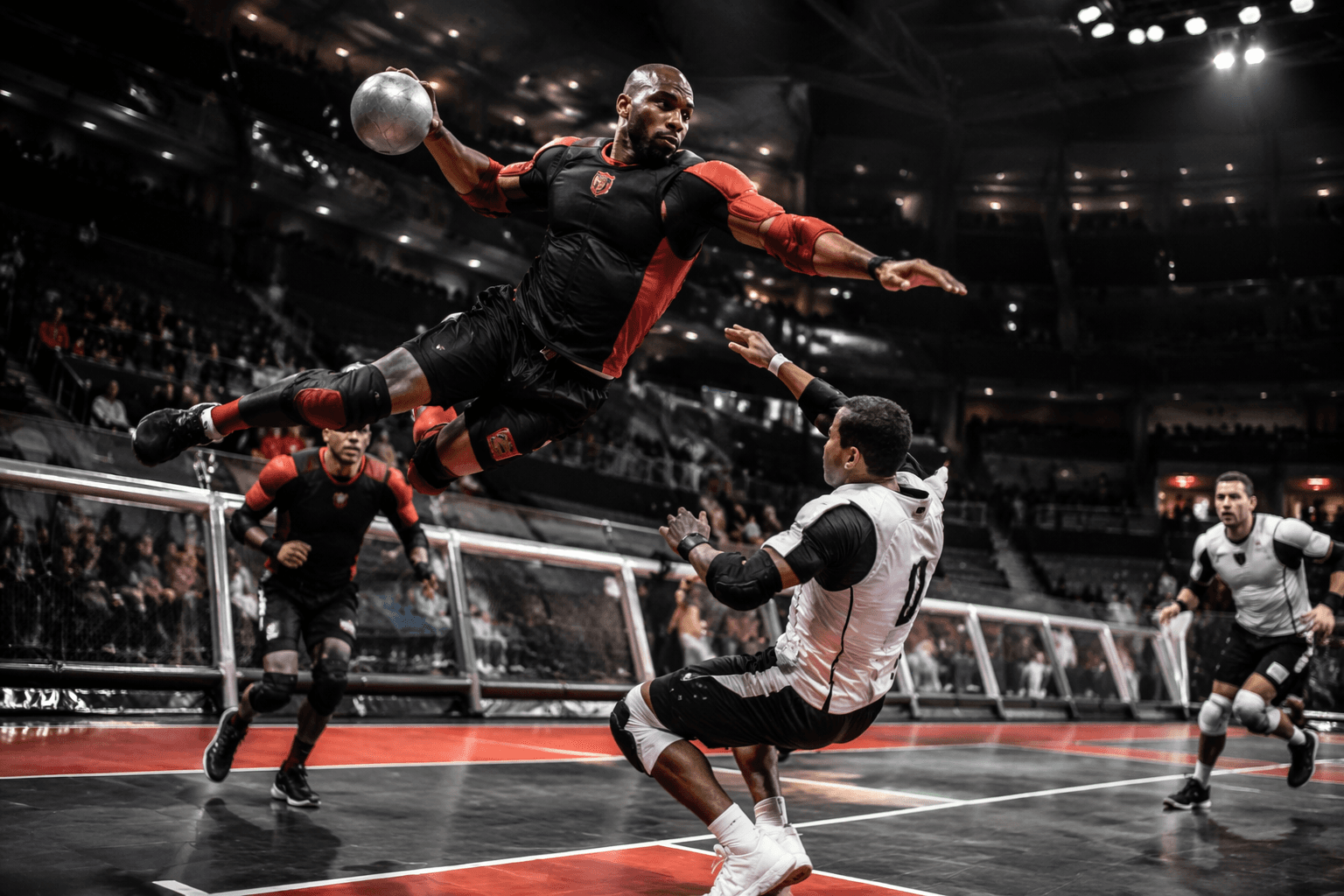
The central breakthrough was not only the trampolines, but how they were arranged to control the action. Recent league materials describe a court with four trampolines around each net and boards enclosing the playing surface, a setup that keeps the game in motion while creating the high-flying collisions that make SlamBall distinct. Those design choices let the sport borrow from basketball, football, hockey, and gymnastics without collapsing into chaos.
That balance is why the format endured beyond its first burst of attention. The trampolines create verticality, the boards keep the ball and bodies in play, and the enclosed space makes contact part of the design rather than an accident. SlamBall’s hybrid structure was built to be legible at first glance, which mattered just as much as the spectacle itself.

Why television made sense immediately
Gordon’s instinct was not just athletic, it was media-savvy. A game that could be understood in one glance, then explained in one sentence, had a better chance of surviving the shift from novelty to programming. The sport’s combination of quick possessions, visible collisions, and repeated scoring chances made it easy to package for TV without needing a long learning curve.
That is why the early broadcast path came so quickly. After the first exhibition series in 2001, the league moved into two professional seasons televised on The National Network in 2002 and 2003. The path from a warehouse prototype to national airtime gave SlamBall a proof point that many new sports never get: it could be both strange and schedulable.
The first proof points came fast
The exhibition series in 2001 was the bridge between invention and competition. It gave the sport something more durable than a demo, a chance to show that the format could survive real play, real contact, and repeated repetition of the same basic rules. By the time the pro seasons arrived in 2002 and 2003, the sport had already moved beyond an isolated stunt.
That early sequence also explains why SlamBall keeps coming back in new forms. The league had a 2008 revival, then returned again in 2023 after a 20-plus-year absence. A sport does not get those second and third acts unless the core idea can still be explained, marketed, and played without rebuilding the whole concept from scratch.

The business of making it feel new
SlamBall’s appeal has always lived at the intersection of invention and packaging. The league originally launched with a hybrid promise: the best elements of basketball, football, and hockey, with the energy of a video game come to life. That mix gave investors, broadcasters, and fans a concise way to understand why the sport existed at all.
The 2023 comeback showed how the league still thinks in event terms. It was framed as a six-week season, and the championship was staged at Cox Pavilion in Las Vegas, a venue that fit the sport’s compact, entertainment-forward model. That structure reflects the same logic that shaped the first warehouse court: keep the experience tight, physical, and visually obvious.
Why the origin story still matters
The reason SlamBall endures is not nostalgia for an oddity from the early 2000s. It is that the original design solved several problems at once. It delivered contact without ambiguity, speed without losing structure, and enough visual novelty to cut through a crowded sports market while still feeling easy to follow.
That is the rare part of the Gordon story. A napkin sketch in Hollywood became a warehouse court built from discarded gymnastics parts, then an exhibition series, then televised pro seasons, then revivals in 2008 and 2023. The through line is not luck or retro charm, it is a format built from the start to survive being seen, repeated, and sold.
This article was produced by Prism’s automated news system from verified source data, official records, and press releases, then run through automated quality and moderation checks before publishing. The system is built and supervised by the people who set the standards it runs under. Read our full AI policy.
Did this article answer your question?