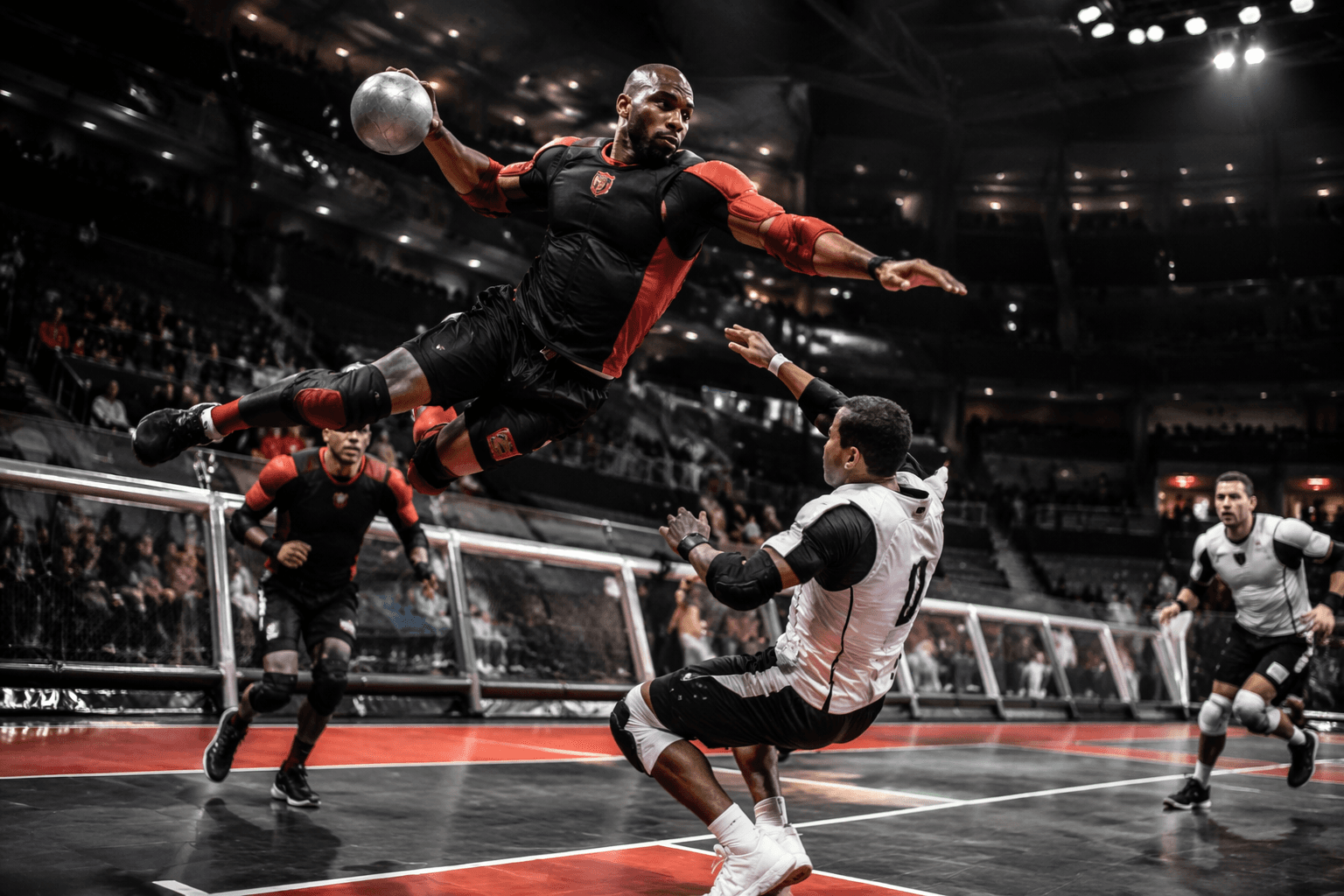
MOB and RUMBLE remain SlamBall’s foundational powerhouse teams
MOB and Rumble are more than old names. They are the style, swagger, and rivalry blueprint that still defines what SlamBall looks like today.

The MOB and the RUMBLE did not just win games, they built the language SlamBall still uses to talk about itself. From the original warehouse era to the Series 6 relaunch on ESPN at Cox Pavilion in Las Vegas, these two franchises have remained the league’s clearest reference points for how the sport is supposed to feel, play, and sell.
The MOB set the standard with violence, skill, and trophies
The MOB’s value to SlamBall starts with the fact that it was one of the original two warehouse teams, built in the league’s earliest era and defined by big hits, suffocating defense, and one-tramp lobs. That mix matters because it shows the MOB was never just a bruising team. It was a team that could punish you physically and still beat you with timing, space, and precision.
The championship resume is even louder. The MOB won back-to-back titles in Series 4 and Series 5, then finished the job again in Series 6 for a third straight championship, an unprecedented run in league history. That stretch was built around handler Noah Ballou, Series 4 MVP Trevor “Eagle” Anderson, and Shanghai star Lu Feng, the first international SlamBall player to become a true centerpiece. The message from those titles is simple: the MOB was not a one-note bully. It was a championship machine with multiple ways to beat you.
Ballou sits at the center of that identity. SlamBall’s own legends page places him in Hall of Fame territory and credits him as the league’s all-time career assists leader, which tells you everything about how the MOB functioned. Yes, the franchise had the physical edge. But Ballou’s profile as an elite playmaker with flashy scoring, aerial acrobatics, and game-breaking distribution shows why the MOB was so hard to solve. It could hit you at the rim and then carve you up on the next possession.
That is what makes the modern MOB branding so effective. The team still has its own page and roster on SlamBall’s official site, which keeps the franchise present, not just remembered. In a league built on spectacle, the MOB remains one of the cleanest examples of how to turn dominance into identity.
The Rumble gave SlamBall its swagger
If the MOB was the league’s most complete early powerhouse, the RUMBLE gave SlamBall its attitude. SlamBall describes the Rumble as smart, tough, gritty, and cocky, and that mix of traits is exactly why the franchise still matters. It was one of the two original warehouse teams built from spare parts, which is a perfect SlamBall origin story: a group of misfits that became a contender by refusing to play like one.
The results backed up the image. Across Series 1 through Series 5, the Rumble won more than 70% of its games, a level of consistency that separates a memorable brand from a real pillar of the league. That kind of winning percentage is not just good, it is the backbone of a franchise identity. It means the Rumble was not merely entertaining. It was reliably dangerous.
The roster history helps explain why. The Rumble’s lineage includes “Take Flight” Whitney White, James “Champ” Willis, Dion Mays, and Memphis Robinson, a group that matched the team’s mix of flash and edge. Leadership also mattered, with Ken Carter’s “real Coach Carter” reputation giving the franchise an authoritative spine. SlamBall’s legends page keeps the connection alive by listing Jelani Janisse among the league’s top historical players and tying him to the Rumble’s first-era core. That kind of continuity matters because it keeps the franchise from being flattened into nostalgia.
SlamBall still treats the Rumble like a living brand. It has a current team page, a squad page, and a legacy photo gallery, which is not how a league handles a disposable old property. It is how a league handles one of its defining identities.
Why the league keeps coming back to these names
SlamBall’s modern structure makes its priorities obvious. When the league returned in 2023 with Series 6, it opened on ESPN on July 21 at Cox Pavilion in Las Vegas and launched with eight teams total: three legacy teams and five newcomers. The legacy group was the MOB, RUMBLE, and SLASHERS, and SlamBall explicitly described those names and logos as a nod to its history.
That decision says a lot about what the league believes fans want from SlamBall. The return was not built around blank-slate expansion brands. It was built around the franchises that already meant something. The league understood that MOB and Rumble carry shorthand value: the MOB signals power, structure, and championship execution; the Rumble signals grit, personality, and chaos held together by winning.
The Slashers fit into that same historical frame, but in a different way. They were known for technical precision and offensive complexity under coach Kevin Stapleton, which gave SlamBall a stylistic counterweight to the MOB and Rumble. The Maulers added another layer of lore through Stan “Shakes” Fletcher, whom SlamBall has billed as the greatest and most creative player in league history. Together, those teams show that SlamBall’s identity has always been built from contrasting styles, not just a single aesthetic.
The template still shapes how SlamBall is sold
This is where the legacy argument gets real. The MOB and Rumble are not just remembered because they won early. They are remembered because they defined the range of what SlamBall could be. The MOB showed that a team could win through ferocity and structure without losing its aerial identity. The Rumble showed that swagger, toughness, and personality could be more than branding, they could be a competitive advantage.
That is why the league still uses them as reference points in present-day branding. The current team pages, squad pages, and legacy galleries are not decorative. They are proof that SlamBall still sees these franchises as part of its active identity. Fans and media alike still use the MOB and Rumble as the quickest way to explain the league’s DNA, because those teams remain the cleanest expression of what SlamBall is supposed to look like: fast, physical, aerial, and built around characters who feel bigger than the box score.
The league can add newcomers, refresh its product, and move its broadcast window around, but the foundation stays the same. The MOB and the Rumble are still the standard bearers, and SlamBall knows it.
This article was produced by Prism’s automated news system from verified source data, official records, and press releases, then run through automated quality and moderation checks before publishing. The system is built and supervised by the people who set the standards it runs under. Read our full AI policy.
Did this article answer your question?