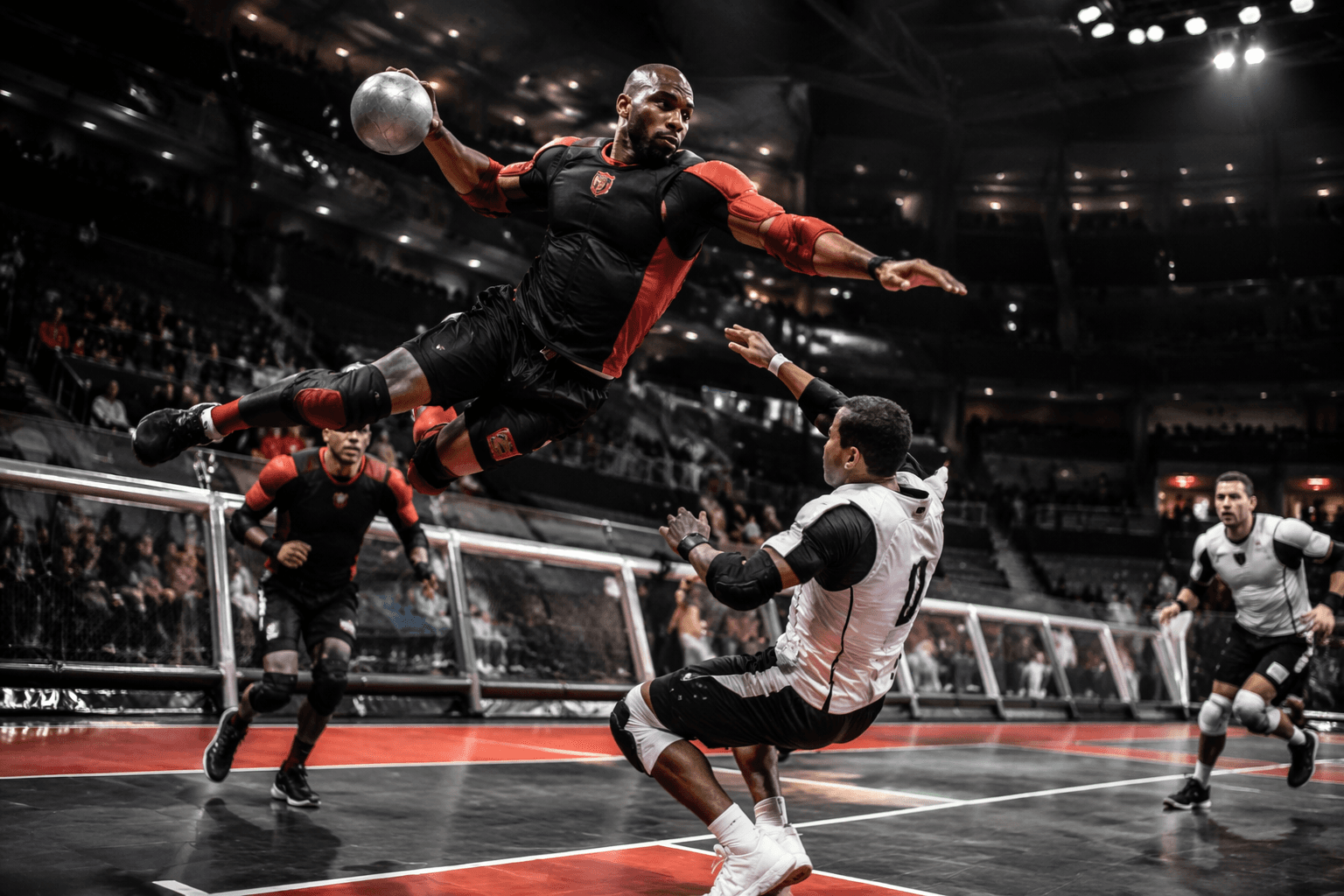
Sean Jackson’s McNasty helped define SlamBall’s high-flying appeal
Sean Jackson’s McNasty turned SlamBall into instant shorthand for speed, control, and spectacle. At 5-foot-10, he beat bigger bodies in the air and made the league unforgettable.

Sean “Inches” Jackson became one of SlamBall’s clearest faces because he made the league’s selling points visible in a single body and a single move. Listed by the league at 5-foot-10 and 175 pounds, he was undersized by SlamBall standards, yet he kept erasing that gap by finishing above bigger players and turning every jump into a highlight.
Why Jackson stuck
SlamBall has always needed more than contact and trampolines to hold attention. Jackson gave it identity: quickness, improvisation, and enough body control to make the sport look both violent and graceful at once. The league’s own legends pages place him among the defining names of the MOB franchise, alongside LaMonica Garrett and Kevin Cassidy, which says as much about his staying power as any single play.
His image also reached outside the court. SlamBall says Jackson starred in films and appeared in commercials for Nike’s freestyle campaign, extending his profile beyond the league and helping make him recognizable even to viewers who never followed a full season. That crossover mattered because SlamBall has always lived at the intersection of sport and spectacle, and Jackson looked built for both.
The McNasty as SlamBall in one play
Jackson’s signature move, the McNasty, is the cleanest explanation of why SlamBall hooked casual fans. SlamBall describes it as a three-dunk combination: a 360, a through-the-legs finish, and a slam on a 45-degree lean. It is not just a difficult finish; it is a sequence that compresses speed, balance, and air awareness into one motion.
A retrospective account says Jackson originated and popularized the McNasty in the 2002 SlamBall dunk contest, which places the move near the league’s early identity rather than as a later embellishment. That timing matters because SlamBall itself launched in 2002, when Mason Gordon and Mike Tollin introduced a professional league that early coverage described as being built in a warehouse with old gymnastics equipment and rules still being refined. In that setting, the McNasty became more than a trick. It became a template for what SlamBall was trying to be.
How Jackson fit the league’s original appeal
The first version of SlamBall did not need a polished inheritance from traditional basketball. It needed players who could turn chaos into a product, and Jackson did that by making difficult aerial finishes look like the point of the game rather than an exception. His size worked as part of the narrative: when a 5-foot-10 player dominates larger bodies in the air, the gap between expectation and execution becomes the entertainment.

That is why Jackson remains such a durable reference point whenever SlamBall is discussed. The league’s most memorable moments were never only about contact or novelty. They were about a player with enough confidence to create something identifiable, repeatable, and just outrageous enough to stick in memory after the scoreboard fades.
From launch-era experimentation to modern revival
SlamBall’s 2002 origin story still frames Jackson’s legacy. A warehouse setup, old gymnastics equipment, and rules that were still being worked out gave the league an improvisational feel from the start, and Jackson fit that atmosphere perfectly. He was not just participating in the experiment; he helped define what the experiment looked like when it worked.
That legacy carried into the league’s return in 2023, when SlamBall announced that Jackson would call the opening weekend of SlamBall League: Series 6 on ESPN and ESPN+. A sports report described that comeback as a six-week regular season in Las Vegas, part of a broader revival of alternative sports. Jackson’s role in that broadcast window underscored an important point: he was not only a face of the league’s past, but still part of how it introduced itself to a new audience.
Why his profile still matters
Jackson is useful shorthand for SlamBall because he embodies the traits the league has always needed to sell itself: speed, improvisation, body control, and a style that feels closer to live-action highlight creation than ordinary team sports. The McNasty captures all of it in one sequence, from the 360 to the through-the-legs finish to the hard lean at the rim.
That is the lasting lesson of his profile. SlamBall did not become memorable simply because it was loud or unusual; it became memorable because players like Sean “Inches” Jackson gave it a face, a move, and a vocabulary fans could recognize immediately. In a sport built to reward risk and flair, he became the clearest proof that personality can be as important as structure.
This article was produced by Prism’s automated news system from verified source data, official records, and press releases, then run through automated quality and moderation checks before publishing. The system is built and supervised by the people who set the standards it runs under. Read our full AI policy.
Did this article answer your question?