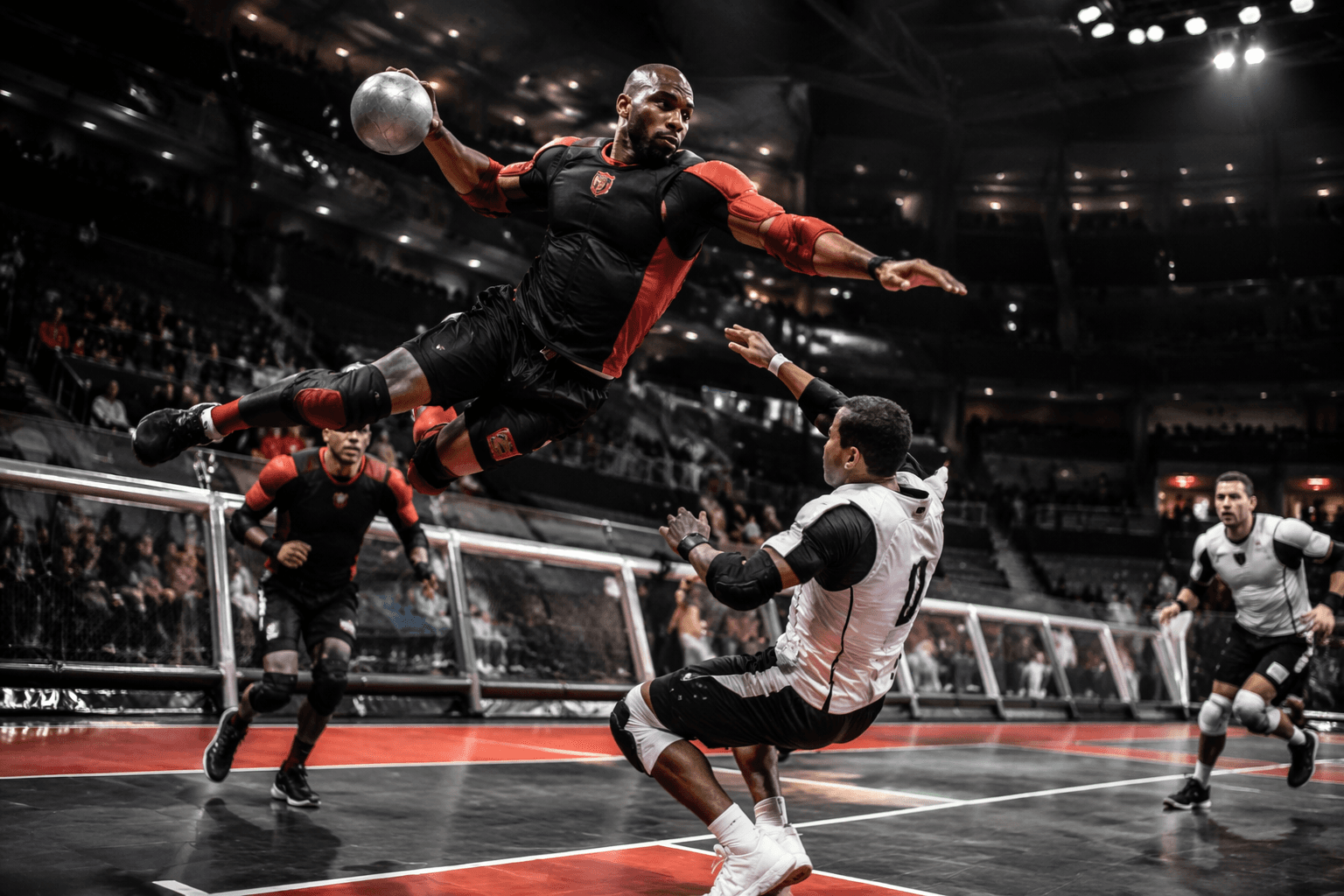
SlamBall co-founder Michael Tollin blends sports business and storytelling
Michael Tollin helped turn SlamBall into a storytelling machine, and that brand-building may be why the league keeps coming back.

Michael Tollin has never treated SlamBall like a novelty act. As co-founder, financier, and storyteller, he helped shape a sport that was built to be watched, packaged, and remembered as much as played. That is the key to understanding why SlamBall keeps resurfacing: its identity has always been as much Hollywood as hardwood.
Tollin as the architect of SlamBall’s identity
Tollin stands at the center of SlamBall’s origin story because he understood, early on, that a new sport needed a narrative to survive. The league’s history says Mason Gordon invented SlamBall in 1999 and first played it in Los Angeles, but Gordon did that while working at Tollin/Robbins Productions, and Tollin helped finance an early prototype court in an East Los Angeles warehouse. That detail matters because it frames SlamBall less as an accident of athletic invention and more as a deliberate media property taking shape inside an entertainment shop.
The league describes Tollin as chairman of MTP, a media company focused on premium sports and entertainment content, and that broader résumé explains why SlamBall has always felt larger than a ruleset. Tollin’s career spans documentary storytelling, scripted television, and sports entrepreneurship, with credits that include The Last Dance, The Redeem Team, The Captain, Coach Carter, Varsity Blues, Smallville, and One Tree Hill. He brings the instincts of a producer who knows that sports become culture when they are framed as something fans can inhabit emotionally, not just score on a box score.
That is why the ForbesBooks conversation is so revealing. It places Tollin not just as a co-founder, but as the kind of creative executive who knows how to make a concept legible to audiences across podcasts, film, television, and live events. In SlamBall’s case, the spectacle is real, but the staying power comes from the way the spectacle has been sold as a story about reinvention.
How SlamBall was built to travel beyond the court
SlamBall’s design was always meant to blur lines. The league’s official history says it combines basketball and football with trampolines, and that invention was first tested in Los Angeles. That mix is part sport, part stunt, part stagecraft, and it creates a product that can be understood quickly by viewers who may not know every rule but instantly grasp the appeal of high-flying collisions and aerial finishes.
The league reached television in 2002, then returned in 2003 and again in 2008, a pattern that tells you everything about its unusual place in the sports ecosystem. SlamBall was not built like a traditional league with a steady seasonal rhythm and deep institutional roots. It was built like a media event, something that could pause, disappear, and then come back with a fresh pitch when the market, or the audience, was ready again.
That episodic history also helps explain its cult following. SlamBall never had the permanence of the major leagues, but it had the memorability of a concept with a strong visual hook. Fans did not just watch games; they remembered the idea, and that memory became a form of brand equity that survived the gaps between runs.
Why the comeback kept finding an audience
The most striking proof of SlamBall’s cultural afterlife is the fan campaign that reportedly generated 200 million views for the hashtag #BringBackSlamBall. That kind of response is more than nostalgia. It is evidence that the league had become a recognizable piece of internet-era sports memory, one that could be revived by the same dynamics that now power so much of entertainment: virality, community pressure, and the promise of something that feels fresh even when it is rooted in the past.
That momentum helped Tollin and Gordon raise about $11 million to bring the league back. The scale of that funding matters because it shows the comeback was not just sentimental. It was a real business bet on a property that had already proven it could attract attention, generate discussion, and convert curiosity into an audience.
The 2023 relaunch sharpened that strategy. SlamBall secured a two-year broadcast partnership with ESPN, giving the league a national platform and a more credible lane back into the sports conversation. A docuseries was also reported to be in development, which is exactly the sort of cross-platform packaging Tollin’s background suggests he would favor. For a property like SlamBall, the live game is only one part of the pitch. The other part is the myth around the league itself: where it came from, why it vanished, and why it keeps returning.

What SlamBall reveals about sports in the attention economy
SlamBall’s story shows how modern sports properties are built when attention is scarce and competition is everywhere. A league does not only need athletes and competition. It needs a distinct identity, a repeatable visual language, and a backstory that can survive long absences. Tollin’s Hollywood-style instincts helped supply all of that for SlamBall, which is why his role matters so much to the league’s survival.
That distinction also separates SlamBall from many other alternative leagues. Some startups try to win by rewriting the rules alone. SlamBall has always understood that the rules are only part of the value. The bigger asset is the narrative architecture around the games, the sense that viewers are seeing a genuinely original sports universe with its own history, its own revival cycles, and its own cast of builders.
Tollin’s résumé reinforces that approach. Someone with an Academy Award nomination, three Emmys, and three Peabodys does not think only in terms of points and standings. He thinks in arcs, images, and emotional payoff. That mindset helps explain why SlamBall can feel both futuristic and familiar, both niche and mainstream-ready.
The league’s long-term lesson is simple: in the attention economy, a sports property has to be more than an event. It has to be a brand with a story people want to revisit. SlamBall keeps resurfacing because Michael Tollin and Mason Gordon built it that way from the start.
This article was produced by Prism’s automated news system from verified source data, official records, and press releases, then run through automated quality and moderation checks before publishing. The system is built and supervised by the people who set the standards it runs under. Read our full AI policy.
Did this article answer your question?