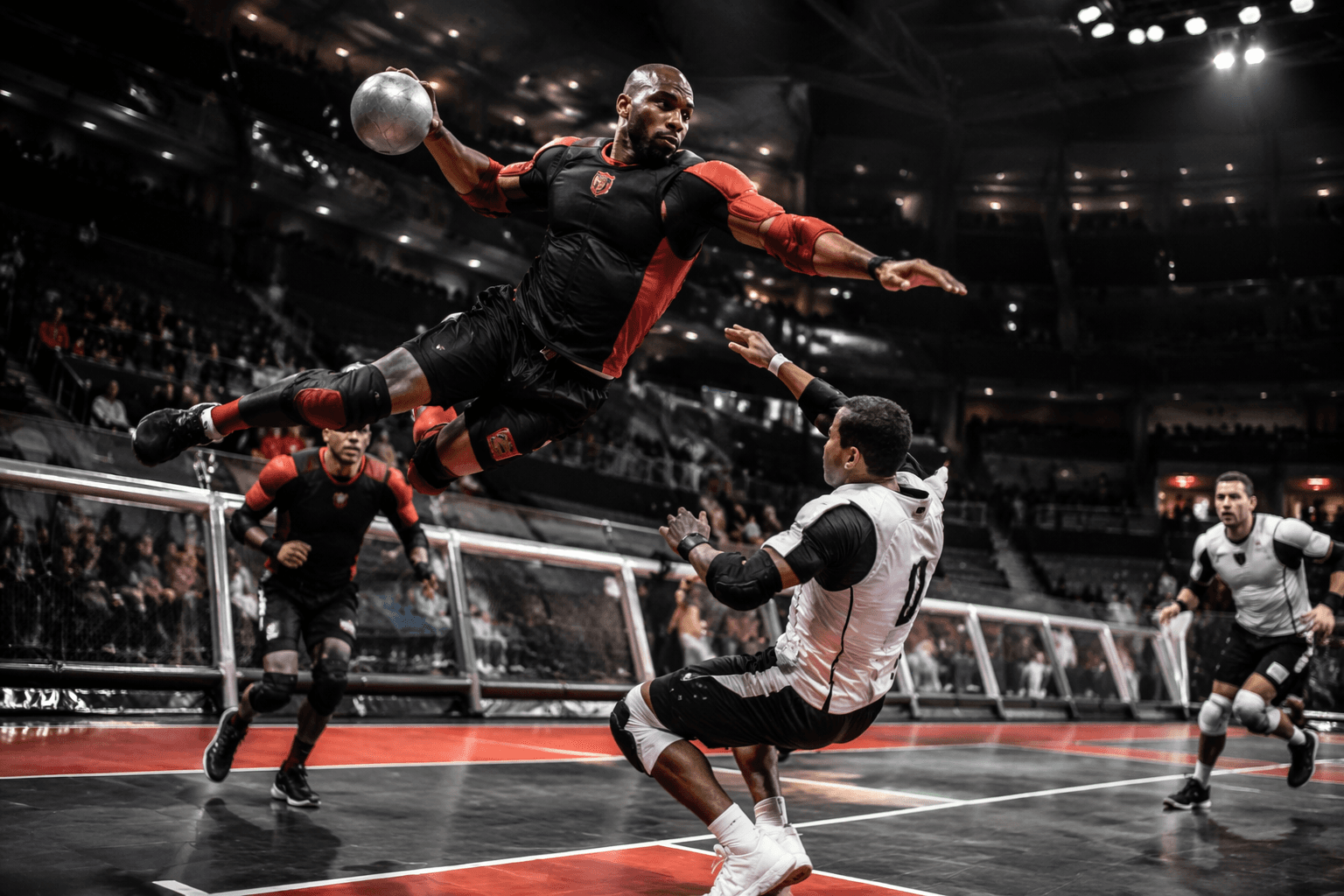
SlamBall rewards dunks, deep shots, and fast-paced scoring decisions
SlamBall turns every possession into a scoring gamble, where dunks are worth three and deep shots pay four. MOB's 16-0 run showed how fast that math separates teams.
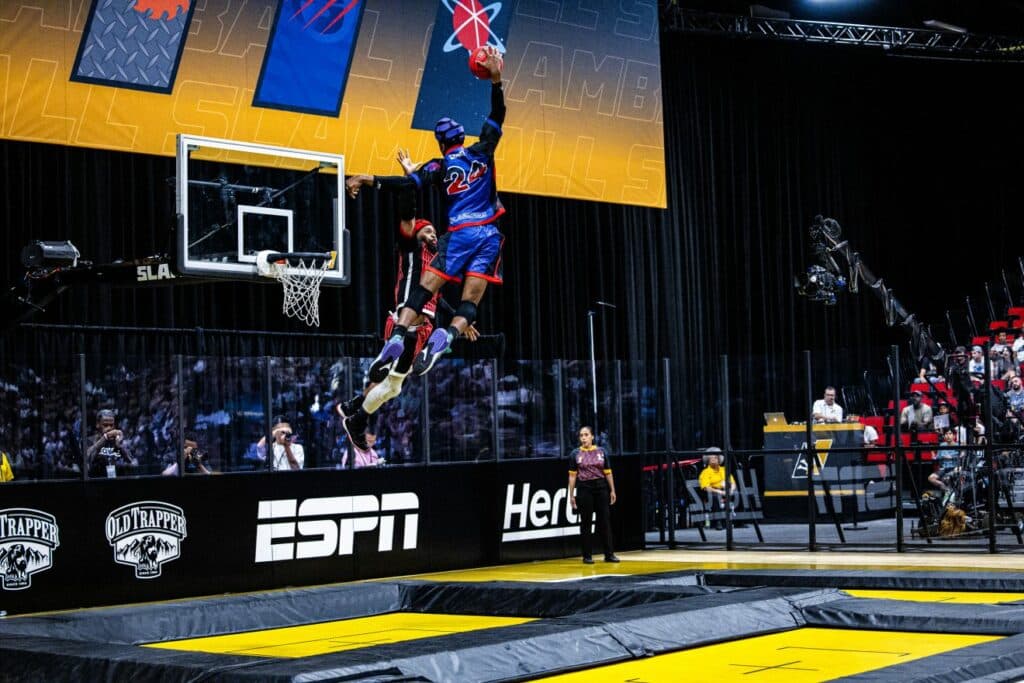
A SlamBall possession is never just about getting a shot off. It is a calculation shaped by scoring tiers, a 20-second clock, and a floor built to reward height, speed, and contact in equal measure. On a 96-foot-by-64-foot court with four springbeds and 10-foot rims, teams like MOB have shown how punishing that math can be, racing to a 16-0 regular season by making every trip feel like a leverage play.
The point economy changes every decision
The simplest way to read SlamBall is as a point economy. A forceful dunk through the rim is worth three points, shots from beyond the 26.5-foot arc are worth four, other shots inside that arc are worth three, and trampoline-assisted jump shots or layups are worth two. That hierarchy flips normal basketball instincts on their head: the most explosive finish is not just a highlight, it is a premium scoring event, and the long bomb carries its own reward.
That is why coaches have to weigh distance and verticality on the same possession. A clean lane to the rim can be just as valuable as a set shot from deep, because both routes can generate three points or more, while the safer trampoline-assisted finish is only worth two. The result is constant risk management, especially with a 20-second shot clock that resets to 12 seconds after offensive rebounds, a rule that keeps second-chance pressure alive and prevents offenses from settling into slow, predictable possessions.
The four-player lineup and seven-player active roster also sharpen that calculus. With fewer bodies on the floor than in standard basketball, every mistake leaves more open space, and every specialist matters more. A team does not simply need scorers; it needs players who can attack the rim, stretch the floor, and handle contact without losing the possession.
Why a stop can become a huge swing
SlamBall’s most striking strategic feature is how quickly one defensive stand can turn into a scoring burst. A block or forced turnover does not merely end an opponent’s trip, it can launch the other way into a three-point dunk or a four-point long-range finish. That is where the sport’s shareable drama comes from: one stop-and-slam sequence can swing seven points if it erases a four-point attempt and turns into a three-point score at the other end.
The four-point arc at 26.5 feet creates a premium that basketball fans recognize immediately, but SlamBall pairs that perimeter reward with an equally loud interior reward. The best offenses do not choose between the springbed and the deep shot once and stick with it all night; they force the defense to solve both threats on every trip. That is why the game can feel chaotic without being random, because the scoring system itself keeps the pressure pointed at the next decision.
MOB’s 16-0 regular season offered the clearest proof of how hard it is to survive a team that controls that rhythm. In a sport with such compressed possessions, a perfect run signals more than talent. It suggests a group that knew when to attack the rim, when to hunt the arc, and how to keep opponents from turning defensive contact into easy momentum.
Contact is legal, but not free
SlamBall also changes the value of defense. The official rules allow contact on the ball handler or near the ball, permit goaltending, and turn many fouls into faceoffs rather than standard free throws. That means defense is less about protecting space in the soft, familiar sense of basketball and more about controlling what happens next after the collision.
The “Island” makes that even sharper. Contact there is prohibited, defenders cannot draw charges there, and more than incidental contact can trigger a faceoff or a change of possession. In practical terms, that creates a very specific kind of pressure defense: aggressive hits are part of the sport, but only when they are disciplined and tied to the ball, because sloppy contact away from the play can hand the other side immediate control.
This is where SlamBall stops looking like a novelty and starts looking like a possession sport. If contact leads to a faceoff instead of a routine free-throw sequence, the defense is not just trying to stop a shot. It is trying to force a reset on its own terms, and that makes every close-out, collision, and rebound feel tied to the next scoring chance.

Tempo is built into the structure
The game’s format keeps that pressure high from the opening tip. SlamBall is played in four five-minute quarters, so regulation lasts only 20 minutes, and the clock leaves little room for dead stretches. With live hockey-style substitutions, teams can change bodies during play, which encourages tempo and role specialization instead of long stoppages and slow line changes.
That structure matters because it rewards teams that can separate jobs cleanly. Some players are there to attack the rim through the springbeds, others to punish the defense from beyond 26.5 feet, and others to absorb contact without breaking the possession. The live-sub system lets coaches ride those roles in motion, which is one reason the sport feels closer to a fast, continuous tactical battle than a series of half-court set pieces.
The floor itself makes that tempo possible. The four springbeds are not an accessory, they are the engine of the sport, creating the height and hang time that make three-point dunks and trampoline-assisted finishes possible. Once those surfaces are in play, the offense can generate angles that would not exist on a standard basketball court, and the defense has to react to the bounce as much as the ball.
How the league has been built and rebuilt
SlamBall was invented in 1999 by Mason Gordon and first played in Los Angeles. The league’s own history traces the sport to an L.A. warehouse in 2000, which fits the sport’s long-standing image as something engineered rather than inherited. Gordon later worked with producer Mike Tollin to build a prototype court, and the sport made its television debut on Spike TV in 2002 and 2003.
The league then returned in 2008 through NBC Sports and CBS, before extending its development internationally, including events in China beginning in 2012. That history matters because SlamBall has always been tied to broadcast-era reinvention. It has never been just a game in search of a gimmick; it has been a format repeatedly rebuilt to fit the demands of television, highlights, and fast scoring.
The 2023 relaunch showed that the format still travels. ESPN’s coverage of the comeback season placed all of the games over five weekends at Cox Pavilion in Las Vegas, with more than 30 hours of SlamBall programming across ESPN, ESPN2, and ESPN+. The social-media push around #BringBackSlamBall drew more than 200 million views, a number that captures why the league’s highlight-to-strategy ratio remains so potent.
Why the structure still works
The strongest thing about SlamBall is that its spectacle and its strategy are the same thing. A dunk is not decoration, a long shot is not a bonus, and a foul is not always a free-throw pause. Every rule pushes the offense to choose between the high-value slam, the safer two-point-style finish, and the cost of contact, which is why the sport produces so many possession swings in such a short window.
That logic explains why teams that master the point economy can overwhelm opponents quickly. It also explains why a season like MOB’s 16-0 run feels so meaningful: in SlamBall, control is not just about winning the next play, it is about forcing the other side to live with the wrong math.
This article was produced by Prism’s automated news system from verified source data, official records, and press releases, then run through automated quality and moderation checks before publishing. The system is built and supervised by the people who set the standards it runs under. Read our full AI policy.
Did this article answer your question?