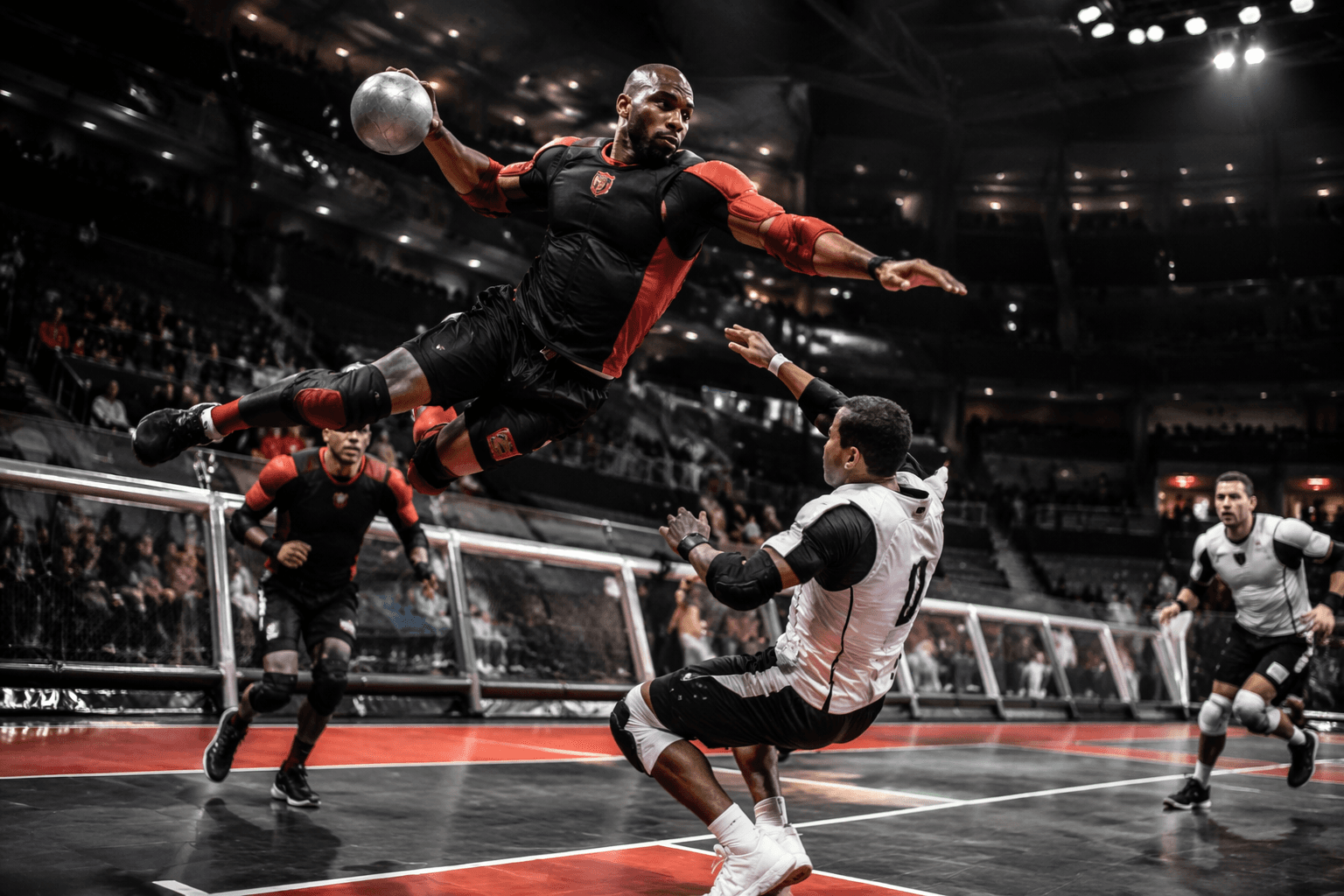
SlamBall's Darius Clark, Guinness vertical record-holder, brings elite track speed
Darius Clark’s 50-inch vertical is the headline. The deeper story is how SlamBall is hunting track speed, body control, and contact tolerance, not just bounce.

A 50-inch proof of concept
Darius Clark’s 50-inch running vertical is the kind of number that stops a scroll, but SlamBall is not using it as trivia. The 6-foot-2, 200-pound athlete from Blue Springs, Missouri, set the Guinness World Records mark at 1.27 meters, or 4 feet 1.92 inches, in Salt Lake City, Utah, on June 28, 2022, while attending a basketball camp with spectators cheering him on. That matters because SlamBall is built on the exact skill set the record hints at: explosive launch, clean air control, and the confidence to keep attacking after contact.
Clark is a reminder that SlamBall is scouting for more than raw spring. The league wants athletes who can turn a first step into separation, a leap into a finish, and a collision into a second effort. In that context, his record is not a stunt. It is a measurement of the physical tools that make a player dangerous in a sport where the rim area is crowded, the pace is relentless, and the margin for error is tiny.
What SlamBall is really measuring
The best SlamBall players are not simply high jumpers in a different uniform. They have to process space quickly, explode on cue, absorb hits, and recover their balance in the air or on landing. Clark fits that profile because his résumé is rooted in track and field, where takeoff mechanics and body control matter as much as raw speed.
That makes him a useful case study for how the league evaluates talent. A vertical number tells you he can reach the ceiling, but his track background tells you he can get there efficiently. In SlamBall, that combination is gold. A player who can run, plant, rise, and still control his body through contact is far more valuable than a pure leaper who can only cash in on clean looks.
The track pedigree behind the bounce
Clark’s athletic history runs through Florida State and Texas A&M, and his best work came in the long jump, a discipline that rewards speed on the runway, timing at takeoff, and spatial awareness in the air. Texas A&M’s roster information says he was a 2021 second-team All-American in the indoor long jump with a mark of 7.64 meters, or 25 feet 0.75 inches. The same program lists his personal-best 7.85 meters, or 25 feet 9.25 inches, at the SEC Championships on February 27, 2021, a jump that ranked fifth in school history.
That profile explains why SlamBall would see him as more than a dunker. Long jump is a sprint event disguised as a leap, and it rewards the same traits SlamBall prizes: acceleration, coordination, and the ability to stay composed while moving at full speed. Clark’s time at Florida State and Texas A&M shows that he did not arrive in the league as a one-note athlete. He arrived as someone trained to convert speed into lift.
Texas A&M’s transfer release also labeled Clark an All-ACC athlete and an NJCAA national champion. Pat Henry, who has built his reputation on identifying elite track talent, sharpened that point further when he described Clark as “a near 8-meter long jump” and said, “I like the way he presents himself.” That is the sort of assessment that translates neatly to SlamBall, where projection only matters if the player already looks capable of handling the game’s demands.
Why Clark’s numbers have carried over
SlamBall’s own production tells the rest of the story. In the Mob’s perfect regular season, Clark helped power a team that finished 16-0 with an 88-50 win over the Gryphons. One league recap said he scored 22 points in that finale as the Mob raced to a 48-23 halftime lead. Another SlamBall article pushed the performance even higher, crediting Clark with a league-record 44 points in the same regular-season finale and naming him Offensive Player of the Week.
Either way, the takeaway is consistent: the athletic profile showed up on the scoreboard. SlamBall’s season review said the Mob led the league in scoring at 61.6 points per game, and its awards coverage said Clark finished second in the league in scoring at 19.8 points per game while leading the league with 77 dunks. Those are not empty highlight numbers. They point to a player who can repeatedly convert his physical tools into possession-changing plays.
That is where the league’s talent logic becomes clearer. SlamBall does not just need spectacle. It needs athletes who can sustain it over a full season, score efficiently, and keep producing when the game gets messy. Clark’s scoring load, his dunk total, and the Mob’s perfect record suggest he is already doing more than chasing viral moments.
Why traditional basketball may miss players like this
Clark also highlights a larger question about athlete development. Traditional basketball often sorts players by conventional positions, shooting profiles, and half-court fit. SlamBall can value a different kind of specialist, one whose runway speed, aerial timing, and willingness to absorb contact matter more than polished guard skills or a clean perimeter résumé.
That creates a potential talent pipeline that basketball sometimes overlooks. A long jumper with a 50-inch running vertical and a track pedigree may not be the easiest player to classify in a standard basketball ecosystem. In SlamBall, though, those same traits can be the foundation of a roster spot and, more importantly, a repeatable role. The league is not merely collecting jumpers. It is identifying athletes whose explosiveness holds up under pressure and whose coordination turns one bounce into a scoring chance.
Clark’s story shows how that pipeline works when it is functioning well. Blue Springs to Salt Lake City, Florida State to Texas A&M, track runway to trampoline court, all of it points to the same conclusion: SlamBall’s best recruits are built for speed, timing, and collision. Clark’s Guinness record is the headline, but his real value lies in how complete an athletic package he is beyond it.
In a league still proving it can be more than a spectacle, players like Clark matter because they make the spectacle sustainable. He is not just leaping over defenders. He is showing exactly what kind of athlete SlamBall is built to find, and why that search may uncover talent the rest of basketball never fully uses.
This article was produced by Prism’s automated news system from verified source data, official records, and press releases, then run through automated quality and moderation checks before publishing. The system is built and supervised by the people who set the standards it runs under. Read our full AI policy.
Did this article answer your question?