SlamBall’s dunk glossary reveals the sport’s own language
SlamBall’s glossary turns chaos into code, showing how springbeds, spins, and timing create a language new fans can finally read.
The league built a language for flight
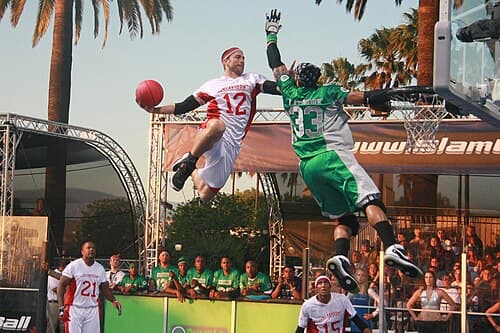
A SlamBall dunk is rarely just a dunk. It is a sequence, a read, and a risk calculation packed into a move with a name that sounds like a comic-book weapon or a street nickname. That is what makes the league’s dunk directory so revealing: it does not just label highlights, it teaches the sport’s culture, the same way a playbook teaches a team how to survive its own speed.
The glossary is filled with names that tell you something before the ball even reaches the rim. 360 Stall to Windmill and Around the World borrow the drama of dunk-contest vocabulary, but SlamBall reshapes those familiar ideas around springbeds, timing, and a court built for bounce. Then come the names that feel uniquely SlamBall: BB McNasty, Blender, Boomerang, Triple Tap, Flying Squirrel, Ghost 360, Lasso, Reemix, Revolution, and Sh8kdown Baseline Transfer. Even without a frame-by-frame breakdown, the language suggests what the sport demands: spin, lift, control, and a willingness to leave the floor in one direction and finish in another.
That naming matters because SlamBall is not trying to hide behind generic dunk language. It is building its own vocabulary around the collision of basketball, football, hockey, and trampolines, the hybrid Mason Gordon imagined when he invented the sport in 1999 and first played it in Los Angeles. In a league where the action can rise to twenty feet off the game floor, a move name has to do more than sound cool. It has to help the viewer understand what happened in a matter of seconds.
Why the names feel so visual
Some SlamBall terms work because they picture the motion inside the word. A move called Flying Squirrel sounds airborne before it starts. Ghost 360 suggests a blur of rotation, while Boomerang hints at a path that seems to leave and then snap back. Revolution and Reemix suggest not just style, but a change in direction or rhythm, which is exactly what the sport rewards.
The directory also stretches into names that feel more technical and more specific to SlamBall’s own geometry. Triple Tap and Sh8kdown Baseline Transfer sound like plays that happen in pieces, not in one clean leap. TPL Tap Glass and other glossary entries turn the backboard itself into part of the language. That is the key to the sport: the best names are not just flashy, they are descriptive enough to help a viewer trace the sequence from springbed to backboard to rim.
A SlamBall dunk is usually a chain, not a single jump
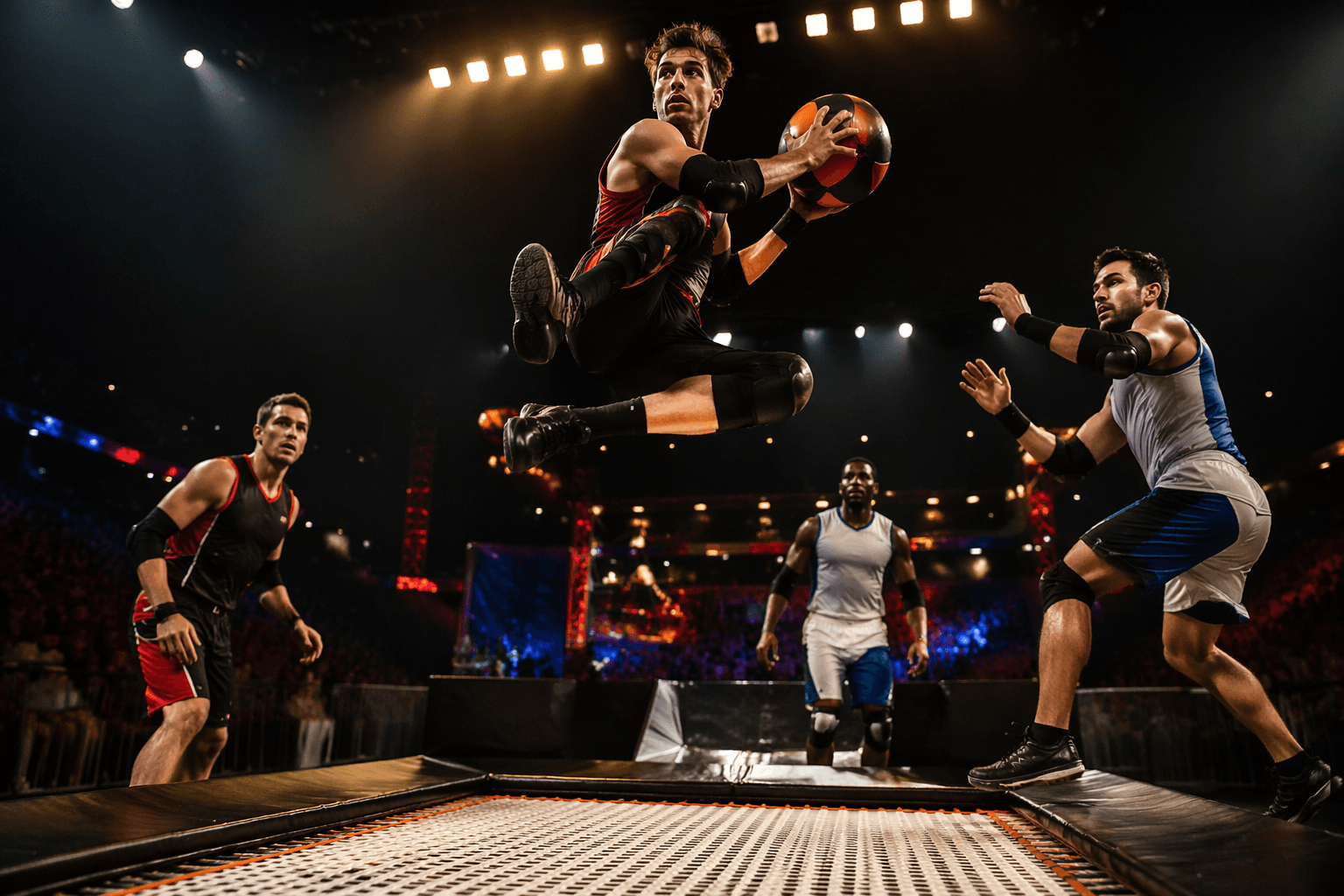
The glossary works because the sport itself is built on chained actions. Several of the named moves require taking off from an outside springbed, transferring to another bed, spinning, flipping, or using the backboard in sequence before the finish at the rim. That means a dunk is rarely one explosive motion. It is more often a timed series of decisions, where the player reads rebound height, defender position, and landing angle almost at the same moment.
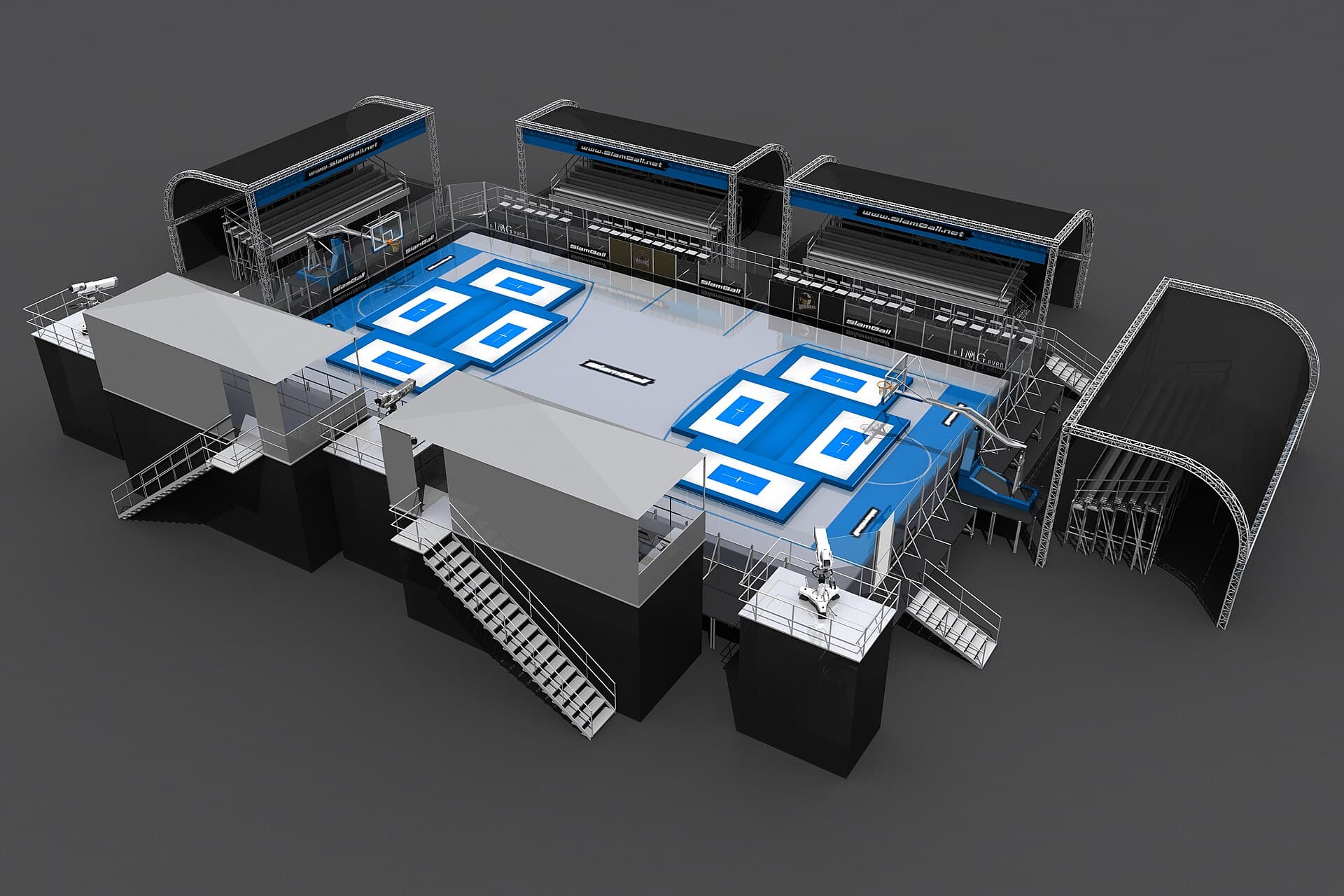
The rules make that technical layer even more important. SlamBall’s court measures 96 feet long by 64 feet wide. Each end has three identical springbeds, plus a fourth scoring bed that is slightly larger at 10 feet by 14 feet. An offensive player with the ball gets a first bounce to make a play and a second bounce to exit the springbed, which is why timing is everything. The body has to launch, adjust, and finish before the sequence closes.
There is also the island area, where contact is not allowed. More than incidental contact can lead to a face off, which gives the game another layer of restraint inside all that violence of motion. That rule helps explain why a move can look reckless while actually being highly controlled. The highlight is the payoff, but the real art is in staying legal long enough to create it.
The glossary is part of the broadcast experience
SlamBall understands that its best moments have to be legible instantly. The sport lives on clips, replays, and the kind of highlight that makes sense even if you see only three seconds of it. The dunk directory is part of that broadcast logic. It gives new fans a way to decode what they are seeing, and it gives longtime fans a common shorthand for the tricks, transfers, and finishes that define the game.
That clarity matters even more because the league’s modern return was built for television. ESPN and SlamBall announced an exclusive two-year national broadcast partnership for the 2023 and 2024 seasons on June 21, 2023. The package was positioned as more than 60 hours of action, a signal that the sport was being treated as a real televised property, not a novelty act. When the 2023 season launched from Las Vegas on July 21, ESPN’s opening-night telecast began at 7 p.m. ET and included three games, starting with Rumble vs. Mob.
The league’s eight-team relaunch added structure to the spectacle. Three legacy teams, Mob, Rumble, and Slashers, returned alongside five newcomers, Buzzsaw, Gryphons, Lava, Ozone, and Wrath. SlamBall said each team was coached or led by a former SlamBall player or coach, and that the players were assigned through a draft. That gave the reboot both history and continuity, which is exactly the kind of framing a culture-rich sport needs when it comes back into the spotlight.
The scoreboard gives the language stakes
The most useful thing about a dunk glossary is that it does not float above the competition. It is attached to games, standings, and outcomes. SlamBall later said the Mob completed a perfect season in 2023, an achievement that gave the league a concrete competitive milestone to put beside its highlight vocabulary. A team with an undefeated run gives the sport gravity; the glossary gives it texture.
That is why SlamBall’s dunk directory feels bigger than a list of tricks. It is a translation guide for a sport that was invented to look impossible and then built the rules to make it real. The names capture the flair, but the structure beneath them, the court, the springbeds, the bounce counts, the no-contact island, and the broadcast stage, is what makes the language stick. In SlamBall, the vocabulary is the game.
This article was produced by Prism’s automated news system from verified source data, official records, and press releases, then run through automated quality and moderation checks before publishing. The system is built and supervised by the people who set the standards it runs under. Read our full AI policy.
Know something we missed? Have a correction or additional information?
Submit a Tip